
Parashah Shemot — Existential Lessons
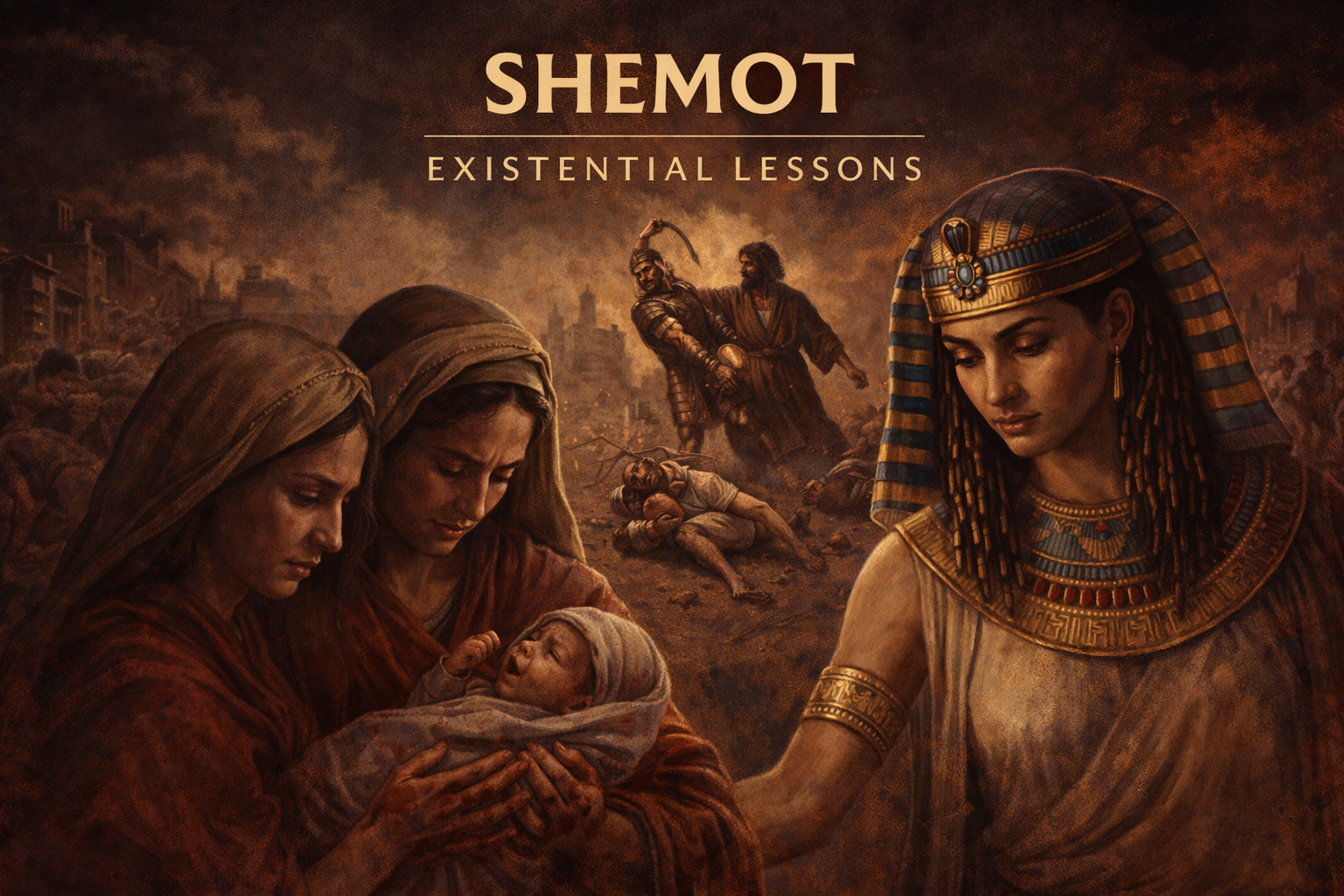
Parashah Shemot — Existential Lessons
Oppression does not begin with chains, but with amnesia. A system becomes lethal not when it hates life, but when it forgets why life matters. The erasure of Yosef’s name is not a historical detail; it is the ontological precondition of slavery. When memory collapses, the human being becomes administrable. Exile begins the moment a person can be counted without being named.
The danger of power is not cruelty, but fear of vitality. Pharaoh does not act because Israel is violent, rebellious, or corrupt. He acts because life grows beyond his capacity to control it. Fertility terrifies every system built on order without meaning. Whenever growth is perceived as threat, the response follows the same pattern: regulation, control, elimination. This is not moral failure; it is structural logic.
Resistance does not arise from ideology, but from fidelity to life at its most fragile point. The midwives do not confront Pharaoh with arguments or open rebellion. They simply refuse to collaborate with death. Their disobedience is quiet, almost invisible, yet ontologically decisive: they interrupt the system’s automatic reproduction. The most radical form of resistance is not confrontation, but refusal to normalise what destroys life.
Authentic faith is born where control ends. The mother who places her child in the river does not choose courage over fear; she chooses surrender over illusion. She understands that holding on guarantees death, while releasing opens a narrow corridor of possibility. This is the first law of liberation: salvation does not arise from mastery, but from relinquishing false security. Control is the most refined form of despair.
The fracture in the system emerges from within its own walls. Pharaoh’s daughter does not overthrow power; she violates it from inside through compassion. She responds to a cry, not a principle. No system is total. Even the most closed structure contains human points of leakage. History does not change only through overthrow, but through cracks where life is still recognised.
Moshe embodies the most dangerous position of all: a consciousness formed inside the very structure it will later confront. He is educated in power, fluent in its language, skilled in its logic. And yet something in him does not assimilate. It is not rebellion; it is dissonance. That dissonance is the seed of liberation. Freedom begins as an inner mismatch that refuses to resolve itself through adaptation.
The ethical act precedes identity. Moshe does not act because he knows who he is; he discovers who he is because he acts. The killing of the Egyptian is neither heroism nor strategy. It is the point at which perception becomes intolerable without response. Responsibility is not derived from role or mandate, but from the impossibility of remaining intact in the presence of injustice.
Such gestures do not organise life; they dismantle it. After the act, Moshe loses position, protection, and belonging. This is the cost of fidelity before vocation. Every true beginning passes through dislocation. Whoever acts from truth before being authorised inevitably becomes a stranger — first to the system, then to themselves.
The desert is not punishment; it is a space of integration. Only where roles collapse can the self be reduced to what remains when nothing is left to perform. Silence is not absence of meaning, but removal of noise. Revelation does not arrive to teach, but to confirm what has already been lived at the cost of everything else.
The bush that burns without being consumed does not explain God; it stabilises a condition. Fire that does not destroy names a truth that does not annihilate the one who bears it. The command to remove the sandals is not ritual; it is ontological. Abandon the identities that separate you from the ground. Truth can only address the one who remains exposed.
The cry of the people precedes prayer, covenant, and understanding. It is not articulated faith that moves history, but raw suffering that refuses to remain anaesthetised. Liberation does not begin when human beings speak correctly, but when pain is no longer silenced. A cry without language is still truth.
Departure does not begin with vision, but with saturation. Change becomes possible only when continuation becomes impossible. The story does not promise immediate relief; it promises the end of false continuity. The first step out of Egypt is not freedom, but the collapse of the capacity to endure what once seemed normal.
The exodus does not begin when God speaks.
It begins when the human condition can no longer lie to itself.