Parashat Acharei Mot–Kedoshim
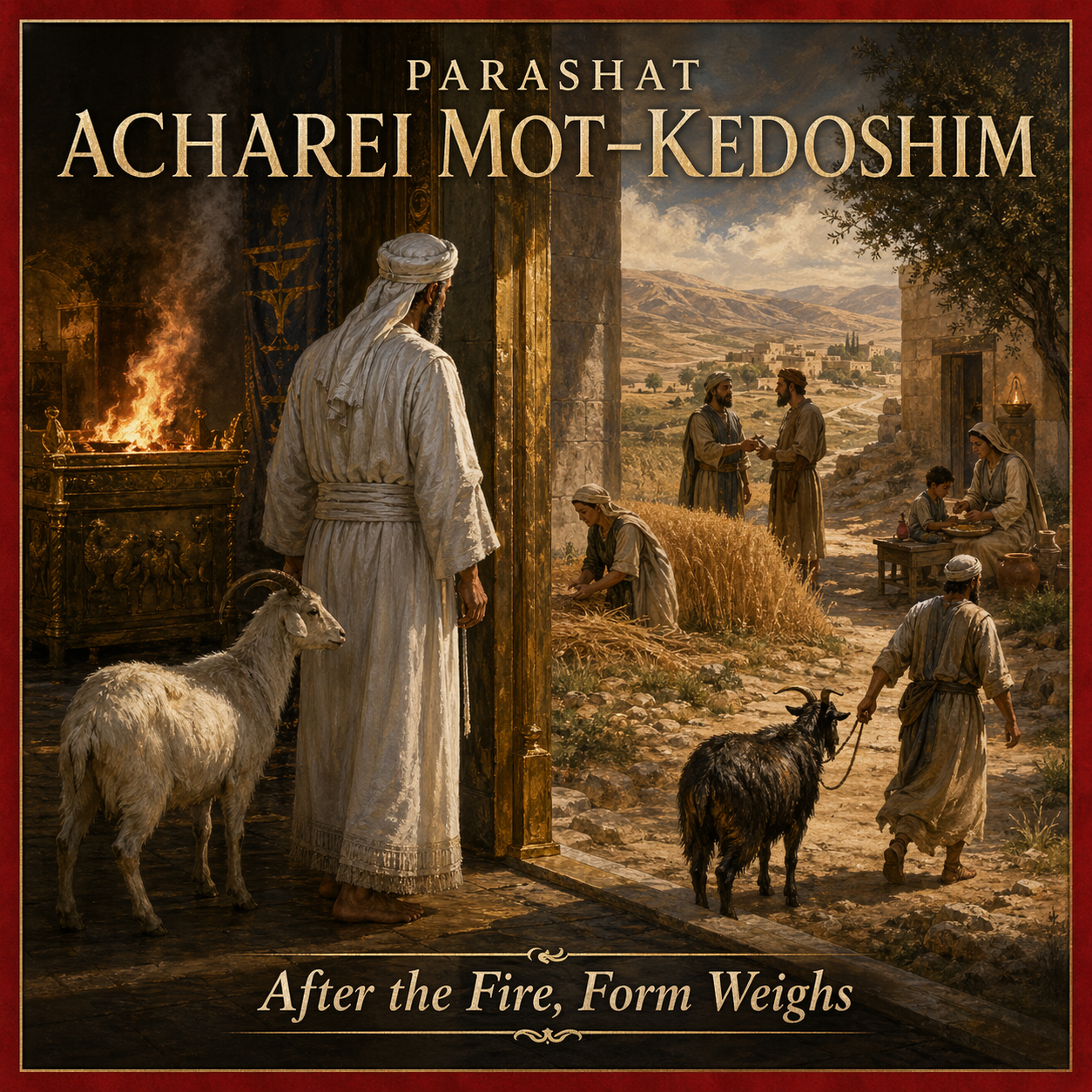
After the fire, form weighs
I write this from a threshold — not from a place, but from an interior point at which one notices that not everything one can touch can also be held. From the place where intensity no longer suffices as truth. This text does not begin with consolation. It begins after death. The sons of Aaron died when they drew near, and the Torah does not pause to recount the mourning. It sets the fact at the threshold and continues. Everything that follows breathes beneath that weight — and what that weight does to the one who must continue serving is the true subject of what comes after. The Holy of Holies remains, but it is no longer an open place. The Presence has not withdrawn; access has become danger. Closeness is no longer innocence. It is burden, measure, and form.
Aaron is told he cannot enter whenever he wishes. Not always. Not on impulse. Not because he is a priest. Time itself becomes a boundary. Desire must learn season. Before entering, the body speaks. One must wash. One must remove the vestments that weigh with role and splendour. The gold stays outside. The linen enters. At the threshold there is no spectacle. Only water, skin, and obedience. Closeness does not begin with feeling; it begins with form.
Aaron does not enter first for the people. He enters for himself. No one can carry others before the fire if he has not first discovered how heavy one’s own life is when it lies bare — and I do not say this metaphorically: there is a moment at which one perceives that sincerity alone does not suffice if it has no vessel. Outside, two he-goats wait. Identical. The lot decides. One ascends. The other goes out alive and carries what cannot remain at the centre without destroying it. The text does not explain how Aaron felt standing between them. It only records what he did afterwards.
Kedoshim deepens what Acharei Mot has restricted. Because once access has been limited, life itself must become a vessel. Holiness does not descend in ecstasy. It descends into the house, the field, the wage — into the speech that costs something, into the heart that has stopped pretending it did not know. It does not begin in the sanctuary alone. It enters, in severe silence, into ordinary life.
Acharei Mot teaches that not everything intense is habitable. Kedoshim teaches that what is habitable afterwards must be ordered. The first limits access. The second gives weight to form. Together they describe what surviving in the proximity of the Holy truly demands: first boundary, then coherence — because one must first survive the fire before life can be ordered, and these are not the same discipline.
Boundary and coherence
There are experiences that are not overcome. They are reordered. There are desires that are not denied. They are framed. Acharei Mot begins with the truth that excess without a vessel burns. Kedoshim continues with the truth that life without form empties slowly. The one speaks of access, the other of conduct. Both describe the same danger: a soul governed by impulse — whether spiritual or common — cannot harbour what is greater than itself. This is not an abstract warning. I have understood what it means.
Holiness appears first as boundary. Not every door that exists may be crossed whenever one wishes. Waiting is not failure. It is protection. Remaining outside at the right hour can be more faithful than entering in the wrong state. And when one has learnt not to enter too soon, a second discipline begins: to stop profaning the ordinary through carelessness. The edge of the field matters. The wage matters. The tongue matters. The hidden resentment — the one that has already decided before speech begins — matters. The small calculation matters. Holiness does not fail only in catastrophe. It fails in repetition.
Again and again Kedoshim returns to the same reminder: I am the Eternal. Not as ornament. As structure. As though it wished to say: this is not a private ethic of good conduct. It is the question of whether life can remain open to something beyond appetite, beyond comfort, beyond the self that is silently enthroned at the centre.
The two parashot form a single movement. First: not everything in you may enter the centre. Second: not everything you do outside the centre is therefore neutral. Some things ascend. Some must be sent out. And some — this is harder to say, for there is no ritual for it — must simply stop, without anyone knowing. Holiness is not intensity. It is what remains when intensity has been measured against what it can truly hold.
Acharei Mot–Kedoshim in the present time
In the year 2026, from the threshold at which I write — not triumphant, not from a distance, but from the attempt to make closeness habitable — no one dies in a sanctuary. What burns are bodies, vocations, relationships, interior structures that have borne too much for too long. I know what I am writing about. People who have taken their commitments seriously collapse — not because they lacked sincerity, but because sincerity without boundary has exhausted them. They wanted to live near what counts, but they did not first strip themselves bare. They confused access with entitlement, urgency with truth, the denial of limits with faithfulness.
What follows that collapse is rarely a dramatic conversion. It is dissolution — the kind that does not announce itself. Work penetrates rest. Screens penetrate the body. Opinion penetrates truth. Desire penetrates every space. The edge disappears. Nothing is violently destroyed; everything gradually blurs. The contemporary self profanes less through rebellion than through adaptation. It explains, adjusts, defers, manages. The lie is no longer shouted. It softens until it no longer sounds like a lie. Injustice does not always strike. It withholds. Resentment no longer erupts. It settles in the heart and becomes climate — and in becoming climate, it becomes invisible even to the one who breathes it.
This is why the ritual endures. Washing may mean today: switching off what keeps the nervous system in a state of constant intake. Stripping bare may mean ceasing to perform identity. Linen may mean doing less, not more. And the he-goat sent outside the camp is what in you cannot yet be integrated without poisoning the centre — not because it was unreal, but because it would destroy what it touches if brought inward too soon, before you have the form to sustain it.
At the same time, holiness is no longer imagined as an elevated state. It is tested in payment, in a restraint that costs something determinate, in a word whose moment you withheld when you could have released it, in appetite, in justice, in the private motive that no one else will ever verify. The question is no longer only whether you feel near to the Holy. The question is whether your daily form can sustain that closeness without contradiction.
Interior activation
Desire without frame repeats the first fire. That I know — not as a thesis, but as something I know from within. Form without interior truth becomes dead weight. The task is more difficult than either extreme: to remain near what counts without disappearing, and then to order life in such a way that what counts is not betrayed in the ordinary.
There are two renunciations. The renunciation of immediate access: not every impulse may cross the threshold. And the renunciation of compartmentalisation: not every private exception may be excused. The soul that survives must nonetheless be governed. The life that is governed must nonetheless remain alive. That sounds like balance. It is not balance. It is a permanent tension that does not resolve — and of which I would not claim that I have fully mastered it.
In what part of your life are you attempting to enter without first having stripped yourself bare — and in what part do you live without boundary and call it freedom?
“To live in the proximity of fire is only possible when form learns to hold desire.”
Acharei Mot–Kedoshim does not offer triumph. It offers structure. First the boundary that keeps you alive. Then the coherence that prevents you from emptying from within. Holiness is not a moment of elevation. It is the difficult art of remaining close without burning, and of inhabiting the ordinary without profaning it. After the fire, form weighs. And only by bearing that weight — not as an idea, but as daily practice that can also fail — can the Presence be made habitable once more.