An Aging Jewish Feminist
Parashat Bamidbar: In the Desert—Abandonment, Refuge, and Becoming
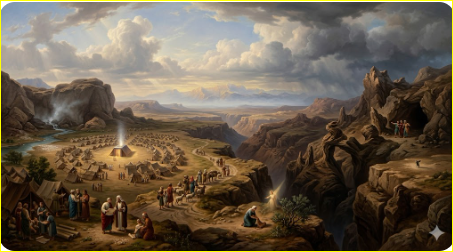
This sweeping landscape, rendered in the romantic and majestic style of the Hudson River School, captures the dual nature of the wilderness. It features the structured, radiant camp and the pillar of cloud alongside scenes of Hagar’s discovery of water and the long, winding path of wandering. The contrasting light and shadow mirror the tension between judgment and care that defines the midbar.
This week we begin the book of Bamidbar—literally, “in the desert.” The English title, Numbers, reflects its opening census, but the Hebrew name captures something deeper: not just a place, but a condition of existence. The wilderness is not merely where the Israelites travel; it is what they must undergo. Even though they have already been traveling for over a year, this moment represents a fresh start because they now have both laws and the Tabernacle. A key theme in Numbers is transition, and the census reflects the shift from separate tribes into a unified nation.
The long list of names and the structured arrangement of the camp highlight preparation—like getting ready for a major journey. The census is meant to organize the people into military units as they prepare to march toward Canaan, a land already inhabited, meaning they must be ready to fight and establish themselves as a nation.
At the same time, the census is a moment of self-reflection, where the Israelites see themselves not as former slaves but as a cohesive people. However, as the story unfolds, this generation ultimately fails to transform into a strong nation capable of reaching the Promised Land, and instead dies in the wilderness, leaving the fulfillment of that goal to their children.
Very quickly, that wilderness becomes the setting for one of the Torah’s most decisive turning points. When the spies return from scouting the land, they describe it in terrifying terms:
The land that we traversed and scouted is one that devours its settlers… we looked like grasshoppers to ourselves, and so we must have looked to them (Numbers 13:32–33).
That moment of fear reshapes the people’s destiny. What should have been a short journey becomes forty years of wandering, as God decrees: “Your children shall wander in the wilderness forty years” (Numbers 14:33–34).
This raises a fundamental question: what is the midbar? To be in the desert evokes, in English, the idea of being “deserted”—abandoned, left behind. At first glance, this seems to fit the Torah’s portrayal. Again and again, the wilderness appears as a place of expulsion. Hagar and Ishmael are cast out and wander in the wilderness of Beersheba, their water gone and their fate uncertain (Genesis 21:14–21). The scapegoat on Yom Kippur is sent away into the wilderness, bearing the sins of the people to an inaccessible region (Leviticus 16:10; 21–22). Those who are impure are removed from the camp and placed outside its boundaries, into what is effectively a wilderness (Numbers 5:1–4). Even the generation that left Egypt is condemned to remain there until they die (Numbers 14:33–35). Earlier still, Cain is sentenced to a life of restless wandering, cut off from stability and rootedness, inhabiting what can only be described as an existential wilderness (Genesis 4:12–16). In all these instances, the midbar is a place of removal, rejection, and danger.
And yet, this is not the whole story. The very same Torah also presents the wilderness as a place of refuge. Moses flees Pharaoh and finds safety in the land of Midian, sitting by a well in the wilderness (Exodus 2:15). Moses, tending the flock of his father-in-law Jethro, the priest of Midian, drove the flock into the wilderness, where he meets up with God in the Burning Bush (Exodus 3: 2). The Israelites themselves are led deliberately into the desert, but they are not abandoned there; they are sustained with manna from heaven and water from rock, protected and guided throughout their journey (Exodus 13:18; 16–17; Deuteronomy 8:2–4). Even threats lose their strength in this setting: Balaam, sent to curse Israel, encounters them in the wilderness and instead blesses them (Numbers 22–24). The desert, then, is not only where one is cast out; it is also where one is kept alive.
In some of the Torah’s most powerful moments, these two meanings converge. Hagar, expelled into the wilderness (Genesis 21:14), believes she is about to witness her child’s death and cries out, “Let me not look on as the child dies” (Genesis 21:16). Yet it is precisely there that God hears the boy’s voice, opens Hagar’s eyes, and reveals a well of water (Genesis 21:17–19). The place of abandonment becomes the place of salvation. So too with Israel: the wilderness is a punishment for fear and lack of trust (Numbers 14), but it is also a period of formation, “to test you… to know what was in your heart” (Deuteronomy 8:2). The midbar thus becomes a space that holds both דין and חסד, judgment and care, at once.
This duality helps explain why the Torah devotes an entire book to the wilderness. Although it is often framed as a transition on the way to the Promised Land, the midbar emerges as a condition in its own right. The book opens with order and structure, as the people are counted and arranged by tribe, and the Levites are set apart for a special role, both included and distinct (Numbers 1:47–53). But this initial order quickly gives way to unrest—complaints, fear, rebellion. The wilderness strips away the illusion of control and reveals the people as they truly are. It is a place where identity is not assumed but forged.
Even language reflects something of this process. The English word “desert,” meaning arid land, comes from the Latin dēsertus, “abandoned” or “forsaken.” “Dessert,” the sweet course at the end of a meal, comes from the French desservir, “to clear the table.” And “deserts,” as in the phrase “just deserts,” derives from dēservīre, “to deserve.” These words are unrelated in origin, yet their convergence is suggestive. The wilderness is a place where something is cleared away. The Torah itself tells us that the generation that left Egypt will not enter the land (Numbers 14:29–30). The midbar becomes the place where an old identity passes, making space for something new. Like a table cleared before dessert, something must end before renewal can begin.
Seen in this light, the wilderness is not merely punitive; it is transformative. It is where illusions collapse, dependence deepens, and identity is reshaped under pressure. It is a place of anxiety, frustration, and doubt—but also of growth and the possibility of becoming.
The question, however, is not only ancient. One cannot help but feel that the experience of the midbar resonates today. The harsh and conflicted reality in Israel since October 7 has intensified a sense of fracture and uncertainty. The feeling of being part of a shared national “convoy” is strained, and the slogan “Together We Will Win” can sometimes sound less like a statement of unity than an expression of longing. We may feel ourselves, collectively, in a kind of wilderness—divided, searching, unsure of direction.
And so the wordplay returns with renewed force. Will we receive our “just deserts,” a fitting consequence for our failures? Will there be a “dessert,” a sweetness that follows bitterness? Or are we still in the desert itself, like Hagar waiting to be seen, or like the scapegoat wandering, carrying burdens that are not entirely its own?
The Torah’s answer is neither simple nor comforting, but it is profound. The midbar is not empty. It is a place where people are cast out and where they are sustained, where sin is sent away and where identity is forged, where endings and beginnings intertwine. The challenge is not only to leave the wilderness, but to understand what it is doing to us while we are still within it. Only then can we begin to discern whether we are being abandoned—or becoming.
Related Topics