Parashat Bamidbar: Order in the Void
✦ ✦ ✦
The desert has no edges. Wind erases footprints before anyone thinks to call them a path. And there — where there are no cities, no walls, no fixed horizon — the voice arrives. Without disturbing the dust.
It does not begin with movement. It begins with stillness.
Lift the head of the whole assembly. Moshe understands: every face must be raised. As though the counting were never really about bodies — it was about restoring each person to themselves. One by one. Name after name. The people step out of the mass. No longer slaves dissolved into brick and forced labour. Now each one stands somewhere under the open sky, and that somewhere is theirs.
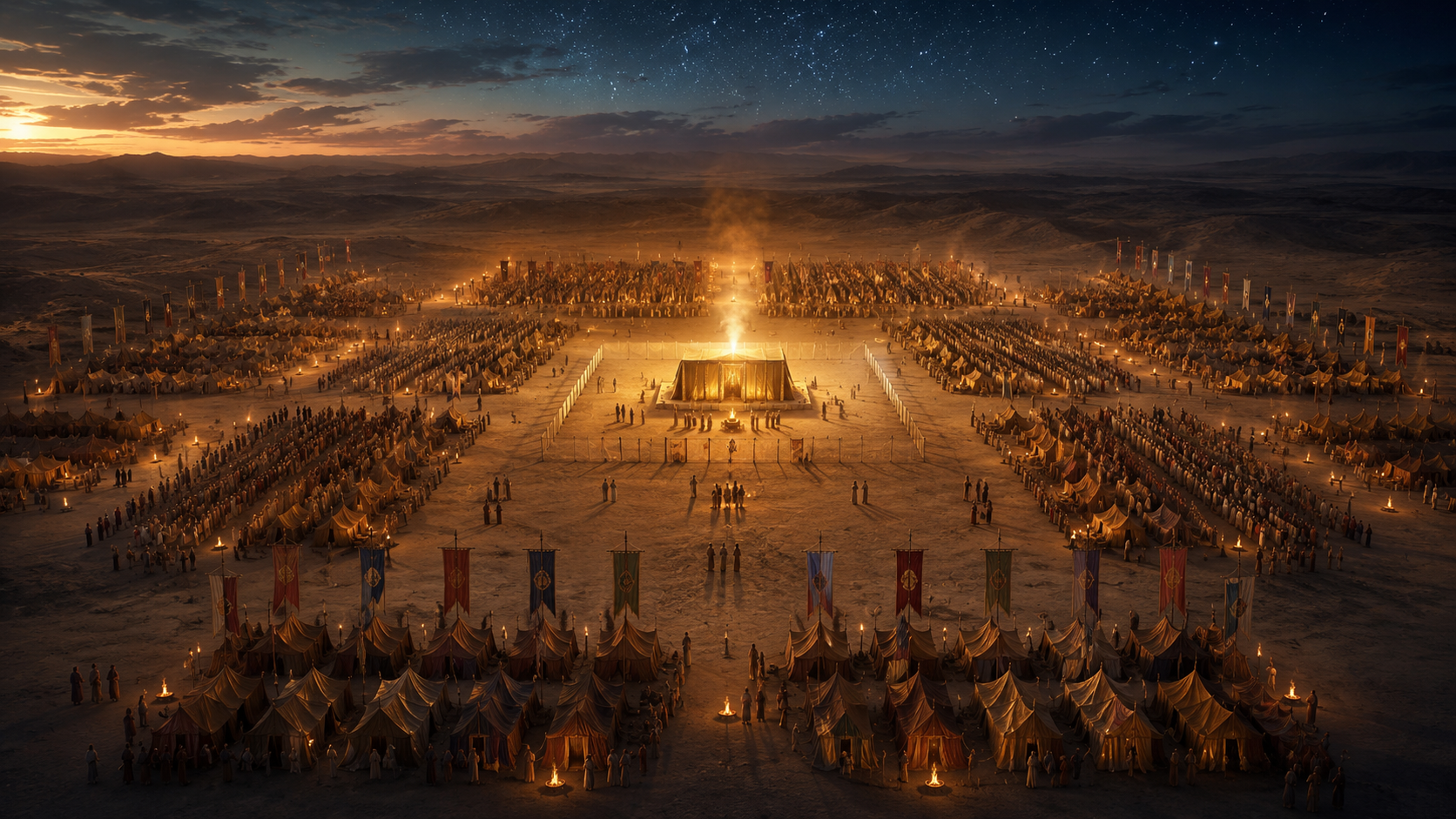
The tribes begin to align. Slowly. There is no hurry. Banners unfold, their colors trembling in the dry air. Each tribe settles by its own standard. Not identical. Not isolated. Difference without fracture — identity that does not need to devour what stands beside it.
At the centre, the Mishkan breathes. It does not speak. It does not move. Yet everything turns around it. The Levites draw close — without weapons, without rank among the soldiers. They guard the space where fire does not consume. While the rest of the camp faces outward, they face inward. As if they already know that the real danger is not what lies beyond the desert, but a heart with nothing at its centre.
The circle completes itself. East, south, west, north. An invisible map traced in sand that will not survive the night. No one moves yet. The silence carries more weight than any command.
Because the desert teaches what Egypt never allowed them to learn: freedom without form scatters. And before the tent rises, before the march begins, the people must first discover what it means to live around a centre that belongs to no one — and to which everyone belongs.
✦ ✦ ✦
THE MISHKAN AS INNER AXIS
There is a kind of emptiness that is not absence — it is exposure. The desert does not attack you. It strips you. Walls go first, then routine, then the social mirror that kept telling you who you were. And then the question surfaces, the one nobody can outrun: who are you when there is nothing left around you to hold you in shape?
Bamidbar answers without speeches. It answers by ordering.
To count here is not to reduce a person to a number. It is to raise the face. To say to each one: you are here, you take up actual space, you are not interchangeable with the person beside you.
The Mishkan at the centre is not religious decoration. It is a psychological and spiritual axis. A people can endure without comfort. It cannot endure without a centre. When the sacred does not hold that place, something else moves in — fear, impulse, violence, the exhausting machinery of comparison.
The camp arranged around the centre teaches without a word: human life needs orbit. Rootedness. A gravity it can return to. What we call freedom is not the absence of pull — it is knowing which pull to follow.
✦ ✦ ✦
BAMIDBAR IN THE PRESENT TIME
The desert is no longer sand. It is saturation.
We live surrounded by stimuli, voices, alerts, opinions that have already shifted before they’ve even landed. And the inner experience still resembles Bamidbar: a landscape with no clear edges, everything in motion, almost nothing with a centre.
The paradox of the age is neither subtle nor new. We have never been more connected, and yet so many people move without any real sense of direction. Bamidbar counts the people before setting out. We tend to do the opposite — move first, then wonder who we are.
The Mishkan at the centre of the camp speaks directly to this moment. Not a temple for leaving the world behind — a fixed point inside the motion. In an age where everything is editable, where every position can be revised overnight, the old question returns without apology: what actually holds when nothing is fixed?
Without a consciously chosen centre, whatever captures your attention longest will claim that place. You don’t decide this — it simply happens. The orbit forms around whatever holds.
The tribal banners still speak. Difference without permanent war. Each tribe exists fully — none collapses into the other, none revolves around itself. A shared centre does not erase particularity; it gives particularity somewhere to stand. Without it, identity becomes a trench. With it, identity becomes a position inside something larger — which is the only condition under which it can breathe.
✦ ✦ ✦
INNER ACTIVATION
The Levites remind us of another law entirely: what is central must never be treated as a tool. The centre is not used. It is kept.
There are things which, once turned into objects of conquest or utility, corrupt everything that surrounds them. Bamidbar sets guardians around the centre not as ceremony but as warning: do not confuse motion with license. Do not mistake proximity to the sacred for ownership of it.
You do not need to leave the world to recover direction. You need to locate the centre from which you actually move — and ask, honestly, whether you chose it.
What is actually guiding your decisions right now — did you choose it, or did you simply follow whatever was loudest?
✦ ✦ ✦
“Do not walk before you have a centre.”
Bamidbar sets down a pattern before any march: if you are going to walk, walk from a centre. If you want to be free, first learn to stay still.
Whoever cannot bear the void will eventually build a new Egypt inside himself.
Night falls. The fires sketch human constellations against the dark. Tomorrow will bring movement, complaint, uncertain marches through uncertain ground. But now, in this held moment, everything is still. As though God had paused time — not to delay them, but to teach them what remaining feels like.