Parashat Chukat
Obedience That Crosses the Desert
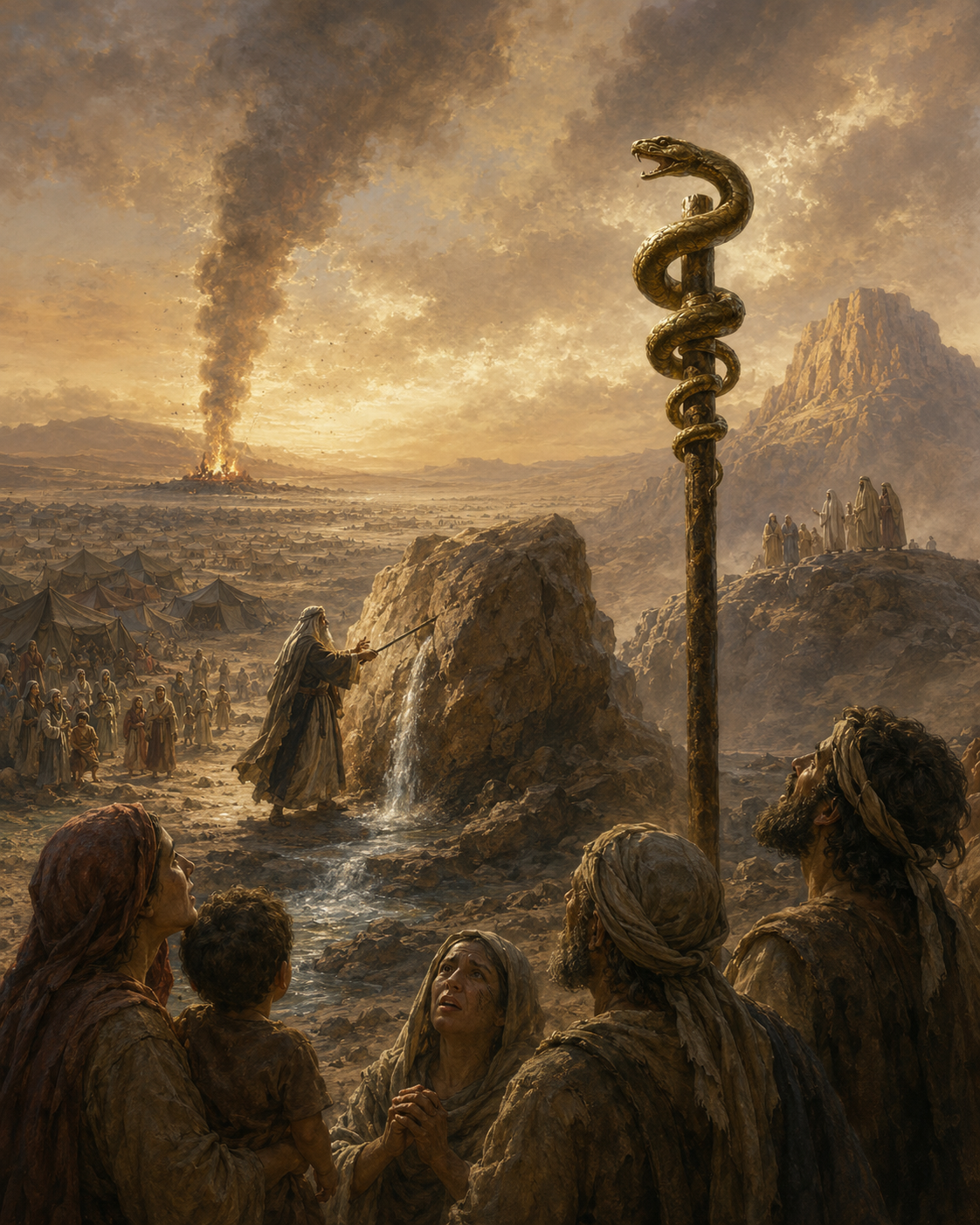
The camp awakens before the sun has fully risen. The air feels heavier than on other mornings. Outside, far from the tents, fire slowly consumes the red body of an unblemished cow. The smoke rises without haste, as if it needs to convince no one. Some watch from a distance; others prefer not to come near. No one fully understands what is happening, yet everyone senses that something deep is shifting beneath the surface of the desert. This is the decree of the Torah. Without explanation. Without justification. Only the command that arrives before any understanding.
Miriam’s death comes without announcement. No thunder, no visible sign, only an absence that becomes evident when the vessels remain empty. The water disappears as if it had never existed. The drought begins not in the throat, but in the spirit. Moshe steps toward the rock as murmuring grows behind him. The command had been to speak, yet the weight of years, accumulated complaints, and the fatigue of leadership pass through his gesture. The staff strikes once, then again. Water flows. The echo of the blow, though, lingers longer than the water — and longer than anyone wanted it to.
The path toward Edom closes without room for negotiation. The camp turns slowly, lifting dust in a direction no one had planned. To go around does not feel like progress, yet the tents are raised all the same. On Mount Hor, time slows. Moshe removes Aaron’s garments with care, as one who knows the final gesture cannot be hurried. Eleazar receives the weight of priesthood without ceremonial words. The serpents appear when weariness turns into open complaint. They move among the heated stones. Then the bronze figure is raised upon a pole: some lift their eyes in desperation. The venom remains. What changes is harder to name than the cure itself.
What Is Not Understood Sustains the Way
There are moments in life when everything seems to demand immediate explanation. The mind seeks reasons, order, logical sense. But Chukat appears precisely at the point where understanding ceases to suffice. The soul discovers that certain structures uphold before they are understood — and that resisting them does not produce clarity. It deepens the dryness. When Miriam dies and the water disappears, it is not only a physical resource that is lost. A silent dimension that maintained flow without noise is broken, and the text does not explain why that dimension was hers to carry.
Moshe’s gesture before the rock reveals another wound — one less visible than the first. Sometimes the result arrives, the water flows, the problem appears resolved, yet the manner of acting leaves a fracture that the outcome cannot close. To strike when one was meant to speak is a form of surviving through fatigue — not failure exactly, but not obedience either. Many human gestures arise this way. Going around Edom reflects a different difficult truth: not every path opens even when one is right. Pride wants to force entry. Structure teaches how to circle without losing the axis. These are not the same lesson.
Chukat in the Present Time
We live in an era where everything must be explained before it is lived, where the value of an action seems to depend on immediate logical coherence. Yet real human experience — the kind that moves through difficult decisions, silent losses, and changes we did not choose — rarely conforms to such rational order. The red cow becomes an unsettling mirror: there are structures that operate before explanation. In a world saturated with analysis, symbolic obedience appears almost incomprehensible. It points toward something older — the capacity to sustain form even when meaning has not yet arrived, and perhaps will not.
Miriam’s death also resonates today. Accelerated societies have lost spaces of silence and receptivity; everything is measured by productivity, speed, visible impact. Contemporary dryness is not always lack of resources, but absence of listening — a distinction that systems of management and self-improvement tend to collapse into the same category. The raised serpent holds particular resonance: modern culture seeks to eliminate pain quickly, to anaesthetize it, distract it, conceal it. Chukat proposes something else. Not escape from the wound — a changed relationship to it. Whether that change is possible without the pole, without the act of looking, is what the passage leaves unresolved.
Inner Activation
Chukat advances through quiet obedience. The desert does not teach first to understand, but to walk even when logic falls short. And in that walking — between red smoke, struck rock, and eyes lifted toward bronze — the soul learns that there are commands not explained, yet they sustain the path when everything else seems to collapse.
To speak when everything urges you to strike. To accept detours without breaking axis. To lift the gaze even when it hurts.
What decision do you already know is right, yet continue to postpone until you feel total certainty — and what is that delay costing you?
“What is not understood can sustain the way.”
When the final battles come, there are no raised staffs or visible miracles. The people move forward with a different calm — not the calm of resolution, but of something that has stopped waiting for resolution. Victories arrive without noise, without spectacle. The desert continues to teach that maturity does not consist in understanding everything, but in inhabiting structures that cannot yet be explained, and that this, too, is a form of fidelity.