Parashat Shelach
When the Soul Becomes G-d’s Scout
✦ ✡ ✦
The camp breathes. Dust still hangs in the air — that fine, hot dust you do not notice whilst breathing it in, and only become aware of once it settles in the throat like a question postponed for too long. The cloud does not move. It too seems to be waiting. Then the sentence comes, and it opens something with no outer wall: Shelach lecha anashim. Moshe hears it, and twelve men set out — eyes sent ahead by a heart that does not yet dare to look for itself. Almost as if the promise now had to be tested. Perhaps. The desert alters the rhythm of the heart. One only realizes that once it is already too late to realize it.
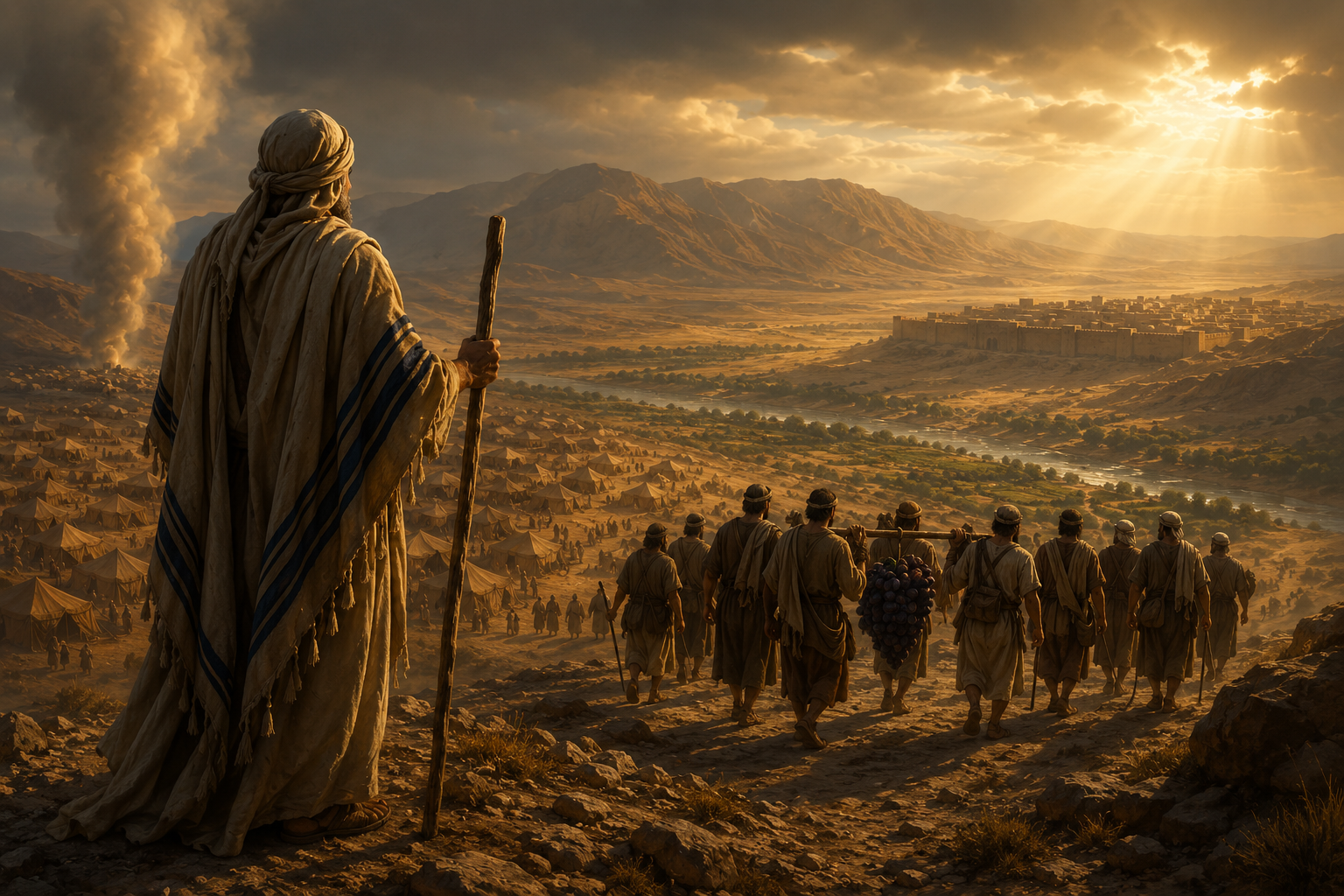
The scouts walk through silent hills. In the Valley of Eshkol — and this is no mythical place, this is earth, light, smell — they cut down a cluster of grapes so heavy that two men must carry it together on a pole between them; inside that weight lies the whole promise, unbearably concrete. Abundance does not hide. Life is there. And yet: during the forty days that follow, it is not the land that changes. What changes, slowly and without any of the men registering it, is the angle from which they regard themselves standing before it. At first they speak of fertility, of streams, of what they have seen. Then comes the but. High walls. Giants. Impossibility.
Caleb steps forward and silences the crowd. His voice does not shout; it holds. He says they can go up, that the land has remained good, that the promise has not shifted. Yehoshua stands beside him like a flame no wind can extinguish — and the wind does grow stronger. Fear has already found its echo in too many hearts, in those exhausted hearts made accustomed to the desert, hearts no longer able to distinguish between what they fear and what is. Night descends, and with it the collective weeping: long, rough, without comfort. Some remember Egypt as though it had been shelter, as though slavery at least had carried the advantage of the familiar — and what a confession lives inside that memory, what a small, ashamed confession. The crowd reaches for stones. Then the Presence fills the Tent.
Silence.
✦ ✡ ✦
The Gaze That Becomes a Boundary
There are moments — and whoever knows them needs no further explanation; whoever does not know them will — when life breaks not because of an external enemy, but because a gaze turns inward and begins to suspect itself. Not suddenly. It begins as caution, as a legitimate need to understand, as the reasonable desire not to be blind. Then, somewhere between the first reservation and the thirtieth, the gaze loses its inner axis. What later appear as giants are often the very same hills — only seen from inside, from the perspective of a heart that has already decided to diminish itself. The scouts did not invent the giants.
The parashah reveals that collective fear does not arise from a lack of signs. The people had watched manna fall from the sky; they had crossed the sea; they had walked beneath the cloud — and yet: all of it became fragile in the very moment they stood before the promised land and were meant to enter it for real. A human being can carry deep experiences and still tremble when the moment comes to move towards something new. That is not absence of faith. It is the truth of growth: growth demands the relinquishing of a familiar identity — and no promise can spare a person that shedding of skin. The promise holds. The skin must go.
✦ ✡ ✦
Shelach in Our Time
The age we live in resembles the moment when the scouts return to the camp — not in its outer appearance, but in its inner architecture. Information is everywhere: images without end, analyses without end. This abundance of vision, rather than producing clarity, often deepens fragility — because it floods the soul with viewpoints when what the soul actually needs is a centre from which to see. The modern soul sends out its own scouts every day. It examines future scenarios, it calculates risks. And when that anticipation loses its axis, something close to the dynamic of the ten emerges: an accumulation of data that erodes trust rather than sustaining it. The land has not changed. The measure has.
The tzitzit enter here as something more precise than metaphor — almost as a technology of return. Against an environment that scatters and fragments, the soul requires concrete reminders that pull it back towards its centre: not necessarily ritual objects, but daily gestures that anchor intention. A conscious pause. A repeated word. A practice that returns breath to the body. Small forms of embodied memory, so that the soul does not merely follow where the eyes are driven. What the soul alone cannot sustain, the habit of the heart maintains: return. Return again. The future opens to those who enter it with a quiet centre — those who have not already exhausted it from a distance.
✦ ✡ ✦
Inner Activation
Moshe holds the axis whilst everything tilts. He does not plead from sentiment — that would be too shallow a reading. He holds coherence together because he understands that without coherence nothing survives, not even the memory of what was once possible. He asks that the Name not be profaned through total destruction. The covenant does not break; time rearranges itself. The story is not erased — displaced: by forty years, by a generation, by the distance between the heart that doubts and the heart that finally allows itself to be guided. When everything collapses, sometimes what remains is a single person who refuses to release the axis. Inside every human being there is a scout, a faithful one, an inner multitude — and a point, silent and heavy as a stone at the bottom, that intercedes.
What decision have you known for a long time you must take — and still postpone, waiting for the guarantees that only the path itself can provide, and only after you have already walked it?
✦ ✡ ✦
“The promise is lost when you regard it only through suspicion. It returns when you allow it to become home before it becomes proof.”
One does not enter the land with sharpened eyes. One enters it with a centre that does not sell itself to fear — and that is harder than it sounds, harder than any wall the scouts ever saw. The desert continues to teach. The true distance does not lie between two places; it lies between the heart that doubts and the heart that allows itself to be guided — two conditions of the same heart, sometimes within the same hour. The tzitzit at the edge of the garment remember the axis once forgotten. The promise remains. What changes is the human being who carries it.