
Parasitical Radicalization: October 7 Alliance
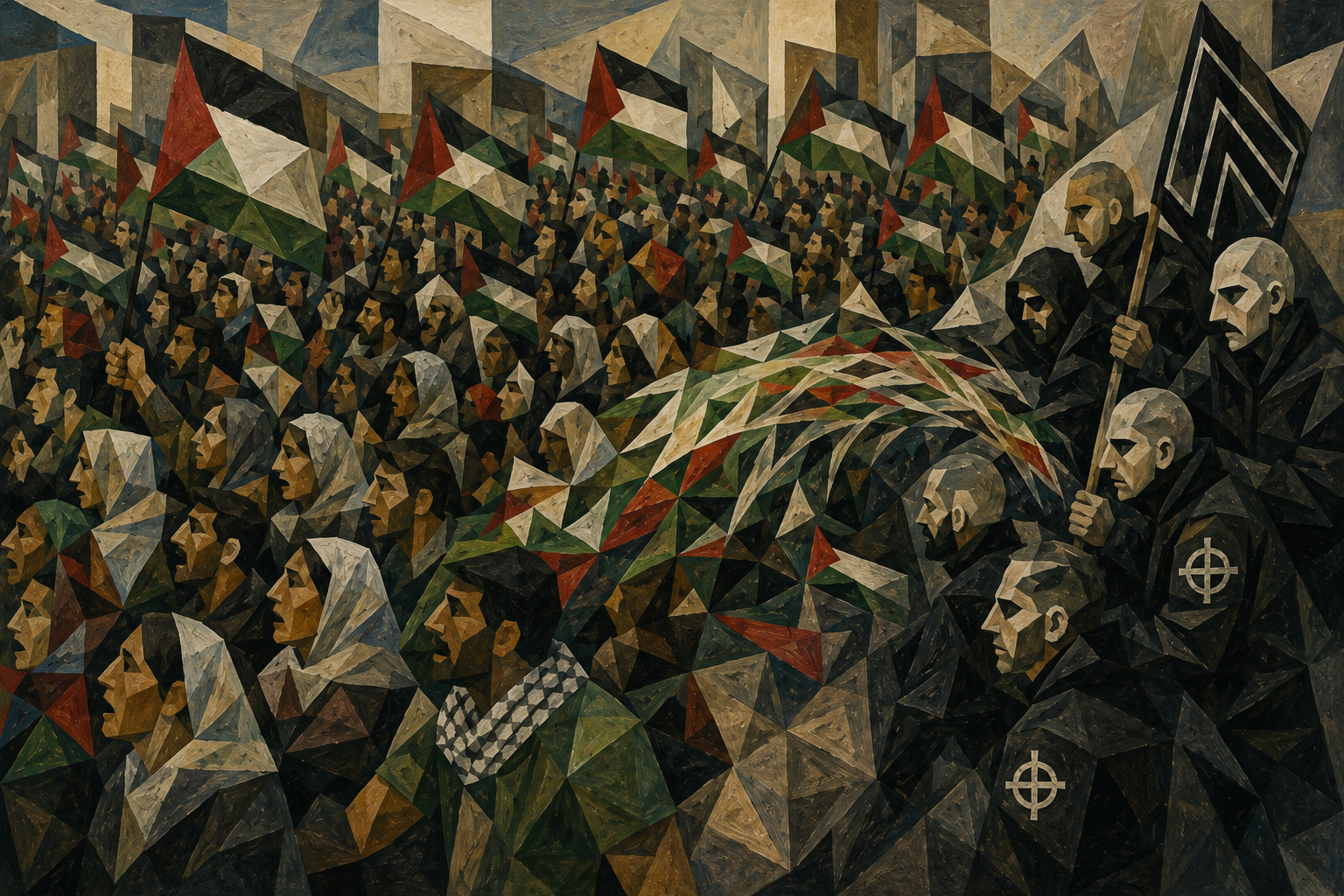
In the days following the October 7, 2023, Hamas massacre in southern Israel, in which over 1200 unarmed civilians were killed and 251 others taken hostage, a wave of anti-Jewish sentiments was unleashed across the Western democracies. According to reports, when the images of Hamas atrocities in Israel flooded the internet, the massacre met with celebration, justification, or endorsement of Hamas brutality instead of condemnation.
This absence of universal condemnation of the massacre displayed an evolving social reality that the values of Western societies that once guaranteed inclusivity and legal protection that were extended to the Jewish people are no longer sufficient to combat Jewish hatred.
In the discourse of October 7, far-right neo-Nazi movements have been comparatively understudied, particularly regarding how these movements strategically appropriated anti-Zionist narratives and sentiments in domestic mobilization within Western democracies. European neo-Nazi groups and white supremacist communities whose ideologies are deeply antisemitic yet historically hostile to Islamist movements publicly celebrated the massacre or expressed support for Hamas. At first glance, this appeared contradictory. Among such neo-Nazi groups, the Nordic Resistance Movement has officially extended its support for the “Palestinian Offensive” a day after the October 7 massacre on Telegram.
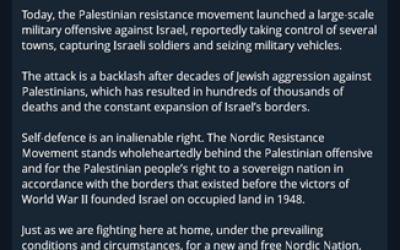
This convergence should be viewed from a strategic position. The Nordic Resistance Movement has a documented white nationalist ideology. It has a documented history of antisemitism and publicly supported the October 7 offensive and rhetorically appropriated a particular anti-Zionist narrative in the context of the October 7 massacre to recruit, mobilize, and legitimize its own presence. This is an example of parasitic radicalization, a process by which an extremist movement appropriates the symbolic momentum of another conflict to reinforce its own ideological objectives.
Despite NRM’s ideological incompatibility with Hamas and Islamist beliefs, NRM’s endorsement of the October 7 massacre and invasion of Israel, despite ideological inconsistency, became a point of symbolic convergence around antisemitism, generating greater strategic benefits than maintaining ideological purity.
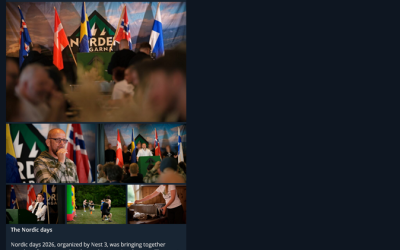
This resurgence of anti-Zionist sentiment created opportunities for far-right neo-Nazi groups to regain a foothold in mainstream politics. They did so under the banner of anti-Zionism, exploiting the legal ambiguity of the distinction while furthering white ethno-state ideology. As of August 2026, the NRM remains active and conducts rallies despite being designated as a terrorist group by several Western democracies and continues to coordinate with more than 8800 members on Telegram.
The existing frameworks acknowledge the far-right neo-Nazi movement and anti-Israeli actors’ convergence around overlapping views on anti-Zionism and Jewish hatred. These analyses stop at describing this convergence rather than addressing the underlying mechanism and operational strategies through which extremist organizations exploit the “Sentimental Energy” of other movements, appropriate familiar rhetoric such as anti-Zionism, and reposition themselves within public discourse to reinforce their own ideological project. The sentimental energy of a movement formed by the grievances of sympathizers reinforces the emotional force that unites people, driving collective actions around a single grand narrative.
This adaptive process becomes parasitic as the individuals initially mobilized in anti-Zionist protests encounter Neo-Nazi narratives and overlapping narratives that create a new pipeline of recruitment and transition into Neo-Nazi ecosystems. It reveals a gap in existing legal and political frameworks, which remain oriented toward static conceptions of extremism rather than dynamic processes of symbolic appropriation.
Jean-Pierre Faye’s Horseshoe Theory (1972) argues that ideological extremes exhibit behavioural similarities, rather than recruitment ecology. It fails to explain distant ideological cooperation and strategic convergence with each other, while each maintains its distinct ideological content and would remain ideologically incompatible and hostile in its own distinctive worldview.
The concept of cumulative extremism, or reciprocal radicalization, developed by Busher and Macklin, focuses on the amplification of violence and rhetorical promotion from group A to group B, in an escalatory loop, e.g., far-right and Islamic extremism feeding each other post 9/11. This framework explains how A’s violence triggers/advances B’s violence. By contrast, parasitic radicalization describes ideologically distinct extremist actors exploiting one another’s actions, narratives, resources, or shared adversaries for strategic gain without moving toward ideological convergence.
Different media outlets, governments, and institutions have adopted diverse definitions to specify separate categories for legitimate distinction between antisemitism and anti-Zionism. The use of vaguely defined legal language and overlapping rhetoric has, in some cases, obscured or understated the antisemitism and Jewish hatred expressed in mainstream political rhetoric. This enabled a strategic opportunity for far-right neo-Nazi organisations to advance an anti-Semitic worldview and find legitimacy for their own agendas.
This ambiguity appears to have facilitated the extremist actors whose long-standing antisemitic ideology could be expressed in mainstream through anti-Zionist narratives and activism, allowing a symbolic convergence without ideological convergence. Exploiting the legal immunities of free speech and political scrutiny, the anti-Zionist expressions propelled antisemitic narratives targeting the Jewish people.
Those responses and legal frameworks have been applied inconsistently and have proven ineffective in curbing antisemitic expression in various other movements, particularly the anti-Zionist mobilization that has been particularly the anti-Zionist mobilization documented in pro-Palestinian protests, rallies, and speeches several members openly extending their support for the designated terrorist group Hamas. This inconsistency reflects a problem with political will rather than a lack of legal tools.
To curb far-right neo-Nazi and Islamist strategic convergence and halt ideological recruitment while preventing the rapid amplification of Jewish hatred in Western democracies, a three-step strategy is required.
The first step should be strengthening the application of the International Holocaust Remembrance Alliance’s working definition of antisemitism, including greater scrutiny of cases in which anti-Zionist rhetoric crosses into antisemitic expression and helps create a rhetorical blind spot.
The second step would involve greater scrutiny of anti-Zionist political protests, speeches, rhetoric, and activities. The polarisation of contemporary student spaces has been a result of unchecked administrative intervention and complacency in regulating speech to distinguish between advocacy and hatred.
This development became particularly visible since the October 7 massacre, at the University of Sydney, for example, a February 2024 student-organised event titled “Who are Hamas? – Palestine, national liberation, and socialism” focused on the active endorsement of Hamas, which is listed as a terrorist organization under Australian law.
The Oxford Union president, Arwa Elrayess, stated, “Any resistance group will inevitably be deemed a “terrorist” organization by the West until they achieve their liberation (by which time, they’ll be lauded as heroes, as history has repeatedly proven).”
This legitimisation of terrorism and endorsement of terrorist factions by prominent student leaders not only creates an atmosphere of hostility toward Jewish students and may cultivate conditions for future recruitment, ideological radicalization, and the emergence of terrorism apologists, thereby amplifying Jewish hatred.
Finally, ensuring the safety and legal protection of Jewish communities remains critical to upholding Western democracies’ commitment to “Never Again”. Therefore, the process of parasitical radicalisation warrants greater attention to identify and disrupt strategic convergence between ideologically incompatible movements that can be reinvigorated during terrorist outbreaks, rather than assuming that ideological distance prevents cooperation.