Paris: The Constantin Brâncuși retrospective
Paris is currently hosting a retrospective of the Romanian-French artist Constantin Brâncuși at the Centre Pompidou, the city’s premier museum for modern and contemporary art, while Venice, is currently hosting the Biennale ARTE 2024 with the controversial theme “Stranieri Ovunque – Foreigners Everywhere,” curated by the first Latin American curator, Adriano Pedrosa.
Alongside other notable cultural events in Paris, such as the Tina Modotti retrospective at the Jeu de Paume, the Robert Ryman retrospective at the Musée de L’Orangerie, the Mohamed Bouroussia retrospective at the Palais de Tokyo, the “The World As It Goes/The Human Comedy” exhibit at the Bourse de Commerce Pinault Collection, and the “Mexica” exhibit at the Musée du Quai Branly, the Brâncuși retrospective stands out as a highlight.
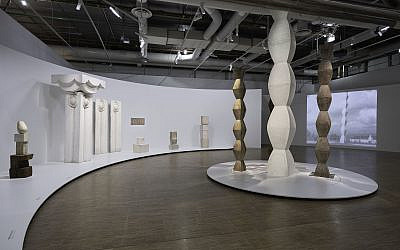
The retrospective is captivating, featuring two hundred sculptures, photographs, drawings, films, documents and tools, and furniture from Brâncuși’s studio on the Montparnasse alleyway Impasse Ronsin.
This studio not only served as a work and an exhibition space but was also a piece of art, filled with objects mainly crafted by him. At his death in 1957, five years after he received French nationality, he bequeathed the entire studio to the French State. Initially, they were partially installed at the Palais de Tokyo before finding their permanent home next to the Centre Pompidou.
The retrospective, curated by Ariane Coulondre with the assistance of Valérie Loth and Julie Jones, commences with Brâncuși’s rooster sculptures in white plaster. These sculptures hold symbolic significance for France as a revolutionary symbol and cultural icon but also resonate deeply in Romanian literary tradition. The rooster is prominently featured in the Romanian folk tale ‘The Impudent Rooster,’ published in 1876 in Convorbiri Literare (Literary Conversations), a Romanian literary journal. This tale explores themes of forgiveness, loyalty, and respect.
Upon entering the exhibit, visitors find themselves in a dark hall with black walls, facing Brâncuși’s rooster sculpture from 1935, presented dramatically in spotlit isolation. Moving into the first exhibition hall, titled “Whiteness and Light,” viewers encounter the three rooster sculptures: ‘Grand Coq I’ (1924), ‘Grand Coq II’ (1930), and ‘Grand Coq III’ (1930 to 1934), embedded within white walls. This intentional presentation aims to recreate the impression of editor Margaret Anderson upon her first visit to Brâncuși’s studio. Anderson was delighted by the serene, zen-like atmosphere, characterized by a combination of white – seen not only in Brâncuși’s work but also in his attire, his hair and beard, and surroundings – and the infusion of light, which emanated from the magnolias adorning a white table.
The retrospective eschews a strictly chronological approach, instead weaving a narrative that draws from both Romanian folklore and the spirit of the French Revolutionaries who sought liberation from monarchy and religious oppression.
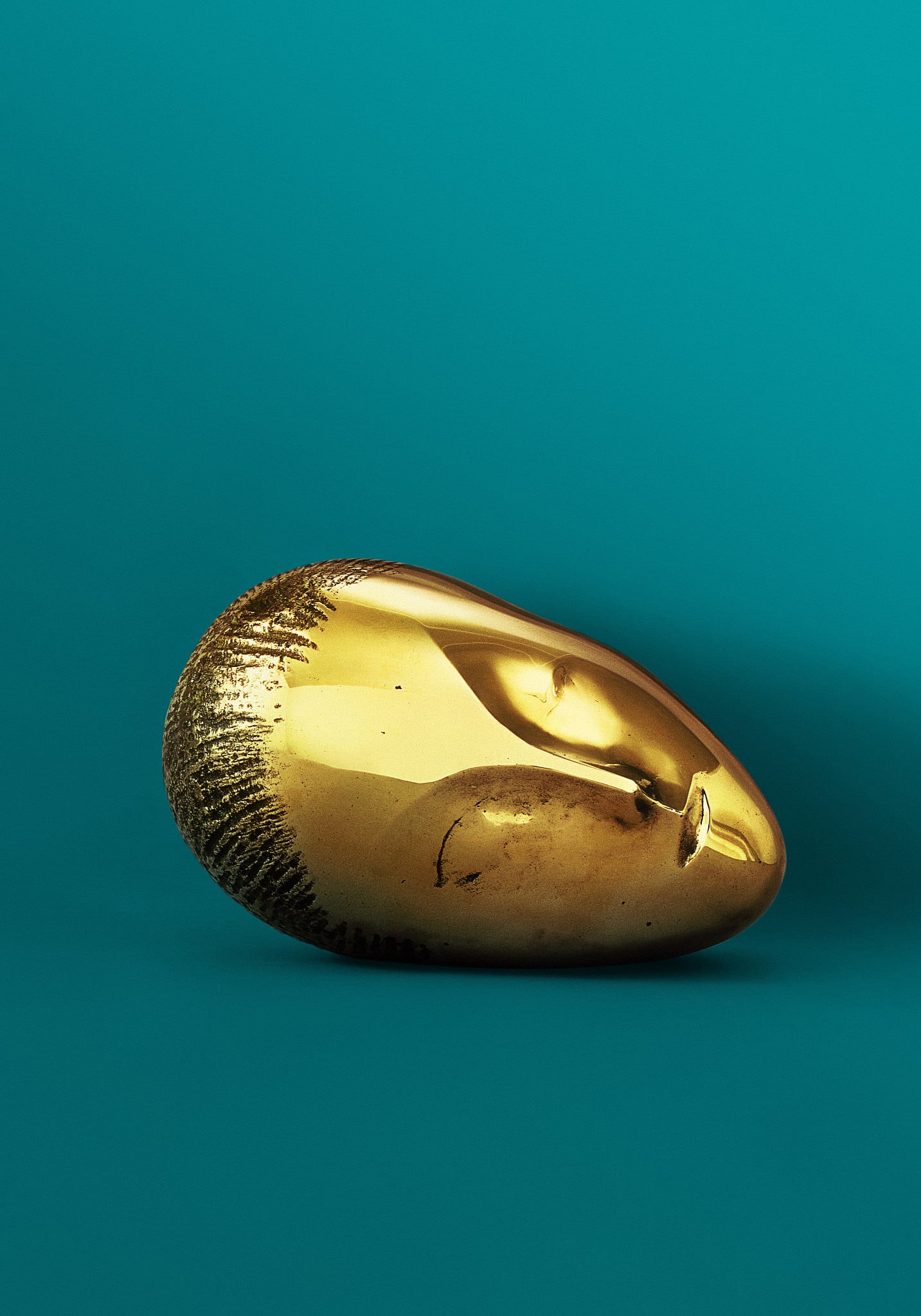
It then continues with the ‘Sleeping Muse’, from 1910, a sculpture that shows how he found his own artistic language moving away from the typically portrayed bust, thus showing a reclining head in polished bronze with only the innuendo of features, that viewers can find themselves reflected in. It is modeled on Baroness Frachon, or Renée Frachon, born Renée Toussaint a poet, novelist, and traveler, patroness, who with her aristocratic origins, embodies the Parisian “high society” that was active and visible during the Belle Époque.
In the next hall, which shares the same dimly lit ambiance as the entrance, Brâncuși’s major works from the period following his tenure at Auguste Rodin’s studio, circa 1907-1908, are prominently displayed. Among these significant creations are ‘The Kiss,’ ‘Wisdom of the Earth,’ and ‘The Prayer.’ Contrasting with Rodin’s earlier rendition of ‘The Kiss’ from 1882, Brâncuși’s interpretation takes a different approach to depicting this universal theme. Rather than capturing precise anatomical details of the figures’ embrace, Brâncuși chooses to convey the essence of the gesture in a geometric manner, reminiscent of African-style sculpture. In doing so, he emphasizes the core message of opposite genders embracing each other while eschewing superfluous details that can sometimes serve to divide rather than unite people in their shared humanity. Perhaps Brâncuși sought to establish his cultural legacy alongside other artists who explored similar themes of emotional bond and connection, such as Edvard Munch and Gustav Klimt.
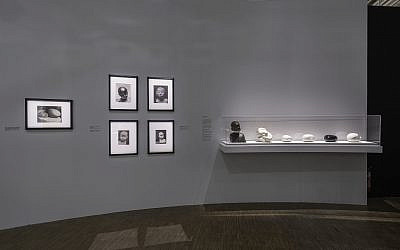
In this section of the retrospective, visitors can also discover Brâncuși’s famous series of children’s heads, which he began creating from 1906 onwards, inspired by his friend’s children. One notable piece is ‘Portrait of George’ (1911), on loan from the Guggenheim Museum in New York. This sculpture portrays a child with his arms crossed and head bent, capturing a sense of drowsiness or fatigue. Adjacent to ‘Portrait of George’ is an infant’s head sculpture from 1908, with an ovoid shape displayed horizontically. Crafted from smooth marble, the infant’s head emanates a sense of innocence and serenity, inviting viewers to reflect on the universal experience of infancy.
This particular piece stood out to me as my favorite in the retrospective, not only for its elegant appearance in white marble and subtle features but also for Brâncuși’s ability to capture a visual expression that connects all human beings. We all begin life as embryos, and this sculpture evokes the universal experience of infancy. I find a profound depth in this artwork, reflecting vulnerability and innocence. The closed eyes invite contemplation—does the child sleep peacefully, or does it rest eternally? The head, as the home of the brain, holds immense importance, governing all bodily functions regardless of one’s background. Children’s brains are especially delicate, making them vulnerable to external influences.
Then, white marble accentuates purity and innocence, while the symmetry suggests notions of beauty and perfection. Personally, this piece resonated with me deeply, as I am still grieving the loss of a friend’s son to suicide. It also brings to mind memories of my brother as an infant, his head still without much hair, and his struggle with uncontrollable epileptic seizures that ultimately led to his premature death. The sculpture also prompts reflection on the countless children affected by war, abuse, and trauma, whose brains bear the scars of their experiences. Unlike bronze, marble is fragile and prone to breakage when subjected to heavy impact, serving as a poignant reminder of life’s fragility.
Then, another major attraction of the retrospective, as I mentioned earlier, comprises the personal items of Brâncuși. These include letters, books, records, and other documents preserved at the Centre Pompidou’s Kandinsky Library. Among these personal artifacts are a photograph of his mother, an anatomy session image—a standard component of artistic education in Romania—and a session with an anonymous model. Additionally, visitors can view his certificate from the Fine Arts School in Bucharest, sketches by Amadeo Modigliani that influenced his work, and photographs of the dancer Lizica Condreano, among other notable items. Lizica Condreano visited his studio in 1922 to dance to Erik Satie’s ‘Gymnopédies’, a composition created by Brâncuși’s friend Eric Satie. These personal artifacts offer insight into Brâncuși’s life, influences, and artistic process, enriching the retrospective experience.
Additionally, visitors have the unique opportunity to explore a reconstructed segment of Brâncuși’s studio, alongside a dedicated section showcasing his controversial bronze sculpture, ‘Princess X’ (1915-1916). This artwork sparked controversy and was banned from the Salone des Indépendants in Paris in 1920 due to its phallic appearance. It portrays Princess Marie Bonaparte, a French author, psychoanalyst, and distant relative of Napoleon I of France. Bonaparte maintained a close association with Sigmund Freud, whom she assisted in escaping the Nazis.
Brâncuși defended the sculpture, asserting his intention was to capture the subject’s vanity. Bonaparte had a habit of examining herself in a hand mirror during meals, showcasing her elegant neck and full bust. However, considering Freud’s concept of penis envy and Bonaparte’s endeavors to overcome frigidity, culminating in her publication of theories in the medical journal Brussels-Medical, Brâncuși succeeded in distilling complexity into essential simplicity. Freud and Bonaparte shared an interest in sexuality and its role in human behavior, a theme resonant in the interpretation of Brâncuși’s work.
Reflecting on his art, Brâncuși articulated, “What my art aims at is, above all, realism; to explore the inner hidden reality, the essence of objects in their fundamental nature: this is my sole preoccupation.” His philosophy is encapsulated in the quote, “Simplicity is complexity resolved.” — Constantin Brâncuși.
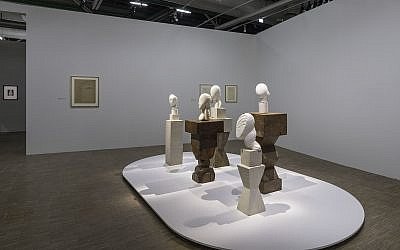
The exhibition progresses from the ‘Princess X’ sculpture to his graphite, gouache, and charcoal sketches of women on white or beige cardboard paper and the sculptures that originated from these sketches. However, in these sculptures, akin to his sculptures of children’s heads, the external experience is diminished to such an extent that only one aspect stands out, reflecting his overall impression of these women—his female acquaintances, including Margit Pogany, Baroness Frachon, Eileen Lane, Nancy Cunard, and Agnes Meyer. Whether it be their almond-shaped eyes, chignon, or curly hair, these features were constructed more from memory than from having a model pose for him.
Another highlight is his animal sculptures, which reflect his fondness for his fluffy, all-white dog Polaire, often seen by his side in photographs or depicted in works by Man Ray and Edward Steichen. Polaire met a tragic end in an accident in 1925. Additionally, his affection for Roman folktales and La Fontaine’s Fables is evident, stories that impart specific morals or lessons through the use of animals or objects to represent human traits or behaviors.
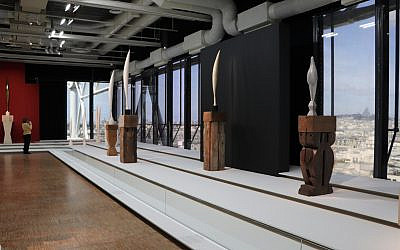
Throughout the last three decades of Brâncuși’s career, leading up to his passing in 1957, he devoted himself more to sculpting animals than human figures. Consequently, an entire exhibition hall is dedicated to his bird sculptures in space, situated with expansive windows that offer glimpses of the Parisian sky, above iconic landmarks like the Sacre Coeur, the Eiffel Tower, and the Haussmann buildings. Brâncuși crafted approximately 30 variations of these avian forms, beginning with the ‘Maiastras’ in 1910, where the semblance of a bird’s shape remains perceptible. Subsequently, his later bird sculptures eschew explicit wings and heads, reducing the bird to a feathered essence, thereby returning it to its fundamental form.
What sets birds apart from aquatic creatures such as fish, seals, and turtles—showcased in another room alongside his swan sculptures, is their capacity for flight. It’s the feathers that facilitate flight, enabling birds to achieve lift and generate thrust.
“All my life, I have only sought the essence of flight. Flight—what bliss!”Brâncuși’s profound words encapsulate his lifelong pursuit of capturing the ethereal beauty and freedom embodied by flight.
Then, as I mentioned are his swan sculptures titled Léda, with a separate black-walled area dedicated to his bronze polished version of it, highlighting the myth of the metamorphosis of a human being into an animal – he believed only women were able to turn into swans – and its magnificence in its perpetual motion, mesmerizing reflections and the portrayal of still water through the polished mirroring disc.
The retrospective concludes with a portion of Brâncuși’s monumental work, the Târgu Jiu Sculptural Ensemble, featuring photographs and a film personally shot by the artist showcasing the ‘Endless Column’ (Coloana Infinitului). This towering, slender column consists of 16 stacked modules, reaching nearly 30 meters (98 feet) in height. Symbolizing the endurance and eternal spirit of Romanian soldiers, it also represents the axis mundi, serving as a link between earth and sky. Additionally, the exhibition presents smaller variations of the ‘Endless column’, which evolved from a simple wooden plinth reminiscent of traditional funeral steles found in Romania and Hungary, once installed in the garden of Brâncuși ‘s friend Edward Steichen in Voulangis. Since I didn’t know this until I started my research for the review, they first reminded me of Herb Alpert’s ‘Black Totems’ I had seen at ACE Gallery in Beverly Hills in 2010.
Furthermore, the exhibition features ‘The Gate of the Kiss’ (Poarta Sărutului), a stone gate adorned with sculpted motifs and symbols, including representations of the “kiss” motif found in some of Brancusi’s other works.
Overall, the exhibition serves as a comprehensive introduction to Brâncuși’s life and oeuvre. The dominant presence of white within the exhibit offers rich layers of interpretation. For me, it evokes associations with women’s suffrage, neutrality in diplomacy, surrender, and the concept of peace. Three or four thousand years ago, in China, the color white was associated with mourning. In some cultures, people have a difficult time expressing their emotions, as demonstrated in the book ‘The Inability to Mourn: Principles of Collective Behavior’ by Alexander Mitscherlich and Margarete Mitscherlich. And right now, I think we have a lot to mourn, considering the wars in Gaza and Ukraine. But I want to leave it up to the viewer to interpret the retrospective as they wish. If you end up going to visit the exhibition, I hope you find it enjoyable and enriching, and my art review helpful.
The photos are allowed to be used with permission from the Centre Pompidou!
https://www.centrepompidou.fr/en/program/calendar/event/mb7ZAkc
The Constantin Brâncuși retrospective
(March 27 – July 1, 2024)
Centre Pompidou
Place Georges-Pompidou
75004 Paris