An Aging Jewish Feminist
Parshat Devarim and Doomsday Scenarios: A Vision before the Flames
Last Shabbat, we concluded the Book of Bamidbar (“Numbers”)—literally In the Wilderness. Fittingly, both the opening and closing haftaroth for Bamidbar (from Hosea and Jeremiah) depict God as a betrayed husband and Israel as an unfaithful wife. Hosea pleads:
“Therefore, behold, I will allure her, and bring her into the wilderness, and speak tenderly to her” (Hosea 2:16). And God warns her when she said, ‘I will go after my lovers’… therefore I will hedge up her way with thorns” (Hosea 2:7–8).
Jeremiah continues this theme of divine abandonment wrapped in betrayal:
“I remember the devotion of your youth… how you followed Me in the wilderness… What wrong did your ancestors find in Me that they strayed so far?” (Jeremiah 2:2–5).
These prophetic metaphors in both haftaroth serve as a kind of inclusio, an envelope structure to the book in which the Israelites grumbled constantly, defied authority, flirted with idolatry, and were repeatedly struck by divine punishment.
DEUTERONOMY
This week, we begin Deuteronomy—a book discovered (or redacted) during King Josiah’s reign (2 Kings 22), presented as Moses’ farewell address. Parashat Devarim always falls on Shabbat Hazon, the “Sabbath of Vision,” named for Isaiah’s grim prophecy read as the haftarah before Tisha B’Av. These texts, along with the Book of Eicha (Lamentations), contain the word eichah, a cry of lament::
-
- eichah esa levadi… “How can I bear alone your troubles and burdens?” (Deut. 1:12)
- eichah haytah l’zonah… “How has the faithful city become a harlot?” (Isaiah 1:21)
- eichah yashvah vadad… “How lonely sits the city…” (Lamentations 1:1)
These verses are often chanted in the mournful melody of Eicha, reminding us of national trauma and divine silence. And once again, the sinning people—Jerusalem, Israel—are feminized and condemned in excruciating terms.
MOSES’ BITTERNESS AND THE THEOLOGY OF PUNISHMENT
In Deuteronomy, Moses is bitter. He recasts history, omits Jethro’s role in appointing judges (Exod. 18), and takes credit for an idea he initially resisted (Num. 11). He accuses the Israelites of being a “dor hara” (דור הרע הזה)—an evil generation barred from the land, himself included. Even after repentance, God does not forgive. What emerges is a theology of conditional love and relentless punishment– obey or be destroyed.
This punitive theology reverberates in Isaiah and culminates in Eicha. God becomes absent, vengeful, or dead. The people, portrayed as women—widows, harlots, bereaved mothers—are vulnerable and shamed. The very word eichah (אֵיכָה) invites reinterpretation. Split it into eich (“how”) and ah (a sigh, or “how O God?). Or transform it into ayeka (אַיֶּכָּה)— “Where are you?”—the question God asked Adam (Gen. 3:9) after the first sin. In our grief, we turn the question back: Where is God? Where are we in this cycle of sin and punishment? Can we break it? And where are you God? Hiding your face again?
.SUFFERING AND SELF-BLAME
Traditional Jewish responses to catastrophe have emphasized introspection and repentance. But there’s a fine line between moral reflection and self-blame. In the book of Lamentations, women’s pain is the dominant metaphor for national suffering, In today’s world, too often it is the abused who go into hiding, while abusers roam free. The symbolic becomes political. Feminized suffering and prophetic rebuke should be re-read with modern eyes. One can argue that this is the message of Shabbat Hazon. In this week’s haftarah, Isaiah’s rebuke is not only divine—it is political: “Your rulers are rogues, cronies of thieves… they do not defend the orphan, and the widow’s case does not reach them” (Isaiah 1:23). Yet Isaiah ends with a glimmer of hope: “Zion shall be redeemed through justice, and those who return to her by righteousness” (Isaiah 1:27).
NOW AND THEN: LIVING THE LAMENT
My late husband, Rabbi Michael Graetz, used to ask, “Why do we enjoy our destruction so much?” There’s something self-indulgent in rehearsing tragedy year after year. Grief, exile, lament have become a national fixation. We rehearse our tragedies with zeal but struggle to imagine alternatives. The old joke— “They tried to kill us, we survived, let’s eat”— no longer comforts. It’s not funny anymore.
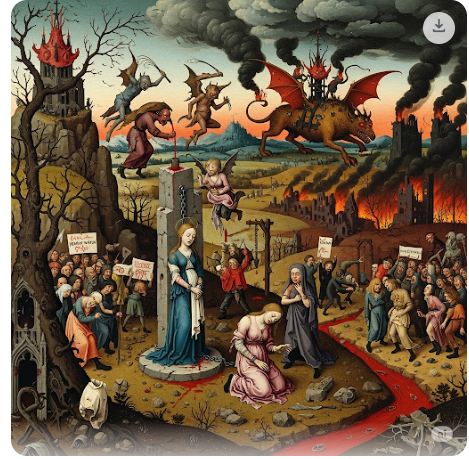
Today, the prophetic flames feel all too literal. As the heat rises—both climatically and politically—Israel burns with internal unrest. Protests rage. People are exhausted. Democracy is under threat.
As Isaiah warns: “The two shall burn together, with none to quench them” (Isaiah 1:31). The prophetic warning resonates: Israel is being destroyed not by foreign invaders but by its own leaders. This week’s haftarah from Isaiah could be read as a commentary on our current government: Our rulers are rogues and cronies of thieves.
JEW VS. JEW
The Talmudic story of Kamtza and Bar Kamtza (Gittin 55b–56a) tells how baseless hatred—sinat chinam— among Jews triggered Rome’s invasion. A private insult escalated to imperial war. Today we see a leader of a democratic country who is retaliating against organizations, former presidents, nations, acting out in vengeance for perceived earlier insults.
STARVATION THEN AND NOW
On Tisha B’Av, we fast voluntarily. But during the siege on Jerusalem, people starved, so much so that women ate their own children:
My eyes are spent with tears, my heart is in tumult, my being melts away Over the ruin of my poor people, as babes and sucklings languish in the squares of the city. They keep asking their mothers, “Where is bread and wine?” As they languish like battle-wounded in the squares of the town, as their life runs out in their mothers’ bosoms (Lamentations 2:11-12).
Arise, cry out in the night at the beginning of the watches, Pour out your heart like water in the presence of the Lord! Lift up your hands to Him For the life of your infants, who faint for hunger at every street corner, See, O Lord, and behold, to whom You have done this! Alas, women eat their own fruit, their new-born babes! Alas, priest and prophet are slain In the Sanctuary of the Lord! Prostrate in the streets lie Both young and old. My maidens and youths Are fallen by the sword; You slew them on Your day of wrath, You slaughtered without pity (Lamentations 2:19-21).
Chapter two of Lamentations serves as a criticism of God who allowed things to go so far; who in His wrath allowed His people to suffer. It is chilling that during the nine days before Tisha b’av reports from Gaza suggest famine is real. And these reports are finally penetrating into Israel’s consciousness. Prime Minister Netanyahu convened a cabinet to authorize food aid. Helicopters dropped supplies. A photo-op? A desperate attempt to salvage appearances? Marit ayin—what will the goyim say? Does he care about the “others”? I don’t know. But the world is watching. As the opening of Lamentations writes:
Jerusalem has committed a sin, therefore she has become a pariah. All who honored her demean her because they have seen her nakedness. She, too, sighed and turned back” (Lamentations 1:8).
The Midrash comments on this:
“Jerusalem has committed a sin.” Do the nations of the world not sin? Rather, even though they sin, it is nothing. However, Israel sinned and was punished. “Therefore she has become a pariah [lenida],” she has become itinerant. “All who honored her demean her because they have seen her nakedness. She, too, sighed and turned back,” back from the priesthood, back from kingship (Eikhah Rabbah 1:35).
The image of Jews starving others—especially on Tisha B’Av—is morally unbearable. Precisely because we suffered in the past, we have a moral obligation not to inflict suffering on others. Empathy is not optional. Those who rule us, are in bed with religious extremists. We are slouching toward theocracy and must beware of the zealots among us. As W. B. Yeats wrote in The Second Coming (1919):
Things fall apart; the centre cannot hold; Mere anarchy is loosed upon the world… The ceremony of innocence is drowned; The best lack all conviction, while the worst Are full of passionate intensity… And what rough beast, its hour come round at last, Slouches towards Bethlehem to be born?
Shabbat Shalom, and for those who start fasting Saturday night—may your fasting be easy and meaningful. May we find the strength to grieve—but also to hope for change.
Related Topics
Related Posts