

Passing on the Family Story
September is here again. The Yamim Nora’im always stir memories, of times and of people.
When school started up again one year ago, the older of our two Israeli grandchildren was entering 6th grade. Grandparents got an invitation to a dozen or so Wednesday morning sessions through the school year. Sabas and Savtas would meet with grandkids, and learn together.
I thought we might be learning Chumash and Rashi, but the aim was otherwise. Along with other elementary schools, this one, an all-boys school, had worked for years to craft a curriculum to help elders convey their generation’s story to the youngsters. They called the program Kesher Rav-Dori, Multi-Generational Connection.
I was intrigued, but skeptical. English speakers turn to friends and say, “Now that’s a story to tell your grandchildren!” This is a pleasant thought, though it assumes that your grandchildren will be listening.
**********
The teacher began by sharing techniques for effective storytelling: vivid descriptions of time and place, and so on. Then there were exercises, generations working together.
One was a circle game, similar to Musical Chairs. They called it Hageshem yored al…, the Rain Falls on…
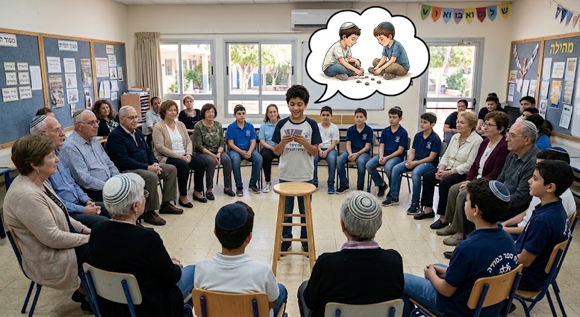
All of us sat in a circle. One child stood in the middle, holding a pile of small cards. He read the top card: Hageshem yored al, the rain falls on…anyone who played kaduregel! (Football, soccer to Americans.) Music plays. Everyone who has played kaduregel jumps up and finds an open seat. When the music stops, the child who can’t find a seat is the next reader.
I stayed put, of course, never having played kaduregel.
The next instruction, spoken Israeli-style (fast and mumbly) was: The Rain Falls on…anyone who played 5 Stones!
I stayed put again, having no idea what 5 Stones was.
The purpose of this exercise was to bond the generations: kids remembering playing Five Stones—just like Saba did when he was a kid! But my grandson’s Saba came from elsewhere. So instead of bonding over similarity, perhaps we could puzzle over difference.
Another exercise on another day: Each grandparent was asked to sit for half an hour with their grandson. We were asked to throw dice to choose questions from a grid listing types of childhood recollections.
One throw: My grandson asked, “How did you stay in touch with relatives who lived far away?”
“By telephone,” I said.
My grandson asked, “Were there telephones then?”
OK, he was fuzzy about whether I preceded or followed Alexander Graham Bell. But my own memory was just wrong. I later recalled that when I was a kid, long-distance calls were costly and reserved for brief, urgent exchanges. People stayed in touch by writing letters. Written longhand.
Getting your story across can be tricky. You make mistakes. When will you correct them? Will anyone be listening when you do?
Last exercise: We all sat before a screen on which the teacher showed images of old objects you might once have seen. Who remembers them?
One classmate of my grandson recalled several. “I saw that at Savta’s,” he said.
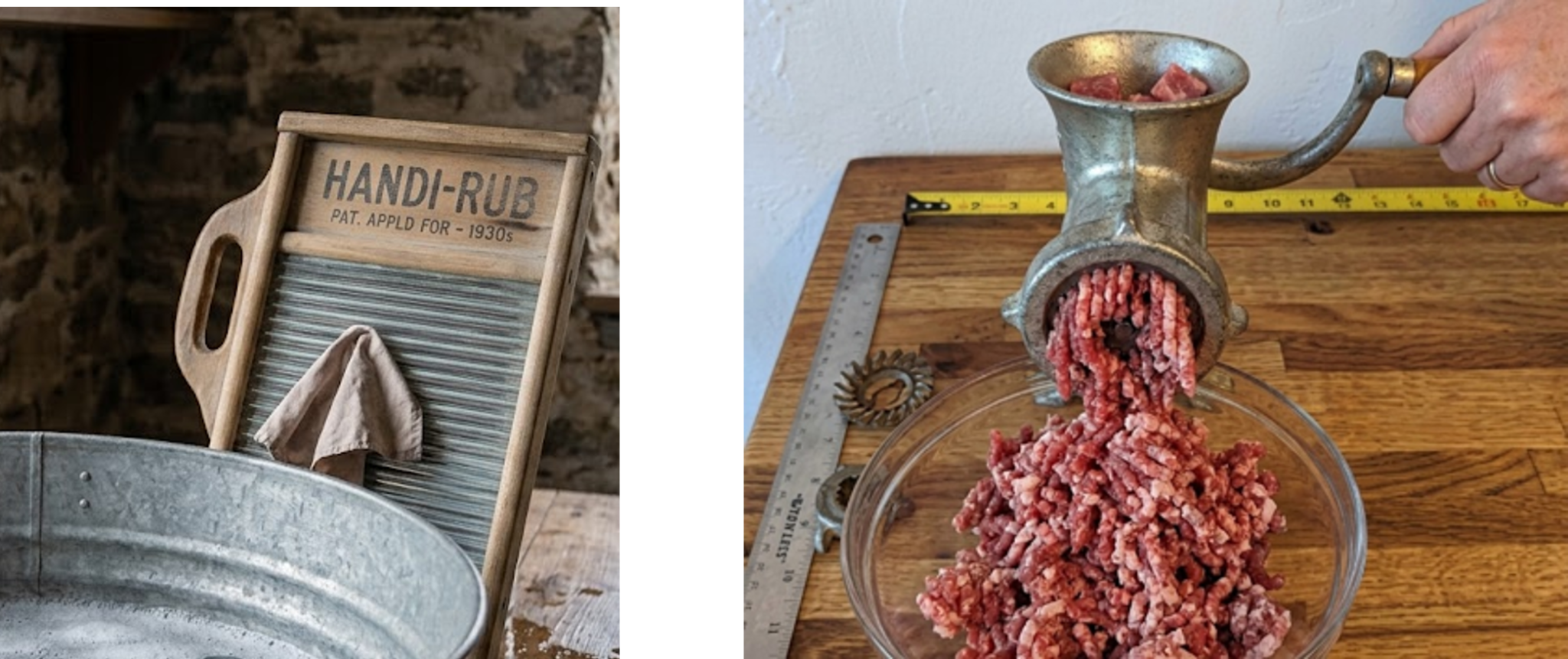
I recognized just two, a washboard and a hand-held meat grinder like the ones my Bubba used at home:
The next slide showed this:
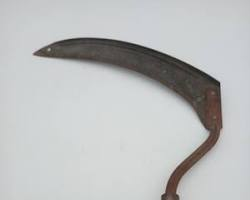
The Israeli boy knew it at once. But he had an advantage: I did not have a forebear who farmed on a kibbutz in the 1930’s.
**********
Immigrants are from elsewhere. They speak and dress differently. They also have different memories. Some differences are not in details but in kind.
One day the teacher had each pair of generations sit by themselves. Saba or Savta would tell a story. Then they would share it with the group.
I told him a story about my father. He was a Rabbi and a chazzan, but also a virtuoso shofar-blower. Each Rosh Hashana he would dazzle the kids in shul with his impossibly-long tekiah-gedolahs. His record was 26 seconds! My grandson was somewhat impressed.
When we all got together, the teacher called on me to start. I told the group that I was born in the state of Pennsylvania, where my father had gotten a job as Rabbi. I shared his shofar prowess. The other grandparents smiled.
The Savta who came next told of her family in Hungary, near Budapest. When the Nazis came to take them away in 1944, two brothers buried the family silver—candlesticks, kiddush cups—in their garden. The ones who survived came back after the war and retrieved them.
The next Saba grew up in Algeria to French parents. When the French left Algeria in 1962, the family returned to Alsace, near Strasbourg, where the family had come from.
The Savta after that came from a town in Iran I had not heard of. Her family were silversmiths. They crafted and inscribed special goblets for each couple in the family when they got married. Her family brought some of these to bestow on future brides and grooms.
As the stories went on, the teacher exclaimed, “Kibbutz galuyot!” Ingathering of the Exiles. She was right: these stories illustrated from how far afield Israel has gathered the Jews who live here.
But that is not all they illustrate. They also show how many people have come here from a background of violence, displacement, expulsion, and death. What is an 11-year-old Israeli boy to make of that? He was born here, into a different Jewish reality.
For that matter, what is this Saba to make of it? I was born in Pennsylvania, because that is where my father got a job. How charmingly banal. I thought mine was a normal Jewish story. Why wouldn’t I? It was the Jewish story I knew.
**********
At the end of the Kesher Rav-Dori program, the teacher asked that we review the tale we wrote with our grandsons, and add המסר שלי לדור הבא והעצות לחיים שאני מעניק לנכדי, My message to the next generation and the life advice I give my grandchildren.
The idea that you can pass on concise life lessons to a later generation is pleasant, and flattering. Ramban wrote a famous ethical will to his son that is still read and studied. But I am not Ramban.
As part of our final sessions, my grandson and I met by ourselves for 45 minutes. I told my story. He took notes and asked a few questions.
Images are easier to recall than adages. I will remember these talks, even if I cannot recall what we said. Perhaps he too will retain an image of what we looked like as we talked. What he thinks his grandfather stood for and wished to convey is something he may choose at some point in his life to work out for himself, as each of us must when we think of our forebears and decide to make the effort.