Grammy and Emmy nominated singer-songwriter, author, essayist
Peace Talks With My Mom
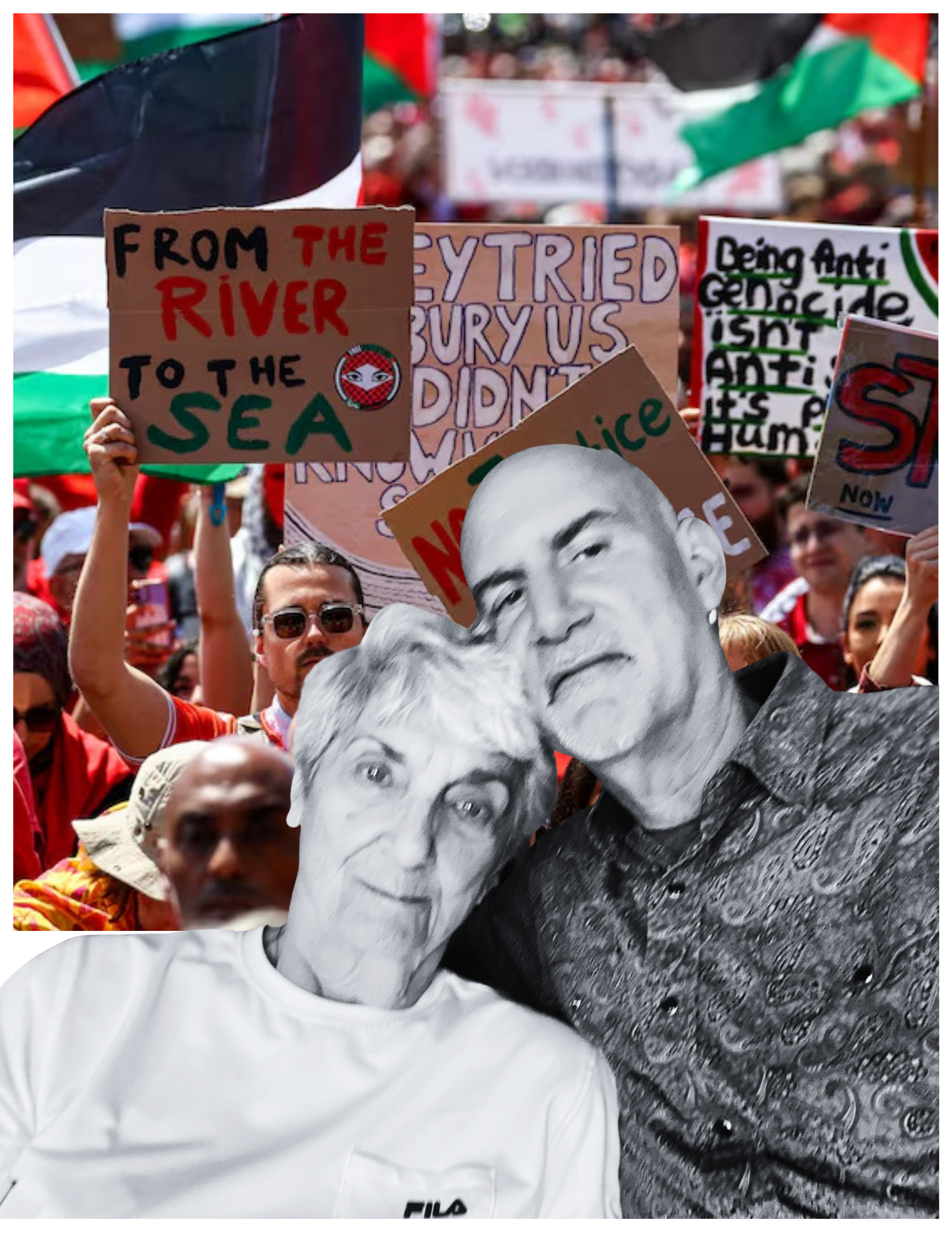
Collage by the author
I was with my mom outside her house in suburban Minnetonka on a porch overlooking a water feature, a small formation of rocks that made up a miniature waterfall. We sat there on metal lawn chairs, listened to the water pour over the flat stones and looked out at the preternatural greenness of the golf course. My mom remarked on the old-growth oaks that broke the monotony of the grass. She is 93, still quite beautiful and very astute. The two of us picked up a conversation we’d begun earlier.
I had just read her an essay I’d written about Israel. These days I’ve been writing a great deal about the place and the people, about the way Israel is spoken of, and the way Jews are being looked at. When I finished reading, she looked at me with an intensity she hadn’t had until then.
“Where is this going to end?” she asked. “The fighting and the back and forth. Where does it end? You don’t mention any solution.”
She was right. I hadn’t mentioned one.
“I don’t know,” I said. “I don’t think anybody knows.”
There is no grand solution sitting somewhere waiting for the right politician to discover it. I don’t think this ends because of a committee, a new UN resolution. I don’t think it ends with a new prime minister or another proposal drafted and redrafted. I have, unfortunately, come to think of this as an intractable problem. I used the word intractable, and I thought I saw my mom wince.
“Well, how is it going to end?” she asked again.
“How do you think it’s going to end?”
She looked out toward the little waterfall. We both listened to the sound.
“I don’t know.”
The absence of an answer, at least a logical one, hung in motionless summer air. Nobody knows.
I’ve been thinking about this on two different planes. One is intensely practical. What is the best way to prevent death? What can be done now? What policies make sense given the world as it actually exists? Those are questions the human mind can attempt to answer, and those are the questions I write about most often. The other plane exists in the realm of faith.
A Jew is bidden to pray three times a day, and throughout those prayers one encounters the word shalom. Most people know shalom as the Hebrew word for peace. It’s true. But what is peace? The root of shalom is shalem. Wholeness. Completeness. A state in which the fractured parts of the world are seen as belonging to a single whole.
All these words stumble.
Somehow, bound up in that idea for me, is the possibility that all human beings will one day, at the same time, come to perceive that oneness, feel themselves to be part of it. Feel it viscerally. Feel it as we feel heat or cold, sorrow or joy.
I told my mom this. Told her that I believe, or perhaps aspire to believe, that there will come a time when all of humankind understands this at the same moment. She looked at me as she often does when the younger of her two sons begins to resemble a crazy person.
“You don’t actually believe this do you?”
I tried to explain. Shalom isn’t an idea. Ideas are easy. They come a dozen at a time. We can agree with an idea and still hate somebody. I mean something deeply felt, something that changes the state of mind itself.
My mom rolled her eyes.
Think about holding your new baby for the first time. There’s a state of mind that comes over you. For that flicker of a moment, you aren’t thinking about which new car to buy. You aren’t thinking about what your annoying neighbor said to you yesterday. You aren’t rehearsing some argument or nursing an old grievance. You’re holding this tiny human being and you’re filled with wonder.
Something similar happens when someone we love passes from the world. Here too, the ordinary state of mind is interrupted. For a time, we are lifted out of our normal concerns. The little things that irritate us last lose their importance. We not only see something larger, we become larger. These moments seem to me like homeopathic doses of shalem. They are gifts, hints of what could be, perhaps even of what one day will be.
I experience this in music as well. A sound can suddenly remove the little prisons we spend so much of our lives building around ourselves. For a few seconds the world is actually different. We are different. What would happen if that state of mind came upon all of humankind at one time?
I don’t know what could cause such a thing. A song, perhaps. A strand of words in a certain order, one that has never been heard before. Something beyond anything we have experienced or are presently capable of imagining. This is where my practical mind has nothing useful to say.
Tomorrow there will still be governments and armies. You’ll hear about negotiations and accusations and terrible decisions on CNN. There will be people who want to murder other people, and there will be people who need to prevent them from doing so.
I will continue to write about Israel and my people and the strange and often disturbing way Jews are being looked at in the world. I will keep on arguing for what I believe is true. These things matter to me, but they aren’t the entirety of how I see the world.
Three times a day I encounter the word shalom. I am reminded of shalem, of wholeness, of the possibility that everything we experience as separate might somehow belong to a unity we cannot presently perceive.
I don’t know how the fighting ends. I couldn’t tell my mom. I can’t tell anyone. But sitting beside her on those metal lawn chairs, looking out at that little waterfall, I realized, with no small measure of gratitude, that somewhere inside me there remains a glimmer of hope for shalem. For a rupture in the flow of time when the oneness of things is deeply felt by all of humankind. Like a lightning strike. One everybody sees, marvels at.
It doesn’t exist in the pages of The New York Times or on Joe Rogan’s podcast. I can’t defend it with statistics. I can’t draw a map of how we get there. Still, I pray for it. Still, I endeavor to believe.
I’m not sure, but somewhere, deep down, I think my mom does too. I am her son, after all.
Related Topics
Related Posts