
Pernkopf’s Anatomy Atlas and Its Controversial Medical Legacy
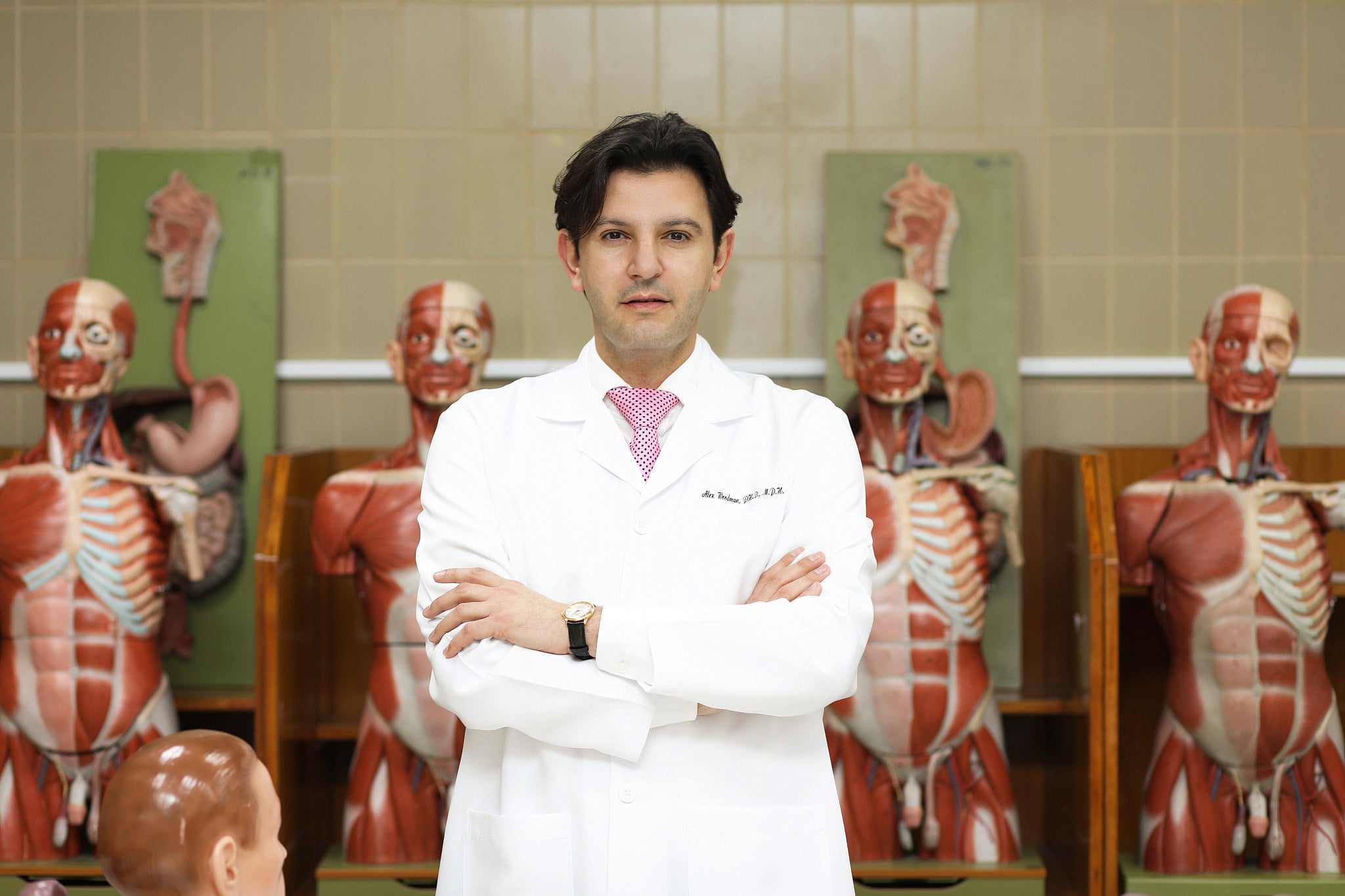
LOS ANGELES, CA, UNITED STATES – Back in undergraduate, when I was studying anatomy and physiology in Los Angeles, California, I never really questioned where the images I was using came from. In a way, I took them for granted, since they were considered to be the best examples of anatomical drawings in the world. They were richer in detail and more vivid in color than any others. Skin, muscle, tendons, nerves, organs, and bone were revealed in graphic detail, and my focus was simply on learning and memorizing. At that time, I did not know that in 1939, under Nazi Germany, a law ensured that the bodies of executed prisoners were immediately sent to anatomy departments for research and teaching purposes.
As I progressed with my education, I began to realize that these images were not just scientific tools, but products of a specific historical and ethical context. Learning about Eduard Pernkopf and the origins of Pernkopf’s Atlas: Topographical Anatomy of Man forced me to rethink my earlier assumptions. What I once saw as purely educational material became something much more complex raising questions about responsibility, memory, and the cost at which knowledge is sometimes obtained.
Given the impact of the Holocaust on healthcare throughout the 20th and 21st centuries, the question of where the middle ground lies between emotional and rational choices of health care professionals and educators becomes even more pressing when we turn to Eduard Pernkopf’s “The Atlas of Topographical and Applied Human Anatomy,” often referred to as “The Pernkopf Atlas” or “The Atlas.”
Created at the University of Vienna, a leading anatomical institute with one of the world’s finest medical faculties, this book has become a truly unique contribution to global medicine. Its watercolor illustrations were of the highest quality. Combined with the quality of the paintings, the superior four-color printing technology allowed for the creation of illustrations of unrivaled reproduction quality for the teaching and study of human anatomy. Yet, The Atlas is considered the subject of ethical debate among doctors, lawyers, ethicists, members of the public and political circles for the past decades. Although The Atlas is considered the pinnacle of color anatomical illustration of the human body, in the 1990s it was discovered that Holocaust victims’ bodies were likely used for the drawings.
The main question that generates controversy is whether this atlas should be used by medical and surgical students, as well as physicians after this discovery. Many medical schools and institutions around the world consider this book to be contrary to medical ethics standards and humane morale as such. There are also those who have been using this book as a comprehensive reference for their medical practice, without knowing its origin. For example, Dr. Susan Mackinnon, a surgery professor at Washington University School of Medicine in St. Louis known as a pioneer in nerve regeneration.
“The atlas became my dissection partner during the many long hours spent in the anatomy laboratory at Johns Hopkins Hospital and later at the University of Toronto. Once I came to know the truth of its origin, my attitude changed. However, having already spent many years with the atlas, still the most detailed anatomy book I’ve ever seen, I continued to feel the need to refer to it occasionally for the sake of improving my patients’ surgical outcomes,” states Dr. Susan Mackinnon (2020).
While delving into the scientific literature and examining perceptions of this book, I came across a study by Yee et al. (2019), who conducted a survey among members of the American Peripheral Nerve Society and PASSIO Education (a video learning platform). The survey provided historical information about the origins of The Atlas and asked 182 respondents whether they would use it. Findings showed that 59% of respondents were aware of the Pernkopf Atlas, with 13% currently using it. Aware of the historical facts, 69% felt comfortable using the book, 15% felt uncomfortable, and 17% were undecided. Additional information about the atlas’s ethical use conditions led to 76% of respondents who had previously felt uncomfortable and undecided feeling comfortable using it. The authors suggested that although the use of The Atlas remains controversial, a proposal detailing the conditions for an ethical approach to its use provides new guidance in surgical planning and education.
The Untermann Protocol was incorporated into the Vienna Protocol in 2017 as an ethical guideline requiring that the history be known before using The Atlas. The Protocol states: “the dead are accorded at least some of the dignity to which they are entitled.” It was further suggested that this can be achieved by including at the beginning of each book an information letter about the possible source of the illustrations and the fact that the ethical responsibility for deciding whether and how to use a particular work rests with the user.
Upon further research, I came across an interview with Michael Alan Grodin, who reflected on whether doctors should learn lessons from Nazi medical research on Holocaust victims, with a particular focus on the work of Eduard Pernkopf. Professor Grodin believed that if this issue is considered from the perspective of Jewish law, then this is where the discussion about saving life arises. “You cannot take one life to save another. Life is sacred and created in God’s image. With respect to the Pernkopf atlas, if it can be used to save a life, that takes precedence over almost anything.” (Michael Alan Grodin, 2019).
Returning to my original question about the balance between emotional and rational choices in teaching medicine and bioethics, as well as in patient care, it is clear that physicians, students, and health care professionals consider this book a revolutionary breakthrough in saving patients’ lives. However, it is also clear that even if the ethical standards set out in the Untermann Protocol are followed, some health care professionals will feel uncomfortable and consider it unethical to open the pages of this book, even if those pages save the lives of people living today.
In closing, hearing only from medical professionals is not enough. I am also interested in hearing the thoughts and perspectives of Holocaust survivors, whose voices are essential to understanding the full weight of this issue.
Further reading
Amadio, P. C. (1996). Reaffirming the importance of dissection. Clinical Anatomy (New York, NY), 9(2), 136-137.
Atlas M. C. (2001). Ethics and access to teaching materials in the medical library: the case of the Pernkopf atlas. Bulletin of the Medical Library Association, 89(1), 51–58.
Boston University (2019). Should Doctors Learn from Nazi Medical Research on Holocaust Victims? BU Today. https://www.bu.edu/articles/2019/learn-from-nazi-medical-research/
Lax L. (2021). Towards Informed Use of the Pernkopf Atlas. The Journal of biocommunication, 45(1), E15. https://doi.org/10.5210/jbc.v45i1.10851
Mackinnon, S. E. (2020). When medical information comes from Nazi atrocities. BMJ, 368. https://doi.org/10.1136/bmj.l7075
Rubenfeld, S. (2010). Medicine after the Holocaust: from the master race to the human genome and beyond. Springer.
Scheinfeld, L., Saragossi, J., & Kasten-Mutkus, K. (2020). A Reconsideration of Library Treatment of Ethically Questionable Medical Texts: The Case of The Pernkopf Atlas of Anatomy. Library Resources & Technical Services, 64(4), 165-176.
Yee, A., Coombs, D. M., Hildebrandt, S., Seidelman, W. E., Coer, J. H., & Mackinnon, S. E. (2021). Nerve Surgeons’ Assessment of the Role of Eduard Pernkopf’s Atlas of Topographic and Applied Human Anatomy in Surgical Practice. The Journal of biocommunication, 45(1), E7. https://doi.org/10.5210/jbc.v45i1.10823