Perpetrators, Art Custody, and Breaking Silence
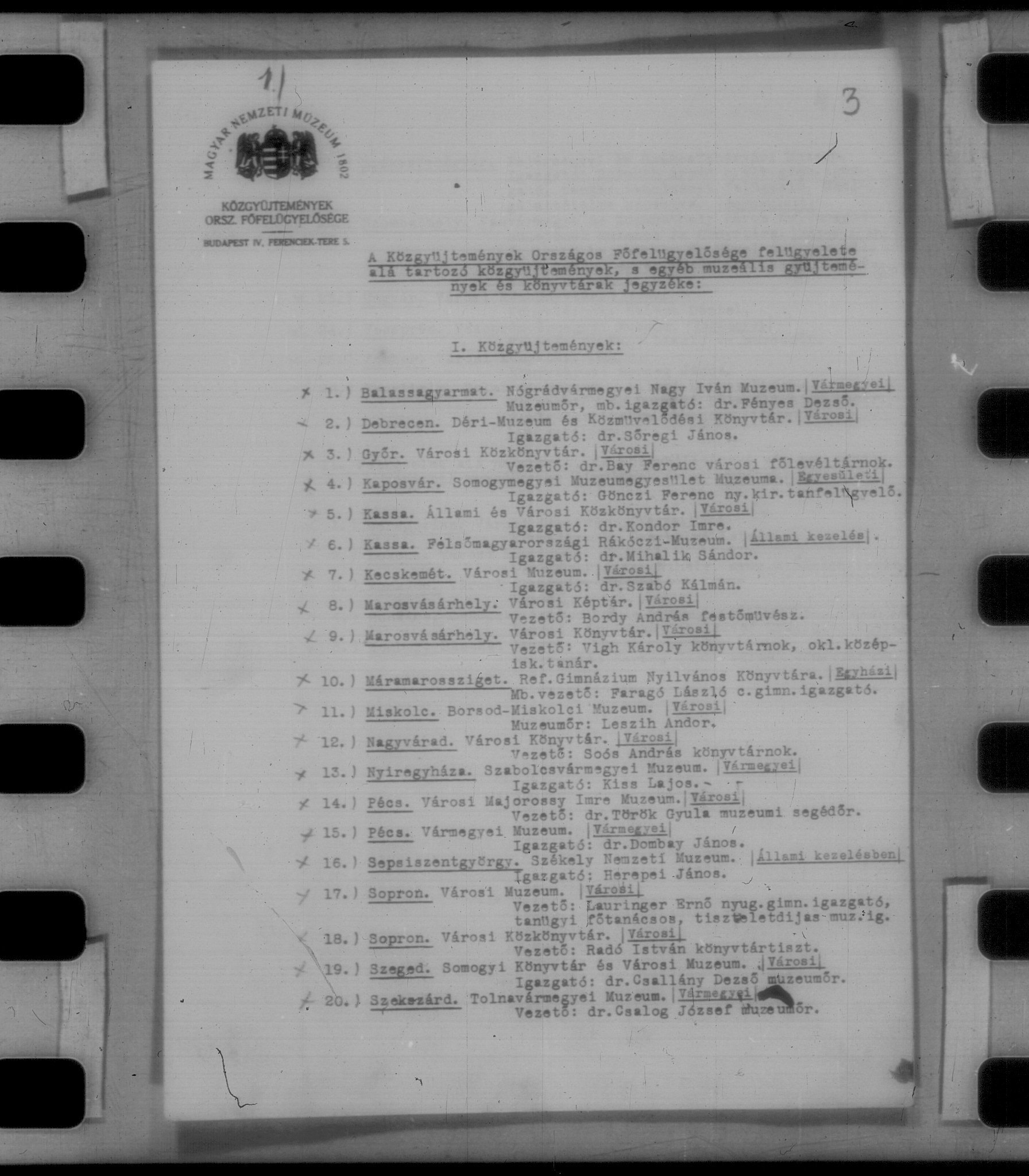
This is Part 2 of the Holocaust Art Recovery Initiative’s Expert Report, exposing Holocaust-era art theft in Hungary, based on newly digitized archival records. Read Part I here.
Institutions Complicit in Receiving and Holding Looted Assets
Over two dozen Hungarian cultural institutions are identified in the 1944 records as recipients or custodians of looted Jewish property. This included nearly every major state museum, as well as libraries and even archives in wartime Hungary. Each played a role – some central, some peripheral – in the handling of stolen art and valuables. The following profiles highlight the key institutions and their documented involvement:
Magyar Nemzeti Múzeum (Hungarian National Museum) – Budapest: The National Museum was a primary repository for looted art, books, and antiquities. Archival references (Reel 143 and 145) show it was first on the list of designated institutions. It received shipments from across the country. A receipt on Reel 145, Slide 485 confirms the museum permanently catalogued confiscated artworks and furniture into its collection ledgers. The National Museum effectively became the central warehouse of plundered heritage in 1944.
Szépművészeti Múzeum (Museum of Fine Arts) – Budapest: Hungary’s premier art museum took in the most valuable paintings and sculptures. It is documented as receiving the Herzog and Sváb collections in late 1944. Lists on Reel 145, Slides 471–530 detail these transfers, with museum officials signing off. The museum assigned its own accession numbers to these works, obscuring their provenance. Postwar, the Museum of Fine Arts continued holding many of these pieces (some even displayed, others hidden). The archives now expose that the museum’s curatorial staff knowingly integrated stolen art.
Országos Széchényi Könyvtár (National Széchényi Library) – Budapest: Hungary’s national library. It is recorded as receiving the Knorr family’s 9,000-volume library (and likely other book collections). Reel 143, Slides 41–45 show Director Pitz József evaluating the Knorr books and coordinating their transfer. The library kept these confiscated books without returning them.
Déri Múzeum – Debrecen – A major provincial museum (in Debrecen, eastern Hungary). It functioned as a regional depot for looted art. Documents (Reel 143) indicate the Déri Museum actively requested authority to take control of seized assets in its region. Director Dr. Sőregi János is noted in correspondence related to this. The museum inventoried items locally (Reel 145, Slides 1–10 contain some of its records) and forwarded high-value pieces.
Baja Városi Múzeum (Baja Municipal Museum) – Baja: A city museum in southern Hungary. It “handled local seizures” – notably the string of confiscations in Baja in June–August 1944. Reel 145, Slides 531–566 are pages from Baja Museum’s inventory book, signed by its personnel (e.g. Mikolay Ferenc) documenting the contents of Jewish homes. The Baja Museum prepared these items for state custody; some were later sent to Budapest.
Nógrád Vármegyei Múzeum – Balassagyarmat: A county museum in northern Hungary. It received looted property from its area. Notably led by Dr. Fényes Dezső, who appears in the archives as having retained assets (Reel 143, Slide 91 mentions him).
Somogy Vármegyei Múzeum – Kaposvár: A county museum in Kaposvár (southwest Hungary). It is implicated in receiving assets as well. Some “cataloged items” from looted collections are noted on Reel 145, Slides 1–10 related to this museum. Likely it took custody of items from local Jewish communities (e.g. Kaposvár, Nagykanizsa region).
Székely Nemzeti Múzeum – Sepsiszentgyörgy: An ethnographic museum in then-Hungarian Transylvania (today Sfântu Gheorghe, Romania). It appears on the master list (Reel 143, Slide 4) as slated to receive loot. This indicates even museums outside today’s Hungary (but then under Hungarian administration) were in on the scheme.
Somogyi Könyvtár és Városi Múzeum – Szeged: In Szeged (south Hungary), the Somogyi Library and city museum together handled seized cultural assets. The archives mention them cataloging “Class IV paintings” (likely a bureaucratic category for confiscated art) on Reel 145, Slides 1–10. Director Dr. Gaál László of Szeged is known to have coordinated these efforts (from external sources). They essentially absorbed local Jewish collections into the city’s library/museum system.
Fejér Vármegyei Múzeum – Székesfehérvár: County museum of Székesfehérvár. It received assets as directed by the ministry. The director, Dormuth Árpád, is referenced in a report (Reel 143, Slide 5) about taking in looted items.
Vas Vármegyei Múzeum – Szombathely: Museum in Szombathely, listed on the master chart (Reel 143, Slide 5) as well. It’s noted as having received property, with evidence in the “master list” document.
Veszprém Városi Múzeum – Veszprém: City museum in Veszprém, also on the master list. The archives indicate it cataloged items (Reel 143, Slide 5) from local seizures.
Bácskai Múzeum – Zombor (Sombor): Museum in Zombor (today Sombor, Serbia). Handled seizures in Bácska region. Director Herceg János is mentioned (Reel 143, Slide 5) in connection with these activities.
Balatoni Múzeum – Keszthely: Museum in Keszthely (western Hungary). It received looted assets, directed by Dormay Béla per archival note.
Győr Városi Könyvtár (City Library of Győr): The city library in Győr is named on the list as well. It was implicated in holding confiscated books (Reel 143, Slide 5).
Sopron Városi Múzeum – Sopron: City museum of Sopron (west Hungary), which received looted assets and cataloged them (Reel 143, Slide 5). Sopron’s case is notable: local librarians like István Radó actually protested the mishandling of seized books, urging proper safekeeping. Despite this, the museum took control of the property.
Szabadka Városi Múzeum és Könyvtár – Subotica: City museum & library of Subotica (Szabadka, then Hungary, now Serbia) handled seized property (Reel 143, Slide 5).
Ungvár Városi Könyvtár – Uzhhorod: City library of Uzhhorod (Ungvár, then in Hungary’s annexed Carpathian region, now Ukraine) also listed as receiving assets (Reel 143, Slide 5).
Lehoczky Múzeum – Munkács: Museum in Munkács (Mukachevo, then Hungary, now Ukraine). On Reel 145, Slides 1–10, it’s noted as having received looted property via regional transfers.
Tata Múzeum – Tata: A small museum in Tata (northwest Hungary). Mentioned as a temporary storage site for looted items – a 1944 memo by Magyary Zoltán notes valuables being held at Tata Museum to protect them from bombing or theft. (Reel 145, Slides 561–564 document this).
Each of these institutions either stored, cataloged, or ultimately retained the stolen property. The Institutions Registry (Appendix C) provides a full list of all identified institutions (over 25 in total) and the archival citations confirming their roles. The big picture is clear: Hungary’s cultural sector was an active partner in the despoliation of the Jews. Museums and libraries proactively sought and kept the looted treasures.
Spotlight on Dr. Dénes Csánky: Architect of the Looting – and Aftermath
No single individual is more central to this story than Dr. Dénes Csánky. He was the high-ranking official who led Hungary’s Museum Department (Ministry of Education) during WWII and served as the de facto “art theft czar” orchestrating the looting operation. The archival reels contain dozens of references to Csánky – his name, signature, or directives – at critical junctures of the plunder. He emerges as a complex figure: an art historian by training, a bureaucrat by profession, and an unpunished war criminal by consequence.
Wartime Role: Born in 1885, Dénes Csánky was an established art expert (ironically, also a painter) who by 1944 had risen to be Head of the Museums Department of the Ministry of Religion and Education. In this capacity, he was appointed Government Commissioner for (Jewish) Art Collections. The evidence confirms Csánky’s direct oversight of the entire process: he gave orders for inventorying, he corresponded with museum directors about receiving shipments, and he ensured that prized collections (Herzog, Hatvany, etc.) were secured for the state. For example, Reel 143, Slides 66–70 include communications bearing Csánky’s name where he instructs that Jewish-owned art in provincial areas be gathered and sent to Budapest institutions. On Reel 143, Slide 4 (the master institution list) and many subsequent memos, Csánky’s official seal and signature appear, authorizing the redistribution of looted cultural assets. In short, Csánky was not a passive functionary – he was the mastermind who coordinated museum and ministry efforts to appropriate Jewish collections. One contemporary document even described him as “the moving spirit” behind the scenes of this cultural theft (as cited in secondary sources).
Notable Acts: Several archival case studies highlight Csánky’s personal involvement:
- He oversaw the packing and transfer of Baron Hatvany’s paintings to the National Museum (as noted on Reel 145, Slide 351).
- Inventory lists on Slides 393–395 show methodical logging of dozens of looted artworks (Cranach, Courbet, Utrillo, etc.), which were executed under Csánky’s department’s supervision. These were not routine museum accessions; they were confiscation inventories and Csánky’s team compiled them.
- A critical memo on Reel 143, Slides 66–70 details a meeting of officials where over 20 institutions (museums, libraries, archives across the country) were assigned specific looted collections; Csánky led this coordination. This shows he built the network that enabled nationwide plunder.
- Correspondence from museum staff (e.g. Varju Domokos at the Fine Arts Museum) back to Csánky report on the receipt of collections like the Herzog paintings – again indicating that everyone down the chain acknowledged his authority.
Csánky did not merely facilitate – he directed the art looting program.
Postwar Escape and “Invisible” Life: Csánky’s career continued undisturbed after 1945. As communist Hungary formed, Csánky – who had been a civil servant – managed to avoid prosecution or public scrutiny. By the late 1940s, with the political climate shifting, Csánky quietly fled Hungary. Detective work online shows that in 1949 he escaped to São Paulo, Brazil. There, he lived out the remainder of his life in comfortable anonymity, dying in 1972. He was never held accountable for orchestrating the theft of thousands of artworks. He effectively escaped justice, with his ill-gotten gains to be further investigated, one of many fascist-era figures who found refuge in South America.
Bizarre Legacy: Perhaps the cruelest twist is what became of Csánky’s own reputation. Far from being remembered as a perpetrator, today Csánky is still honored in Hungarian cultural circles – as an artist. He was a painter of animals in his spare time, and incredibly, the Hungarian National Gallery’s official website lists Dénes Csánky as a featured artist, with his paintings (e.g. watercolor sketches of birds and deer) in their collection. There is no mention on those sites of his role in wartime looting; he is presented simply as an artist and museum director. Some of Csánky’s mundane artworks are shown in the very museums that benefited from his crimes, possibly even alongside unrestituted masterpieces he stole. This situation is an outrage and a glaring example of the historical amnesia that HARI seeks to rectify.
Dr. Dénes Csánky represents the intersection of culture and crime: a man who used his scholarly authority to carry out cultural genocide. Publicly naming Csánky’s actions is long overdue, and it underscores why transparency from institutions is necessary. (Indeed, we call upon the National Gallery and other institutions to prominently acknowledge Csánky’s dark role, rather than simply showcasing his art.) Csánky’s story also demonstrates how easily key figures avoided reckoning – something we aim to change.
Official letter dated 1 December 1944 from Dr. Lajos Nemes-Nagy (Office of the Museum Commissioner) to Dr. Dénes Csánky, acknowledging receipt of an inventory (in this case, of art objects from a Jewish estate). The letterhead and language illustrate the bureaucratic formality of the looting process – Csánky is addressed by title (“Government Commissioner”) and thanked for entrusting the local office with handling the seized collection. Such documents, stamped and signed, show Csánky’s central administrative role and how museum officials reported to him on the disposition of looted art.
Survivor Testimony and Discovery: Clara Garbon-Radnoti’s Pursuit of Truth
This entire body of evidence came to light thanks to the dedication of one Holocaust survivor: Clara Garbon-Radnoti. Clara’s personal history and her discovery provide crucial human context to the dry documents. She was a young woman in 1944, surviving the genocide that killed her family and obliterated her former life. Decades later, living in the United States, she made it her mission to uncover what happened to the culture that was stolen along with the lives.
The Discovery: At the Zekelman Holocaust Center in Farmington Hills, Michigan, Clara spent over ten years combing through obscure Hungarian microfilms on an old viewer tucked in a corner of the library. Many of these reels had sat untouched. In the late 2010s, her perseverance paid off – she identified Reels 143, 144, 145, which contained an astonishing trove of Hungarian government records from 1944. Realizing the significance, Clara worked with HARI to convince the Zekelman Holocaust Center and the US Holocaust Memorial Museum to get these reels digitized, so they could be further analyzed. It was Clara’s trained eye and lived experience that recognized these documents for what they were.
A Survivor’s Voice: Clara Garbon-Radnoti brings moral clarity to this project. In an interview reflecting on the archives she uncovered, Clara said: “They stole the soul of our culture. They didn’t just take objects. They took our memory.” Her words remind us that this was not mere property – is continues to be pieces of people’s lives and identity. Clara emphasized that the truth must be told now that it has been found, and her discovery has given survivors and heirs a renewed hope.
Clara’s Role in Restitution Efforts: Clara did not seek any personal gain; her goal was justice and memory. By bringing these documents forward, she has empowered legal and historical action. She worked closely with attorney Jonathan H. Schwartz (founder of HARI) over several years, with work accelerating in 2025, to analyze the data and prepare public reports. Clara’s knowledge of Hungarian, her familiarity with names and places from her youth, and her survivor’s empathy were invaluable in deciphering bureaucratic memos and recognizing the significance of entries.
Clara gave voice to the silenced – both the people who were killed and the culture that was stolen. Her involvement is a testament to the power of survivors in pursuing historical truth. The moral imperative driving HARI is crystallized in Clara’s story: She lost her home and family in the Holocaust, yet decades later she toiled to ensure that the cultural theft is not forgotten either. As we publish these findings, we honor Clara and all survivors by committing to pursue justice for the living and dignity for the dead.
Public Accountability: Breaking the Silence of Museums and Media
Despite the overwhelming evidence presented here, there has been a notable silence from major institutions and mainstream media. Silence is what allows injustices to fester. The Holocaust Art Recovery Initiative calls for a robust public response – but the reaction has been muted in several quarters:
Hungarian Museums and Authorities – Lack of Response: The very institutions implicated (the National Museum, Museum of Fine Arts, etc.) have not issued any public statements acknowledging these findings. There have been no announcements of provenance research initiatives, no offers to open archives, and no outreach to the Jewish community or heirs. Some of these museums continue to exhibit items (and even the works of Csánky) without any mention of their tainted history. This institutional reticence is unacceptable. We specifically call out the Hungarian National Gallery and other state museums to break their silence. The time for secrecy and denial is over – these museums must publicly acknowledge that their collections are partly built on plunder and commit to restorative action.
Official Denials and Legal Obstacles: The Hungarian government historically has denied possessing looted Jewish art, often dismissing claims by pointing to the communist era or lack of records. They have also used sovereign immunity in foreign courts to avoid restitution lawsuits. This obstructionism was exemplified in the recent U.S. Supreme Court case Republic of Hungary v Simon, where Hungary successfully argued that Holocaust survivors’ claims (for properties including artworks) were barred by immunity. Such positions are morally indefensible given the evidence of state complicity we now have. We urge the Hungarian government to reverse its stance, waive immunity in art restitution cases, and cooperate in resolving claims. Continued denial not only harms survivors and heirs – it stains Hungary’s own moral and cultural legacy.
Media Coverage – A Deafening Quiet: Outside of a handful of specialized outlets and Jewish community news in the U.S. and Hungary (i.e. Szombat), major media have largely ignored the uncovering of Hungary’s art looting archives. There has been no front-page coverage in leading international newspapers, no prime-time broadcast segments, and minimal reporting even in Hungary. Some articles and op-eds have appeared online (e.g., Times of Israel blogs, local Detroit-area press where HARI is based), but the absence of mainstream investigative reporting is striking. We call on journalists worldwide: shine a spotlight on this story. The theft of art from 1944 may seem like old news, but the implications today are profound – survivors’ families still await justice, museums around the globe may be harboring these items, and a major European nation’s institutions are implicated in war crimes. This deserves widespread attention.
Demanding Accountability: Public pressure is essential to break this inertia. We issue a clear call: Hungarian museums, government ministries, and cultural institutions must publicly acknowledge their role in this Holocaust-era looting and retention. They should commit to transparency (publish the lists of suspect items in their collections) and to good-faith negotiations for restitution or compensation. Moreover, international museum organizations and cultural bodies (ICOM, UNESCO, etc.) should press Hungary to adhere to the Washington Principles on Nazi-Confiscated Art (1998) – principles Hungary claims to endorse. Those principles call for opening archives and achieving “just and fair solutions” for victims.
The looting of art was not a victimless crime – it was an integral part of the Holocaust’s goal of erasing a people. As long as museums sit quietly on this stolen heritage, and as long as media and governments stay quiet, it’s as if that erasure is being allowed to continue symbolically. HARI will not allow this chapter to stay hidden. The world must hear Clara Garbon-Radnoti’s message: “They took our memory… now it’s time to give it back.”
Issued by: Holocaust Art Recovery Initiative (HARI) on July 30, 2025 – Publication for public record and legal advocacy.