

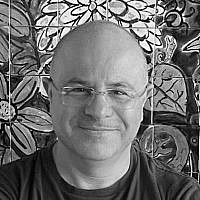
Péter Nádas, the Nobel Contender Who Saw a Jew in the Mirror
Péter Nádas died Wednesday morning, August 26, 2026, at his home in Gombosszeg, Hungary. He was 83, one of the giants of postwar European literature and a writer whose name had long appeared in speculation about the Nobel Prize.
I learned of his death three days after finishing the only one of his books ever translated into Hebrew.
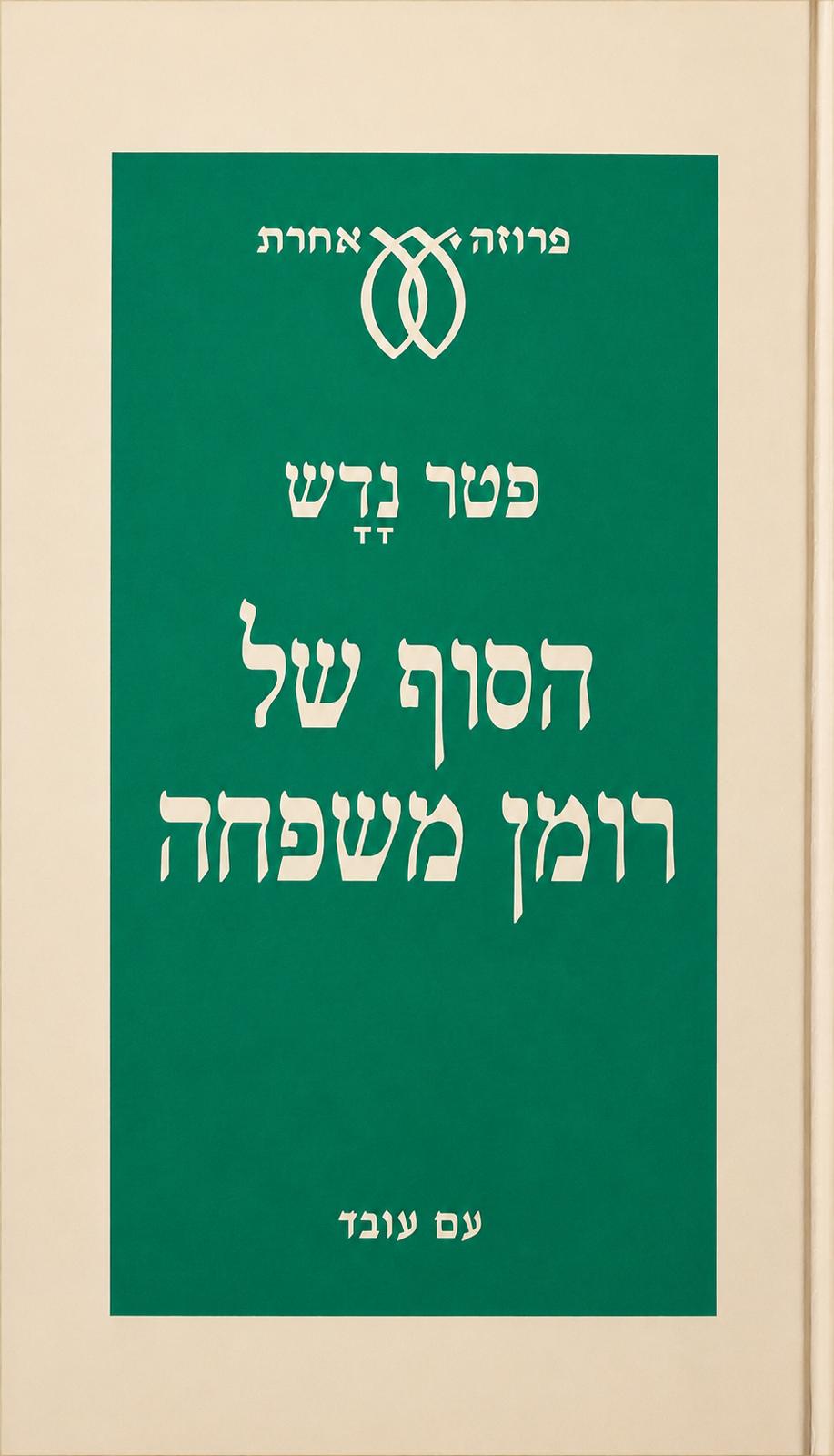
The coincidence felt unsettling. “The End of a Family Story,” published in Hungary in 1977, appeared in Hebrew in 2006, translated directly from Hungarian by David Tarbay and published by Am Oved. Despite the author’s enormous international reputation, it remains his only complete book available to Hebrew readers.
I struggled with it.
For much of the first part, I was not even certain that I liked it. The novel follows a boy growing up with his grandparents in Stalinist Hungary in the 1950s. His mother is dead. His father, caught in the murky world of the communist security apparatus, is mostly absent. The narrative moves through childhood games, memories, fantasies, and fragments of conversation without always telling us where reality ends, and imagination begins.
Some of it disturbed me. I disliked the children’s cruelty toward animals. I disliked the uncomfortable, sometimes brutal relationships among the children themselves. There were moments when I wondered why I was continuing.
But I did.
Gradually, I began to understand that the difficulty was not accidental. Something extraordinary was happening beneath the surface. I began to feel that I was holding a jewel whose beauty I had not yet learned how to see.
And then the book changed for me.
Or perhaps I finally understood what book I was reading.
Through his grandfather’s stories, the boy begins to discover where he comes from. The old man reaches backward through generations, mixing personal memory with biblical stories, Christianity, persecution, and the fate of Europe’s Jews. What had seemed like a strange and sometimes unpleasant childhood narrative suddenly opened onto something enormous.
Family history becomes Jewish history, and Jewish history becomes European history.
I could not stop reading. Three days later, its author was dead.
Perhaps this is an appropriate way for an Israeli reader to encounter Nádas, because his own origins seem to have confronted him in something like this fashion: indirectly, uncomfortably, and without asking permission.
Born in Budapest in 1942 to Jewish parents, he came into the world at one of the darkest moments in European history. His parents were communists. The family survived the Holocaust through hiding and false identities. After the war, he and his brother were baptized as Calvinists. Judaism was not the organizing principle of his childhood.
He later resisted attempts to make it the organizing principle of his identity.
“I am not Jewish,” he said in a 2007 interview. He explained that he opposed antisemitism and the Holocaust as a human being, not because membership in a particular group required him to do so.
It is an arresting declaration from a writer whose work returned so insistently to the world from which he came. But it reflected his resistance to collective identities claiming ownership over the individual. He distrusted nationalism, ideological certainty, and the proposition that ancestry should determine moral allegiance.
And yet the past kept returning.
His own ancestry led directly into one of the great arguments of modern Jewish life.
His great-grandfather, Mór Mezei, and Mór’s younger brother Ernő belonged to the remarkable world of emancipated Hungarian Jewry. They believed deeply in equality, citizenship, and Hungarian patriotism. Mór was a leading advocate of emancipation. Ernő became a member of parliament.
And Ernő argued with Theodor Herzl.
In 1903, Herzl wrote to Mezei that he would gladly concede Hungary’s Jews to Hungary if he could believe their patriotism would protect them from antisemitism. He did not believe it would. Antisemitism, Herzl warned, would eventually strike them with terrible force.
Four decades later, the community was devastated in the Holocaust.
Writing about that exchange more than a century afterward in “Illuminated Details,” Nádas offered a stark verdict: “And how right Tivadar Herzl was.”
For an Israeli reader, it is tempting to stop there. Herzl was right. Assimilation failed. Zionism understood something that Europe’s emancipated Jews did not.
But Nádas would not allow the argument to end so neatly. Recognizing Herzl’s diagnosis did not turn him into a Zionist. He remained suspicious of nationalism, whether Hungarian or Jewish. The failure of assimilation did not persuade him that nationalism supplied the complete answer.
He lived inside that contradiction rather than resolving it.
Perhaps the most powerful expression of it appears in a childhood memory. As a boy, Nádas once told his mother that he hated Jews. She directed him toward his own reflection.
There was a Jew he could hate.
The image is devastating because it requires almost no explanation. A child can know little about Judaism. His parents can be communists. He can be baptized into another faith. He can grow up understanding himself through an entirely different set of categories.
And still the mirror can tell another story.
That is what makes Nádas so compelling to read from Israel. His work asks what happens when the identity we choose encounters the identity carried by memory, ancestry, and the eyes of others. He knew that emancipation had not saved his ancestors. But he also refused to surrender the individual to the collective.
That tension apparently remained with him until the end.
János Kőbányai, editor of the Hungarian Jewish journal “Múlt és Jövő,” wrote after his death that Nádas had repeatedly declined invitations to publish in the journal but remained a subscriber throughout his life. Kőbányai also refers to an expression of solidarity by Nádas concerning developments in the war in Gaza following October 7, 2023.
He does not explain what that solidarity entailed, and it would be wrong to turn the reference into a political position we cannot document. What matters here is simply that the conversation had not disappeared.
The writer who resisted being classified as a Jewish writer remained engaged with the questions from which that classification arose.
There is something almost embarrassing about how little opportunity Israelis have had to read him. “A Book of Memories,” “Parallel Stories,” and “Illuminated Details,” among his most important works, have never appeared in Hebrew. From a vast literary career, we have one book.
But what a book to have.
Three days ago, when I closed “The End of a Family Story,” I was thinking about the strange transformation that had occurred while reading it. I had begun impatiently, resisting its cruelty and fragmented world. Somewhere along the way, as the grandfather began telling the boy where he came from, resistance became fascination.
I thought I was reading about an unhappy boy in Stalinist Hungary. I discovered that I was reading about inheritance: a child learning that he belongs to a story he did not choose and barely knew existed.
Perhaps that is also what Péter Nádas leaves us.
We choose some of our identities. Others are imposed upon us. And some wait quietly inside the stories of our families until, one day, we discover that we have been carrying them all along.