Living at the intersection of Torah and science.
Phase Transition: How Close Are We to the Geulah?
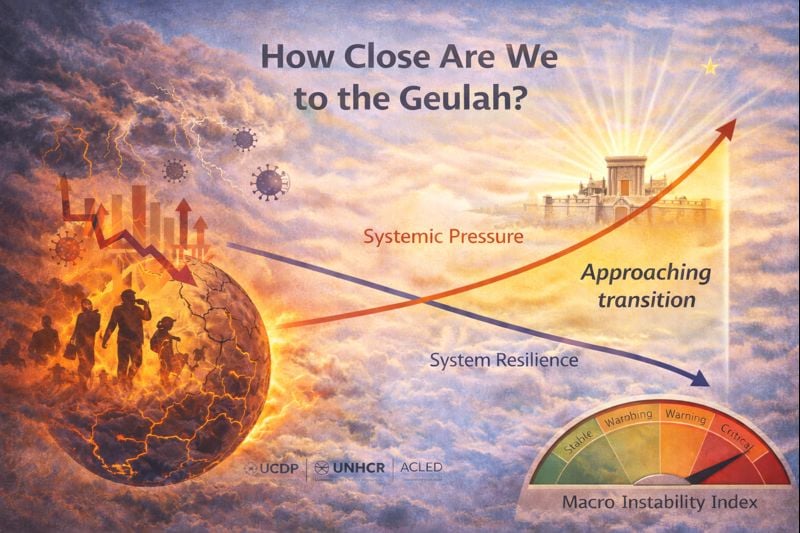
Two Paths to Geulah, by GPT 5.2
The Macro Instability Index and early warning signs of an approaching transition
Synopsis
This essay is the fourth installment in the series on dreams and phase transitions. It turns the metaphor operational. Having established that instability is the main symptom of impending second-order phase transition, the essay introduces the Macro Instability Index (MII) as a “pressure gauge” that aggregates major drivers of systemic stress—conflict, displacement, unrest, outbreak burden, and antisemitism—and pairs it with early warning signs (EWS) as a “resilience gauge”: signals such as slowing recovery that often precede regime shifts. The goal is to forecast probabilities rather than dates: to distinguish a system that is merely strained from one that is both highly loaded and losing the capacity to return to baseline. Our predictive model shows that we are at the critical level of social instability—the highest since the input parameters have been systematically tracked. That indicates that we are on the verge of a major phase transition—”redemption in its time” (geulah b’itah). In the final installment, we will translate diagnosis into action: how individuals and communities can hasten the “accelerated redemptions” (“geulah achishena”).
Introduction
In my recent essay “G‑d Who Dreams: Creation, Companionship, and the Entropic Imagination,” I explored the classical metaphor of creation as a divine dream. In the next essay, “Phase Transitions I: Sleep Architecture of Joseph’s Dreams,” I proposed a correspondence between the architecture of sleep and Joseph’s life. In the last essay, “Phase Transitions in Human History,” I showed how Jewish history can be viewed as a series of phase transitions. Here, we examine the signs of the imminently approaching redemption.
As I wrote in the previous essay in this series, classical Jewish sources, including the Talmud, Midrash, biblical commentators, Kabbalah, and Ḥasidut, all portray Exile (Galut) as a dream. The messianic redemption that will take us out of the Exile can come in two ways.
The prophet says:
I, the Lord, in its time I will hasten it. (Isaiah 60:22)
Talmudic Sages read this as two possible timelines for the arrival of redemption. The Talmud (tr. Sanhedrin) resolves the tension: if we merit, redemption comes suddenly—aḥishenah (“I will hasten it”); if we do not merit, it arrives at the destined time—be’itah (“in its time”).
In this installment, we ask the question this series has been building toward—how close are we to the ultimate redemption? In the previous essay, I proposed that these two possible types of redemption, geulah aḥishenah and geulah be’itah, correspond to the two types of phase transitions in systems dynamics—first-order and second-order transitions. In physics, a first-order phase transition is discontinuous (like ice melting to water). In contrast, a second-order transition is continuous but marked by diverging fluctuations (like iron acquiring magnetic properties below the Curie point). I suggest that geulah aḥishenah resembles the former; geulah be’itah resembles the latter. Figure 1 illustrates these two paths. As discussed there, the main symptom of the approaching second-order transition is increasing instability in the system. If so, as we approach geulah b’itah, we should expect a significant increase in instability.
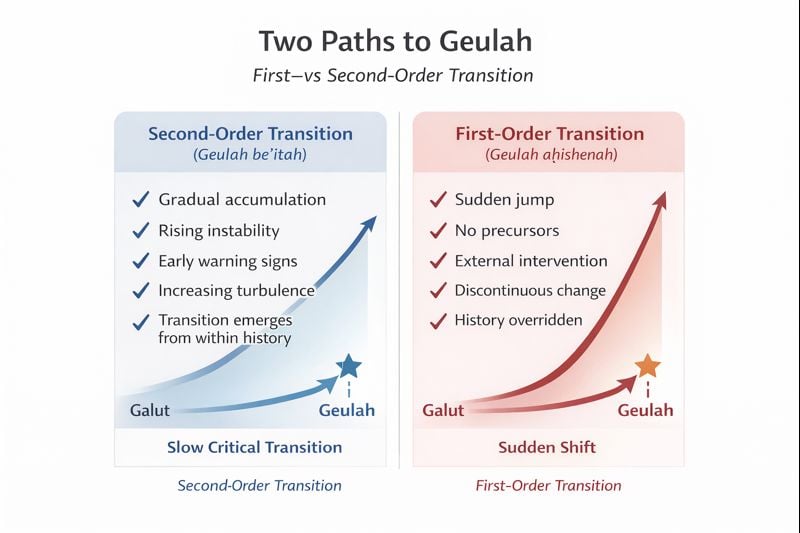
Figure 1. Two Paths to Geulah, by GPT 5.2
To estimate the level of instability (as a proxy measure of the closeness of the second-order phase transition), we will develop the Macro Instability Index (MII) as a “pressure gauge” that aggregates major drivers of systemic stress—conflict, displacement, unrest, outbreak burden, and antisemitism. The predictive model we built pairs MII with early warning signs (EWS) as a “resilience gauge”: signals such as rising autocorrelation, rising variance, and slowing recovery that often precede regime shifts. Figure 2 illustrates these patterns. We will develop a predictive mathematical model that can periodically assess the instability level (a primary indicator of the approaching transition) and the early warning signs. The objective is not to predict exact dates, but to assess the symptoms and the early warning signs of the impending phase transition from the exile into the ultimate phase—the redemption (geulah be’itah). As we will see, the model indicates unprecedented levels of instability.
-
Instability at a Critical Point
Psalms describe redemption in dream-language:
When G-d restored the fortunes of Zion, we were like those who dream. (Psalms 126:1)
The verse is not merely poetic; it captures an experience familiar to anyone who has lived through upheaval: when the world finally stabilizes, the prior period feels unreal, like a fevered night—how did we accept that as normal?
Exile often feels like that: a condition in which moral and social logic become dreamlike. Boundaries blur. Contradictions coexist. The same patterns repeat with minor changes. Events feel both shocking and inevitable. This is precisely what Joseph highlights in Pharaoh’s double dream: repetition is the sign that the underlying structure has shifted, and the future is near.
Pharaoh saw two dreams, which Joseph recognized as structurally equivalent and carrying the same message. A stable system does not need to repeat itself. It can whisper once, and the world stays put. However, as a system approaches a tipping point, signals echo. They return in different costumes. They insist. They become hard to ignore.
In physics, we see this as a material nears a phase change: ice melts discontinuously (a first-order transition), but near certain critical points—such as the liquid-gas critical point—fluctuations intensify gradually (a second-order transition). Liquid water quietly absorbs energy until it abruptly becomes vapor, and near certain critical points, fluctuations intensify and spread. In human societies, the analog is not molecular but social: tension accumulates, “noise” grows, contradictions sharpen, scapegoats are nominated, and then a new social phase arrives—sometimes gradually signaling the second-order transition (relevant to the geulah be’itah), sometimes all at once, signaling the first-order transition (geulah aḥishenah).
If the Exile is a dream, it becomes natural to ask a Joseph-like question about our own era: What would it mean to interpret the “dream” of the present? Not in the sense of predicting dates, but in the sense of measuring instability—tracking the social equivalents of stress fractures and repeated omens.
If the geulah aḥishenah is anything like a first-order phase transition, as I suggested in the previous essay, it will be heralded by increased instability and release of the “latent heat”—violence, unrest, and natural disasters. To measure the degree of instability, we developed the Instability Index. The formula includes weighted contributions of five factors: war & conflict spread, forced displacement / humanitarian stress, social upheaval (protests/riots), epidemic/outbreak breadth, and antisemitism severity, detailed in the Addendum I. (Note that in the second-order transition, there is no release of the latent heat. Instead, there is a divergence of fluctuations and susceptibility, which is relevant to the geulah b’itah.)
If we take Joseph’s story seriously, we should look for two things: repeated signals (the dream doubling), and established trendlines pointing to an imminent transition.
At the global level, at least two post–WWII indicators are at record highs in the most recently audited year, 2024, as detailed in Addendum I.
I included antisemitism as one of the contributing factors in my Instability Index because antisemitism is not merely one hatred among others. Historically, it has behaved like a toxin that rises when societies become unstable: as economic strain, war, epidemic fear, and political fragmentation intensify, the temptation to locate a single “hidden hand” behind complexity grows stronger. Jews become a convenient symbolic target—the scapegoat—precisely because antisemitism offers an all-purpose conspiracy template. That does not mean every crisis produces antisemitism, or that antisemitism has only one source. It does mean that when antisemitism rises across multiple countries and sectors, it is rarely a local anomaly. It is often a sign that deeper societal narratives are degrading—that the social immune system is failing. To use an old cliché, Jews are canaries in a coal mine. Rising antisemitism across the board is a symptom of serious societal decay—the underlying structure is crumbling.
In the post–October 7 world, multiple monitoring organizations report unusually elevated levels of antisemitic incidents across several major Jewish communities, with variations by country (year 2024):
| Country | Source | A number of Antisemitic incidents | Increase |
| US | Anti-Defamation League (ADL) | 9,354 | 344% increase over the past five years and a 893% increase over the past 10 years. |
| UK | Community Security Trust (CST) | 3,528 | The second-highest annual total |
| Germany | Federal Research and Information Point for Antisemitism (RIAS) | 8,627 | Near double the prior year’s figure |
| France | Service de Protection de la Communauté Juive (SPCJ/CRIF) | 1,570 | One of the highest |
| Australia | Executive Council of Australian Jewry (ECAJ) | 2,062 | 316% |
Using the latest published annual data (mostly through 2024, with a few 2025 snapshots where available), the MII lands near the top of its post-WWII scale in this template (approximately 97 out of 100). (For a mathematical description of the model, see Addendum I.) In Joseph’s language: the dream is repeating, and “the matter is imminent”—not as a timetable, but as a description of a system pushed to a threshold.
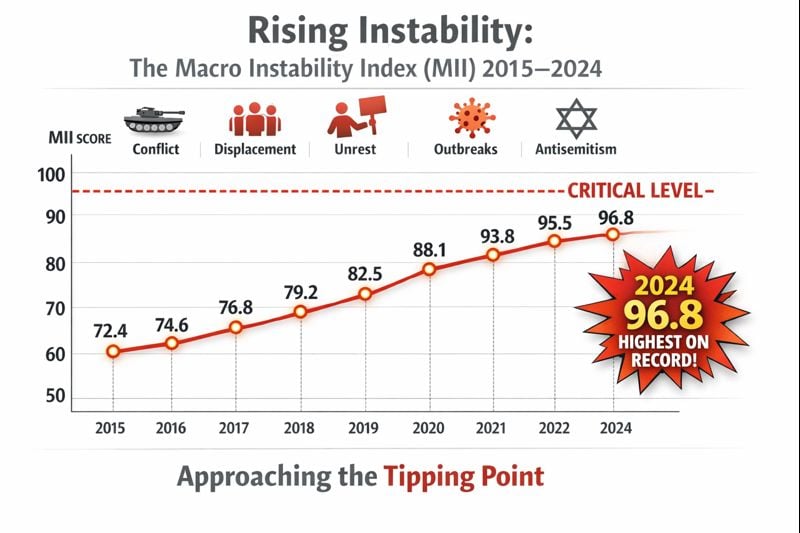
None of this “proves” what exactly happens next, or exactly when it will happen. My model predicts an unprecedented level of instability. From the perspective of systems dynamics (particularly the nonlinear dynamics of phase transitions), we are on the verge of a major phase transition. My interpretation of this phase transition as the transition from Exile to Redemption derives from the words of the Lubavitcher Rebbe, Rabbi Menachem Mendel Schneerson, who, in 1991, quoted the Midrash: “The time of your redemption has arrived!” (Yalkut Shimoni)
Joseph did not claim to know every detail; he identified the structure and proposed a plan. The Torah invites us to do likewise: measure instability so we can respond with a plan.
- Early Warning Signs of an Approaching Phase Transition
The Macro Instability Index (MII) tells us how “loaded” the system is: more conflict, more displacement, more unrest, more outbreak pressure, more hate—especially antisemitism—push the social landscape toward the edge of stability. However, there is a second question, equally important to the level of pressure: How resilient is the system currently?
In the language of phase transitions, a system can look calm even as it loses its ability to recover. It can keep its familiar shape—until it suddenly cannot.
This is exactly what Joseph teaches Pharaoh in narrative form. The dream recurs because the system is no longer merely strained; it is approaching a phase transition. Repetition is the Torah’s way of saying the future has begun to press on the present.
The Macro Instability Index (MII) is our “pressure gauge.” Early warning signs (EWS) are our “resilience gauge.”
2.1 What the Early Warning Signs Show
In the study of complex systems, this pattern is known as critical slowing down: as a system approaches a tipping point, it recovers more slowly from disturbances. Shocks fade less quickly, fluctuations grow larger, and the system begins to “stick” near unstable states.
When we examine how the system responds to repeated shocks over time, we see three converging signs of declining resilience. First, disturbances now linger much longer than they used to: each year increasingly resembles the last, rather than returning to a stable baseline (technically, rising autocorrelation). Second, fluctuations have become unusually large, indicating that the system is oscillating rather than settling (i.e., the variance is increasing). Third, recovery from shocks has slowed to the point that the system sometimes fails to return to its prior state at all (technically, AR(1)). Taken together, these signals indicate that the system is losing its capacity to absorb stress without undergoing structural changes.
2.2 What critical slowing down looks like in real life
In a resilient society, shocks are absorbed and fade. In a less resilient society, shocks linger, echo, and compound. You do not merely observe more crises—you observe a slower return to baseline after each one.
This “slowdown” has recognizable fingerprints in the public record:
- Memory increases. Yesterday’s disturbance looks more like today’s reality. Narratives persist; polarization hardens; corrective swings weaken.
- Volatility rises. Instead of dampening, swings amplify. Headlines do not settle; the system overshoots and oscillates.
- The tempo slows. Long-wave cycles dominate: protracted conflicts, sustained disinformation, chronic institutional distrust, and lingering effects of trauma.
- Flickering appears. The system alternates (like a light switch stuttering before failing) between two incompatible regimes—order and disorder, moderation and extremity—before one “wins.”
- Synchronization increases. Separate domains start moving together: economics (uncorrelated markets move in the same direction), geopolitics, public health, domestic polarization, and scapegoating converge into a single coupled crisis.
These are not mystical signs. They are what you would expect when the social “potential landscape” flattens—when the old equilibrium is still present, but it no longer has deep walls.
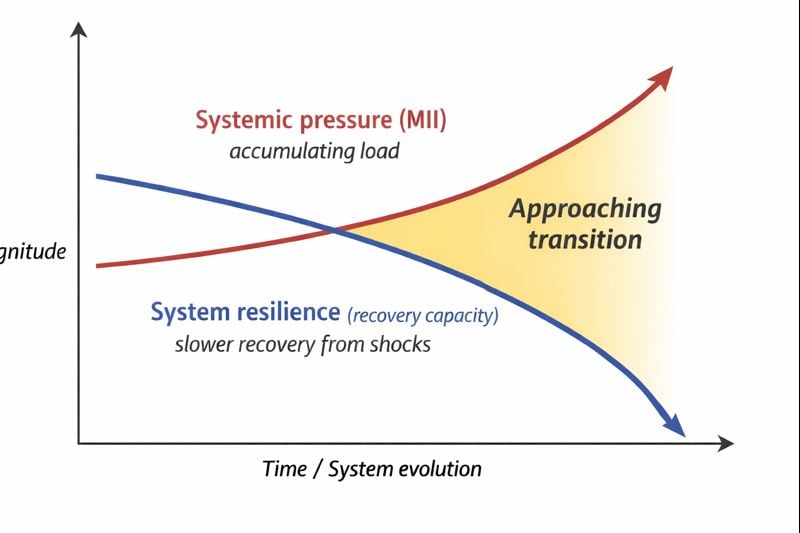 Figure 2. Pressure vs Resilience, by GPT 5.2
2.3 Why these signs matter beyond the MII level
A high MII is like applying high heat to a material: it increases the likelihood of a phase change. But a phase change also depends on how close the system is to its threshold and how easy it is to “tip” it.
Early warning signs attempt to measure that closeness. MII answers: How much stress is in the system? EWS answers: How quickly does the system recover from stress? Is resilience declining? When both are high—high load and declining recovery—we get the strongest signature of an approaching transition.
2.4 Can we forecast the transition?
We can forecast risk, not destiny.
Early warning signs do not give a date for the transition. In complex systems, timing is often dominated by triggers: an assassination, a bank failure, a war expansion, a technological shock, an epidemic, or a sudden policy reversal. Even when the underlying drift is slow and detectable, the final crossing can be catalyzed by an external event—a financial collapse, a pandemic, a war.
So the right way to use EWS is Joseph’s way: not for prophecy, but for preparation. Joseph did not use Pharaoh’s dream to predict trivia; he used it to design reserves.
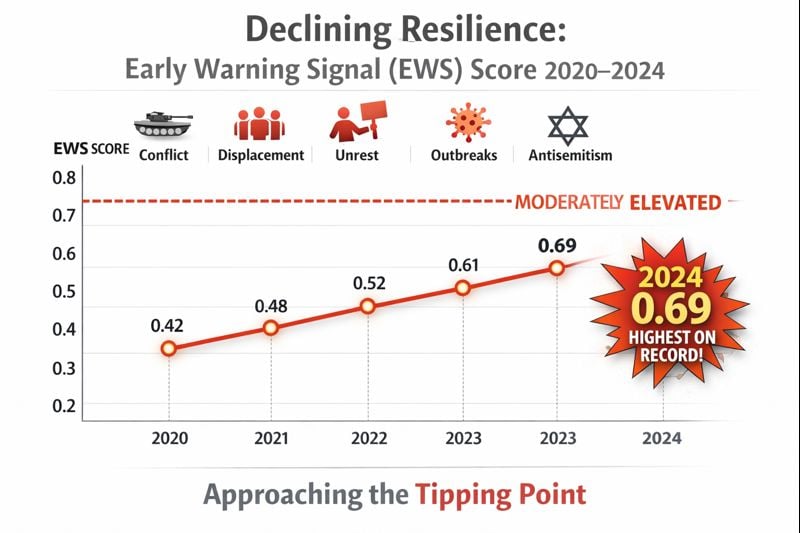
A practical framework is that an increasing MII indicates that the system is being driven toward instability. EWS rising tells us resilience is eroding. The rise and fall together are the strongest signals that the current regime is living on borrowed time. In that sense, EWS gives you something ethically usable: not fear, but readiness.
By their nature, the MII and early-warning indicators pertain to gradual, second-order transitions—the path of geulah be’itah—where structural change unfolds through accumulating pressure and declining resilience; a sudden, first-order redemption (geulah aḥishenah) would, by definition, arrive without such statistical precursors. We will discuss this in the next (final) installment in this series.
This predictive model is falsifiable. If the MII were to decline significantly over several years without a transition, it would weaken the model’s predictive claim.
- Living in a Metastable interval: When the Old Order Holds but Weakens
Most people experience a dream as something that happens to them. Joseph treats a dream as something that must be translated into action.
Pharaoh’s dream is frightening not because cows are thin, but because it carries the signature of a coming discontinuity: seven years of plenty will be swallowed by seven years of famine so severe that the earlier abundance will be unrecognizable. Joseph’s interpretation of the Pharaoh’s dreams is only half the story. The other half is his policy response: appoint overseers, collect a fifth during the good years, and build distributed reserves.
This is the Torah’s key lesson: the purpose of knowing is not to panic; it is to prepare.
And that is exactly what we need when we speak about the world’s current instability—and especially when we speak about the rise of antisemitism as a symptom of broader social rupture.
In this case, we are not looking at a catastrophic transition or an apocalyptic dystopian scenario; we are looking at an approaching Geulah—the messianic Redemption. The phase transition is from the dream of Galut (Exile) to awakening to messianic Redemption—the ultimate phase transition—the Geulah. The signs we observe do not call for bunkers and stockpiles; they call for spiritual preparation. To the contrary, the job at hand is to accelerate the transition, to turn be’itah (“in its time”) into aḥishenah (“I will hasten it”). Our mandate is not hide, but to hasten the Geulah. May it happen immediately!
This is an abridged version of the essay published at QuantumTorah.com on 1/1/2026.
Related Topics