Living at the intersection of Torah and science.
Phase Transitions in Human History
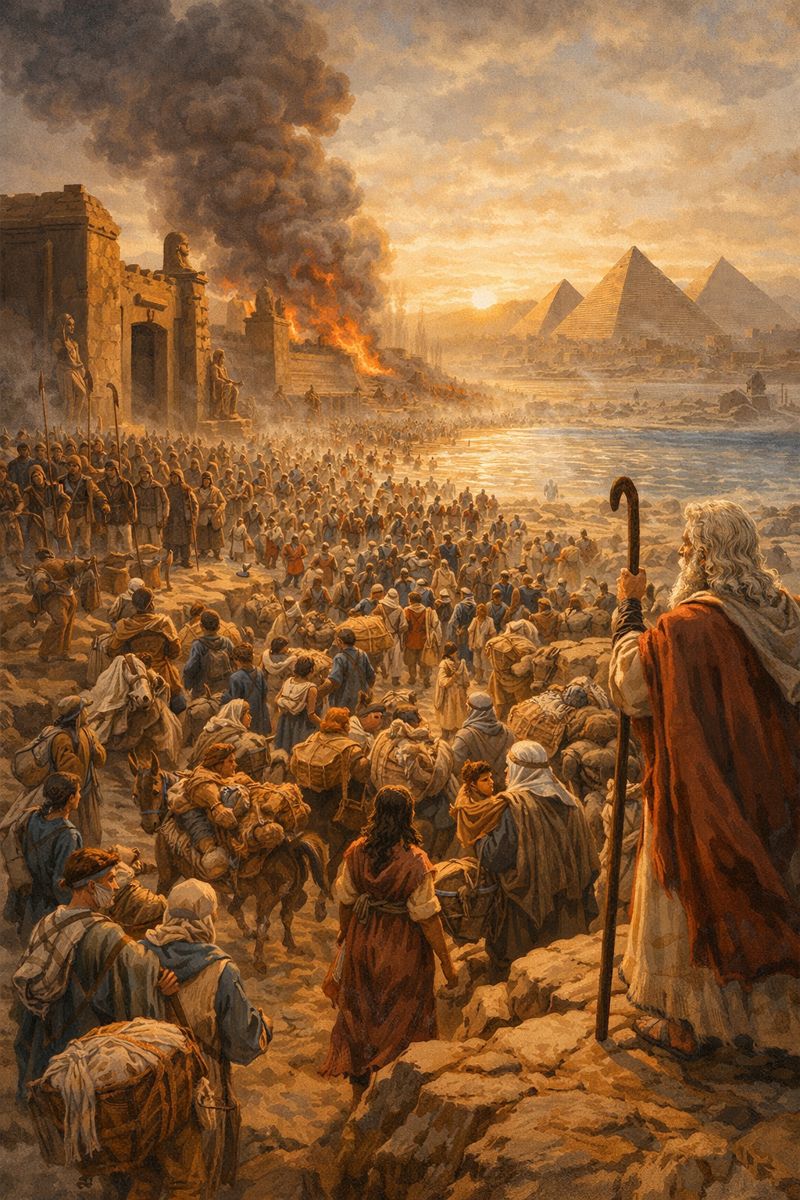
Exodus from Egypt, by GPT-5.2
Metastability, nucleation, and the logic of tipping points
Phase-transition language can illuminate not only Joseph’s story but also the history of humanity.
To be clear, this is a metaphor, not a reduction. Human history is not governed by thermodynamic laws. Still, the vocabulary of metastability, tipping points, and critical fluctuations can help us describe why long periods of apparent stability can collapse or reconfigure with startling speed.
As discussed in the earlier essays “G‑d Who Dreams: Creation, Companionship, and the Entropic Imagination”, “Phase Transitions I: Sleep Architecture of Joseph’s Dreams,” and “Phase Transitions II: Galut as Dream, Geulah as Awakening,” in physics, a phase transition occurs when a system shifts from one macroscopic state to another (e.g., ice to water, water to vapor, paramagnet to ferromagnet). The system’s order parameter—a measurable quantity characterizing its state—changes either abruptly (first-order) or continuously (second-order).
In history, the ‘order parameters’ are not single numbers but patterns: the organizing principles, institutions, and shared narratives that keep a civilization coherent.
This essay distinguishes two broad families of transitions. Some are first-order-like: abrupt, discontinuous shifts when a metastable equilibrium finally fails. Others are second-order-like: continuous reorganizations driven by growing correlations and slow drift toward a threshold.
Phase Transitions in Human History
In human history, we can identify analogous order parameters: the dominant mode of political organization (monarchy → republic), economic structure (feudal → capitalist), religious orientation (pagan → monotheist), cultural paradigm (oral → literate), scientific paradigm (pre-empirical → empirical). Historical “phase transitions” are moments when these order parameters shift at the civilizational scale.
1. First-Order Phase Transitions
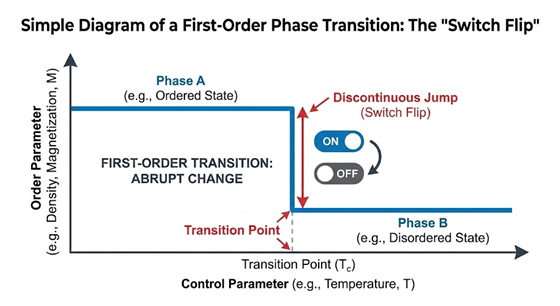
A first-order phase transition is an abrupt jump from one state to another, like water suddenly becoming ice at 0°C or steam at 100°C at standard atmospheric pressure. The key signature is discontinuity—a “switch flip”— in which properties such as density or internal energy do not change gradually but leap abruptly from one value to another at the transition point. First-order transitions also involve latent heat—energy that must be added or removed to complete the change (which is why ice cubes do not melt instantly when taken out of the freezer, and why a pot of boiling water stays at 100°C until all the water has evaporated). During the transition, the two phases can coexist: ice floats in liquid water, and bubbles form in boiling water. Another hallmark is hysteresis—the transition point can differ depending on the direction you are moving (water can be supercooled below 0°C without freezing if undisturbed, then freeze suddenly when disturbed). In the language of energy landscapes, the system sits in one basin of stability until conditions change enough that it suddenly “jumps” into a different, now more stable basin.
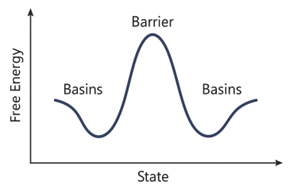
Figure 2. Basins of Free Energy
First-order transitions in history share the key signatures of their physical counterparts:
Metastability: Metastability describes a state that is seemingly stable but is actually “on the edge” of a transition. The system remains in its current phase only because it has not been disturbed enough to tip over. A regime persists even when conditions no longer favor it. Pre-revolutionary France, late Tsarist Russia, and the late Western Roman Empire were all metastable states. The “energy barrier” keeping them in place was institutional inertia, vested interests, and the absence of a viable alternative nucleus around which a new order could crystallize.
Nucleation: Nucleation is the process by which a small “bubble” or “seed” of the new phase forms within the old phase. If this seed reaches a critical size, it triggers the transition of the entire system. Just as ice crystals need a seed to form, and water needs microscopic bubbles to boil, new political orders require nucleation sites—revolutionary cells, reform movements, charismatic leaders, or ideological frameworks that provide a template for the new phase.
Latent heat: In physics, latent heat is energy added to a system that does not change its temperature but is instead used to break the bonds of the old phase. In history, this manifests as the violence, upheaval, and social energy released during revolutionary transitions. The Terror, the Russian Civil War, the Thirty Years’ War—these are the “latent heat” of historical phase change.
Hysteresis: Hysteresis occurs when a system’s state depends on its history. To return to a previous state, the system must be pushed much harder than it took to leave it. Physical systems exhibit path-dependence; a transition cannot be reversed by reversing conditions. Historical transitions show the same asymmetry. You cannot restore the previous regime by reversing the conditions that ended it. The system has undergone a fundamental reorganization.
Trigger events as perturbations: A perturbation is a sudden disturbance. In a system primed for a phase transition, a single small event can act as the “trigger” that collapses the old phase. The assassination of Archduke Franz Ferdinand that led to WWI, the storming of the Bastille, or the storming of the Winter Palace by the Bolsheviks—these function like small perturbations that push a metastable system over the energy barrier. The perturbation itself does not contain the energy of the transition; it merely releases energy already stored in the system’s tensions.
The Exodus from Egypt is a prime example of a first-order-like transition in the Torah. After centuries of enslaved metastability, a sequence of perturbations (the plagues) destabilized the regime until the final trigger—the Death of the Firstborn—flipped Pharaoh from resistance to expulsion. Moses functions as a nucleation point around which the “free phase” crystallizes, while the people’s long preservation of identity under bondage provides the internal energy required to break the old bonds. The narrative also displays hysteresis: even after physical exit, the people repeatedly long to return to Egypt, showing path-dependence in the transition from slavery to freedom.
Return of Jewish exiles from Babylon (538 BCE) is another example. While it took only a single military defeat to exile the Jews to Babylon, the “return” was not a simple reversal. Despite Cyrus’s decree allowing them to return, the majority of Jews remained in Babylon. The “path” back to the Land of Israel exhibited hysteresis: the social and economic bonds formed in exile meant that the “force” required to restore the Judean phase was much greater than the force that ended it. This dynamic can be observed today as well. While we have a sovereign Jewish state—Israel—more than half of the Jews remain in diaspora. A famous saying, “It is easier to take a Jew out of Galut than to take Galut out of a Jew,” expresses the principle of hysteresis.
In the Torah portion of Vayigash, we see another example of a trigger. Since the brothers first came to Egypt to buy food, Joseph was toying with them, first accusing them of being spies, then of stealing his chalice. The pressure was building until Judah confronted Joseph—this was the trigger that broke Joseph’s façade, when he revealed himself to his brothers. This was a first-order transition from schism to unification.
2. Second-Order Phase Transitions

A second-order phase transition is a continuous, gradual transformation in which the system evolves smoothly from one phase to another without an abrupt jump in its fundamental properties. Unlike first-order transitions, there is typically no latent heat, no coexistence of two phases, and (in equilibrium treatments) no hysteresis—the system passes through a single critical point at which the old phase transitions seamlessly into the new one. The classic example is a ferromagnet cooling through its Curie temperature: the magnetization does not suddenly appear but grows continuously from zero, strengthening as the temperature drops further. What makes second-order transitions dramatic is not discontinuity but divergence: as the system approaches the critical point, certain quantities—such as the material’s responsiveness to external influences (susceptibility) or the range over which fluctuations are correlated—grow without bound. The system becomes increasingly “indecisive,” fluctuating wildly between states, with disturbances in one region rippling across ever-larger distances. These critical fluctuations are the hallmark of approaching a second-order transition: the system does not jump to a new state so much as gradually lose its grip on the old one until a new order emerges organically from the instability.
Some historical transformations better resemble second-order transitions.
In Jewish history, the transition from the era of the Judges to the Kingdoms of Saul and David is a classic second-order transition. There was no single “day of revolution” in which the tribes ceased to be autonomous; rather, the “order parameter” (centralized authority) increased continuously. During the period of the Judges, the tribes were loosely aligned. Under the pressure of the Philistine threat, they began to cooperate more frequently. The authority of Samuel transitioned into the kingship of Saul, which was still very “tribal” in nature. It was not until King David and later Solomon that the system gradually reached a “fully ordered” state of centralized monarchy. Unlike the Exodus (first-order), there was no “discontinuous jump”—the states overlapped and gradually morphed.
The movement from a portable Tabernacle (Mishkan) to a permanent Temple (Beit HaMikdash) represents a transition in the “spatial order” of the religion. For centuries, the Tabernacle, after being moved through the desert, sat in places like Shiloh, Nob, and Gibeon. It was a “fluid” phase of worship. David brought the Ark to Jerusalem, but it stayed in a tent. Solomon then built the stone structure. The transition was a gradual “solidification” of the religious center. The rituals remained largely the same, but the system’s “entropy” decreased as worship became fixed at a single point in Jerusalem.
In the later Biblical period, specifically during the reign of King Josiah, there was a transition toward the centralization of worship and the internalizing of the Law.
Earlier, worship involved many local “high places” (bamot) where people offered sacrifices. Through the reforms of Hezekiah and later Josiah, these local sites were slowly phased out in favor of the single Temple in Jerusalem. This changed the nature of the religion from a local, decentralized practice to a unified national identity.
This transition is characterized by a “correlation length” that grows—people across the land began to align their practices more closely until the entire nation was “in phase” with the Jerusalem center.
The later reversal from Temple-centric worship to the decentralized Judaism we have today was also gradual. After the Second Temple was rebuilt under Persian rule (traditionally associated with Zerubbabel), it never regained the central role of the First Temple. While the Second Temple continued to function until Romans destroyed it, it was hardly the focal point—the Ark was no longer there; daily miracles ceased; high priests were often appointed and removed by ruling authorities; sources describe political patronage and, at times, bribery; local synagogues proliferated; and private and communal prayers slowly took the place of Temple sacrifices—it was a long and gradual transition of democratizing and decentralizing Judaism.
Early-warning signals
Critical slowing down (CSD): Near second-order transitions, systems lose resilience and become sluggish in responding to perturbations—they take longer to return to equilibrium. As the system approaches the critical point, its correlation length grows, meaning fluctuations become correlated over larger distances. Because of this, restoring equilibrium after a perturbation requires rearranging many interacting components, which takes more time. Mathematically, the relaxation time diverges as the control parameter approaches its critical value, often following a power law. This slowing down is a hallmark of critical phenomena. Historically, this appears as the prolonged instability of transitional eras: the long 19th century, the interwar period, and the decades before major reformations.
The Book of Judges follows a repetitive cycle: Sin → Oppression → Outcry → Salvation. In the beginning (Othniel, Ehud), the “recovery” to peace is robust and lasts 40 and 80 years. As the era approaches the “critical point” of total social collapse, recovery slows down. By the time of Samson, the “restoring force” (the Judge) is deeply flawed, and the periods of peace are barely mentioned or nonexistent. The system has reached CSD, becoming so “sluggish” that it can no longer return to its original state of tribal autonomy, signaling an impending transition to the monarchy.
Diverging correlation length: Near criticality, local fluctuations become correlated across vast distances. In a normal phase, parts of a system only “talk” to their immediate neighbors. At a critical point, the correlation length diverges, meaning a tiny change in one corner of the system instantly affects the entire system. In historical terms, ideas, movements, and crises that once remained local begin to synchronize globally. The revolutions of 1848, the global unrest of 1968, and the Arab Spring—these suggest systems approaching critical correlation.
In Jewish history, we find an example in I Samuel 11 (The Siege of Jabesh-Gilead). Previously, the tribes of Israel were “decoupled”—if one tribe was attacked, others often ignored it (as seen in the Song of Deborah). However, when the Ammonites threatened the city of Jabesh-Gilead, Saul took a local action: he cut up oxen and sent them across the borders. Suddenly, the “correlation length” became effectively system-wide. The entire nation “stood up as one man.” This was the hallmark of a second-order transition: the system was no longer a collection of independent tribes but a single, correlated “monarchic phase” in which every part became sensitive to the others.
Other warning signs of approaching a tipping point include flickering: intermittent jumps between two regimes before one “wins” (often seen before abrupt shifts). We see this in neuroscience: at the onset of sleep, the brain ‘flickers’ between waking and the first sleep stage (N1).
We see flickering in the Divided Kingdom (Hezekiah to Manasseh to Josiah). Judah was approaching the critical point of the Babylonian Exile. The nation began to “flicker” between two moral/political phases: an order/covenant phase under Hezekiah, when the nation was monotheistic and centralized, and a disorder/idolatry phase immediately after, under Manasseh, when it reverted to paganism. Then Josiah flipped it back again. This “flickering” is a sign that the system is losing its ability to remain in a single phase. The instability intensifies until the system finally undergoes a full transition into the “Exile Phase.”
Early warning signals can help estimate the increasing probability of approaching a transition (“we are getting closer to a regime shift”) and sometimes provide a useful lead time. However, they generally cannot tell you when the transition will occur, because timing is often dominated by triggers (exogenous shocks, policy decisions, assassinations, breakthroughs, a single spark).
The deepest challenge in applying phase transition theory to history is identifying the correct order parameter. In physics, we know what to measure (magnetization, density, conductivity). In history, what is the macroscopic variable that characterizes a civilizational state? Candidates include: Mode of production (Marx’s framework), information technology (oral → written → print → digital), Energy source (biomass → fossil fuel → renewable), political organization (band → tribe → chiefdom → state → empire → nation-state), epistemic orientation (mythic → theological → scientific). Each choice yields a different periodization of history and identifies different moments as “phase transitions.”
Contingency, attractors, and providence
Nonlinear dynamics emphasizes sensitive dependence on initial conditions—the famous “butterfly effect.” Small differences early in a trajectory can lead to vastly different outcomes.
This maps onto the historian’s sense of contingency: that pivotal moments could have gone otherwise, and small factors sometimes determine large outcomes. Had Cleopatra’s nose been shorter (Pascal’s quip), had the weather been different at Waterloo, had certain letters been intercepted or delivered, the entire subsequent trajectory might have diverged. The belief in the divine providence (hashgaḥah protit) holds the opposite view—whatever happened had to happen, because it was divinely ordained.
However, even historians who believe in contingency stress that it must be balanced against the concept of attractors—stable configurations toward which systems tend. Even with sensitive dependence, systems often settle into similar attractor basins. Perhaps Rome would have fallen eventually, regardless of which barbarian tribes arrived first; perhaps industrialization would have emerged somewhere in Eurasia, regardless of whether it started in Britain. The attractor existed; only the precise trajectory was contingent.
This framework does not reduce history to physics—human agency, meaning, and consciousness introduce irreducible complexity. However, it offers a rigorous vocabulary for describing the dynamics of historical transformation: how tensions accumulate, how systems become unstable, how small perturbations trigger large reorganizations, and how new stable configurations emerge from apparent chaos. It is fruitful to apply this vocabulary to the transition from Exile to Redemption. We will develop this parallel more in the final installment of this series.
Limits and responsible use of the metaphor
The analogy has limits. Social systems are open, multi-scale, and value-laden; they rarely have a single order parameter, and many historical ‘transitions’ are hybrids—part abrupt collapse, part gradual reorganization.
Moreover, human beings are not molecules: intention, responsibility, and revelation matter. Phase-transition language should sharpen description and illuminate patterns, not reduce life to atoms.
What might we measure? If we use this metaphor responsibly, we can ask what observables track civilizational stability: institutional legitimacy (trust surveys), economic stress (inflation, unemployment, inequality), polarization (network structure and media-echo metrics), and “critical slowing down” signals such as rising variance and autocorrelation in key indicators. These are heuristics, not prophecies.
Conclusion
Phase-transition language cannot tell us which events must occur or when they must occur. What it can do is sharpen our perception: it trains us to see metastable regimes, to notice when shocks cease to dissipate, and to recognize the role of seeds—persons, ideas, institutions—that can become centers of reorganization. Used with humility, this vocabulary is not prophecy; it is a way of thinking. And once we can think clearly about tipping dynamics, we can ask a more practical question: which indicators reveal that a system is approaching its threshold?
Related Topics
Related Posts