Pierre Makyo Interview | Alexandre Gilbert #288
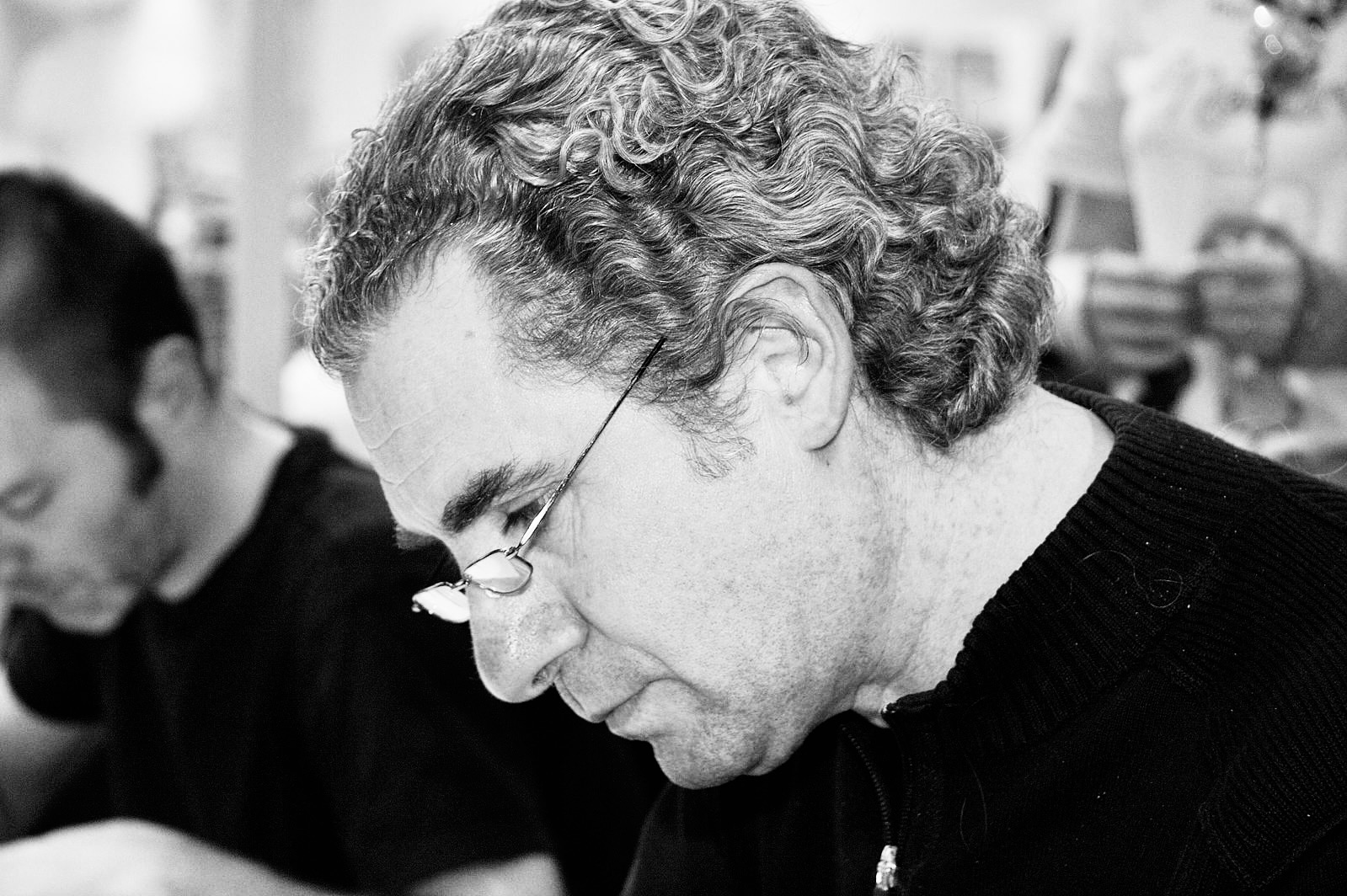
Pierre Fournier aka Makyo is a French comics writer. He published Janvier: Le jour où nous avons été applaudis in 2025.
Do you see yourself in the lineage of the 1970s French comics tradition—mixing fantastic and eroticism of Jean Giraud aka Moebius?
Pierre Makyo: I met him 15 years ago through his sister-in-law—I was living with her. He became my brother-in-law for a while. We were meant to do an event together, but I split with her before it happened. We talked spirituality, family, but he was already moving away from that path. I, on the other hand, went deeper.
I was immersed in that period’s atmosphere. I started publishing in the early ’80s with La Balade au bout du monde, Grimion Gant de Cuir, etc. Initially, I was a child of Spirou. In the ’70s, I collaborated with Dodier, and we submitted work to the Spirou amateur section, “Carte Blanche.” That was my dream: two-page color stories in Spirou. We got rejected at least ten times—”poor scripts, heavy-handed drawing,” and so on—until finally, one got accepted, likely just out of respect for my persistence. Still, seeing my two pages printed in Spirou remains one of my fondest memories in comics. Everything after that felt secondary.
We didn’t feel influenced by the fantastic back then. Dodier and I were more shaped by Spirou, Franquin, Johan et Pirlouit, Tillieux—that whole ecosystem. Real storytellers. But yes, things shifted when we began getting published. That’s when the BD “roman” emerged—graphic novels for adults, with Pilote magazine and others leading the charge.
And then, Les Passagers du Vent—a massive success from Glénat—came before La Balade au bout du monde. That story, about a woman journeying by boat, really signaled a move to serialized, multi-volume narratives.
La Balade au bout du monde was launched in 1981—after Pilote and Métal Hurlant’s golden age’s birth.
Pierre Makyo: I found certain things intriguing in Métal Hurlant but not drawn to Druillet’s style. I admired the art but never finished a story. I needed structured, narrative-driven storytelling. So, La Balade au bout du monde? I wouldn’t call it fantasy—it’s more “fantastical realism.” Not time travel, per se, just lost people living in marshlands. Grounded, with an uncanny layer. I love that fine line—when a man walking through a park thinks a statue just turned its head. That ambiguity is my realm.
That’s the essence of the 1970s’ “realism fantastique” movement—Powell, Bergier, Le Matin des magiciens. Rediscovering ancient knowledge, esoteric technologies, pyramids, the Bible…
Pierre Makyo: Yes, and that does connect. Plus, I’ve practiced Zen for 45 years. I look for meaning in stories. Like in traditional Indian street theater: anyone in the audience—nuclear physicist or shepherd—must grasp it. That’s rule one. Rule two: the story should distract, help people escape themselves. Rule three, most crucial: it must offer a new understanding of the world. Change the reader’s outlook on life or history.
That links to “rational spiritualism” in réalisme fantastique—a mix of metaphysics and knowledge.
Pierre Makyo: Exactly. That’s Laurent Vicomte’s influence too. In the ’70s, the star was the artist—Franquin, Tillieux. But in the ’80s–’90s, the writer took center stage. BD roman changed the landscape. Vicomte suffered from that imbalance. In interviews, everyone focused on me, the writer—he felt sidelined. So when we ended volume four, he asked for an open ending. I wrote it with Arthis stuck in a psychiatric hospital. He wanted to take over and write his own story.
He got lost in the process—four years on the script, four on the art. He was already slow, but writing himself made it worse. I had the next script ready before he’d even begun. So we agreed to pass the baton to another artist. We tried a few, settled on one for the second cycle, then decided each cycle would feature a different artist. Not a great idea in hindsight—readers dislike switching styles. Like recasting Jon Snow mid-Game of Thrones. It disrupts identification.
Vicomte was troubled. Not well known, but he had deep personal struggles.
Pierre Makyo: Absolutely. He was deeply wounded. His family history from a naval town—military Cherbourg, in Normandy, was heavy: problems with both disfunctional parents, a brother who took his life long before La Balade au bout du monde. I told him countless times, “Laurent, you need therapy.” He refused. When we worked together, my scripts kept him grounded. Once he went solo, he got lost. And he never finished the story. The truly disturbed one was Laurent. But extremely secretive. I never fully knew him.
Yet, La Balade au bout du monde is your idea. Do you recall when it came to you?
Pierre Makyo: People always ask. I can’t pinpoint the exact origin. What I do know is that long before La Balade au bout du monde, I was obsessed with Jung. At 17 or 18, I stumbled on The Transformation of the Soul and Its Symbols. I was hooked. Born to a working-class family in Dunkerque—my parents never spoke of psychology—but Jung’s ideas on archetypes, the unconscious, struck a chord. I read everything: Psychology and Alchemy, Man and His Symbols, The Archetypes and the Collective Unconscious.
Later, I dove into Indian philosophy and read all the major gurus: Ramana Maharshi, Ramakrishna, Nisargadatta Maharaj. I don’t know why. It all merged—Jung and Indian metaphysics—to shape my storytelling. When I wandered the marshlands one day, the fog inspired a story. What could happen here? Maybe someone lost. A prison where no one knows why they’re imprisoned. That became the metaphor: we’re all born into a world we don’t understand, searching for an exit.
Today, you practice Zen. But “Makyo” means illusion.
Pierre Makyo: Yes. I met a Zen monk 35 or 40 years ago—pure chance. I was visiting a friend to help bottle wine, and the monk happened to be there. We talked, and he invited me to a Zen retreat that weekend. I went for wine and ended up meditating. Practiced with him for six years.
But even before that, I’d read Zen and the Psychology of the Non-Mental by Dr. Suzuki. He described makyō, the illusions that arise in deep meditation. That word stuck with me. At Spirou, I already had a couple of pseudonyms, and I thought, “Makyo—that works.”
Did Otomo, Miyazaki, Tezuka influence you?
Pierre Makyo: Not really. I love Zen, but manga? I’ve read maybe two. One was incredible—Glénat published it in large format. It blended Japanese history, Noh theater, Zen monasteries—beautifully done. But beyond that, I’m not drawn to manga. I know there’s amazing work out there—but as with European comics, 75% are forgettable.
So what do you read these days?
Pierre Makyo: Frankly, not much comics anymore. It reminds me of work. I’ve worked a lot, but comics were never “work” to me—it was always passion. Like everyone in this field: readers, booksellers, gallery owners.
Comics offer such creative freedom. I’ve done short films, written unproduced screenplays. I could send you two links to my short films if you’d like. I also have several comics projects in progress—one with Spirou, another about fast fashion, some for children, others more literary.
I also wrote a novel, Grande Vie, released last year, and I’m working on two more. These days, I’m focused on writing—exploring as many forms as possible. I work constantly, but I never feel like I’m working.
I’m juggling two novel projects at once right now, and I enjoy it—I’m really immersed in writing these days. I like exploring a wide range of things. I work a lot, but it doesn’t feel like work to me. Writing, especially screenwriting, has become a real passion.
Unlike illustrators, who often burn out—because comic art is physically demanding—I find myself more and more inspired as a writer. I keep coming up with new stories. Right now, I’ve got fifteen scripts in development.
Jacques Chirac praised La Balade au bout du Monde.
Pierre Makyo: It was after the release of the first album, I think. We’d won the City of Paris prize and were invited to a small ceremony, maybe at City Hall or during the Paris Book Fair—I can’t remember exactly. Chirac gave a short speech about the book, possibly written by his daughter. It was only about twenty lines, then he shook our hands. We got 5,000 francs at the time—not bad. It was a small thing, but a fun memory.
There’s a real depth to the saga, and in some ways, it echoes Game of Thrones, though it also resembles Star Wars in terms of cultural crossovers.
Pierre Makyo: The second arc explores altered states of consciousness—out-of-body experiences and themes that were a bit bold for the time. I always aim to tell a story that has something meaningful underneath. The third arc was the Cathar cycle. I was fascinated by the Cathars—I later wrote a seven-volume series on them. I studied them in depth. The fourth arc is about the Ligures, a pre-Celtic people who were said to have magical powers—like making it rain or discovering immortality. With each cycle, I choose a theme that forces me to dive into research. I read extensively before writing. When I started in cinema, I was told that to write a good script, you must become a specialist in your subject. That’s still how I work.
Recently, I wrote Robespierre, the melancholic sphinx—read ten books on him. I co-wrote Louis XI, the universal spider with a friend who specializes in conflict, because Louis XI was a master negotiator. I love screenwriting for the opportunity it gives me to explore entire worlds.
As for the first cycle—it’s an allegory of the human condition. Not in the Malraux sense, but more generally. Our personalities are about 15% conscious and 85% unconscious. And the unconscious is the reservoir of our traumas, repressions, ancestral memory. It holds a massive, transgenerational energy. Jung said the greatest human victory is gaining ground on the unconscious.
That’s why my work moves between philosophy and spirituality. We know so little about ourselves—about birth, about death. Funerals bring that mystery to the surface. We stand by the grave and ask: where is this person? What happens now? It touches on religion and belief, but it’s still a universal enigma. I think we all have a duty to try and decode ourselves—and the world around us.
If I had to sum up what drives me: it’s the need to break free, to understand. That’s what links me to the character of Artis. It’s autofiction—he’s not me, but he carries my passion for deciphering existence, for learning from philosophers and spiritual teachers. My biggest obsession is trying to understand death.
Any locations in the series inspired by Dunkirk?
Pierre Makyo: Not really. We used imagery from marshes and prisons in the Pyrenees. The setting often adapts to the style of the illustrator. What I appreciate in comics is the way some artists breathe life into characters.
Unfortunately, publishers don’t always get that. They talk about “relatable” characters without understanding how an artist makes a figure come alive. Some illustrators draw beautifully—but their characters feel lifeless.
In Ancient Egypt, sculptors created statues of gods, but it was the priests who performed the “opening of the mouth” ritual to imbue the statue with spirit—making it “alive.” Some Egyptian statues are still considered alive today. They’re called netjer.
This idea also relates to alchemy. The alchemist projects his inner world into matter; by transforming the material, he transforms himself. Likewise, a comic artist who animates his characters is channeling something deeply personal, infusing it into the drawing.
Laurent Vicomte had that gift. Even when his early drawings had flaws, he injected such energy into his characters that they felt real. He brought the story itself to life.
Were either of you raised in a religious environment?
Pierre Makyo: Not particularly. I did my communion, my mother went to church. Nothing intense. Same for him.