
Sports, Politics, Broadcast and Media Specialist
Playing Against a Ghost
The Ireland-Israel fixture and football's selective conscience
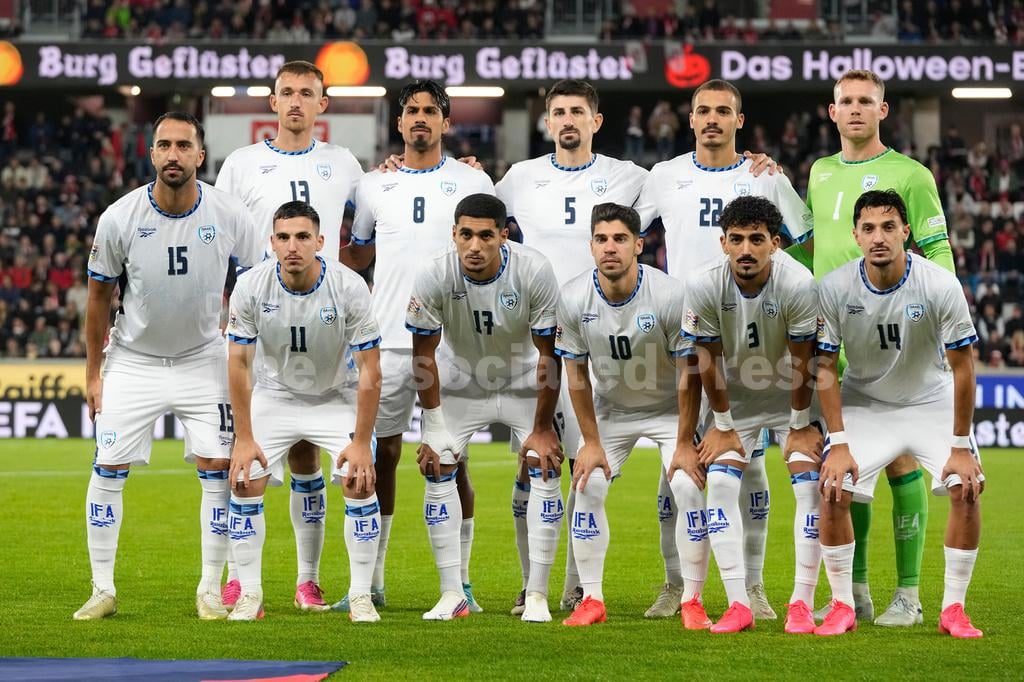
Israel's players line up for the Nations League Group B3 soccer match between Austria and Israel in Linz, Austria, Thursday, Sept. 24, 2026. (AP Photo/Matthias Schrader)
On Sunday, in a stadium in Debrecen, Hungary, a country neither team calls home – Israel and the Republic of Ireland will play a UEFA Nations League match that has become more of a political spectacle, than actual Football match. Israel, barred from hosting matches on security grounds since October 2023, will be the “home” side in a Hungarian venue, with the Israel Football Association confirming a small allocation of its own supporters will be let in. The FAI, for its part, has ruled out any in-stadium access for travelling Ireland fans at either leg of this tie. Ireland’s reciprocal “home” fixture on October 4 has been moved entirely behind closed doors to a neutral venue in Bačka Topola, Serbia, with no fans of either side present at all. Two national teams, already dropping points in damaging opening games, and barely a crowd in sight at either ground. If UEFA wanted a tidy metaphor for how thoroughly politics has swallowed this fixture and Football as a whole, it could not have designed one better.
The immediate trigger was Ireland manager Heimir Hallgrímsson’s remark, on naming his squad, that none of his players felt comfortable facing Israel and that Ireland would be “playing against genocide,” not “playing with” it. The Israel Football Association’s reply was blunt, accusing him of “stupidity, ignorance and hypocrisy,” and adding on social media that it had contributed Nobel laureates to humanity but had found no cure for the affliction its coach represented. It is the word “hypocrisy” worth sitting with – because the accusation, thrown at the IFA by critics, is exactly the one that collapses under scrutiny once you look at who Ireland, and international football generally, is actually willing to share a pitch with.
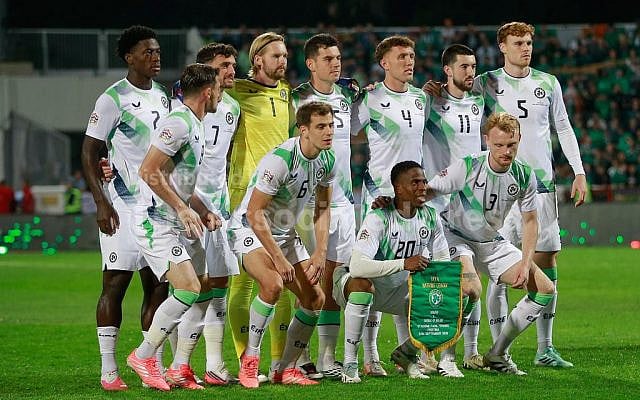
Furthermore, the strain inside the Ireland camp itself has been real, not rhetorical. A scheduled training session and press conference in Debrecen were abruptly postponed on Saturday after goalkeeper Gavin Bazunu told Hallgrímsson he did not want to play either fixture against Israel. What followed was a four-hour players’ meeting at the team hotel before a majority voted to fulfil the games as scheduled. Bazunu was the only squad member to withdraw. In a statement, the Bolton Wanderers goalkeeper said his decision rested “purely” on a belief that the killing of innocent people is wrong, and stressed that his stance was “not in opposition to the Israeli people or the Jewish community, but against the atrocities in the region.” The FAI has confirmed the Ireland squad will wear black armbands for lives lost in the conflict, decline the customary pre-match handshake and pennant exchange with their Israeli counterparts, and skip media duties around both fixtures. With match-fee proceeds from the Austria game in Dublin going to charity. A somewhat contradictory move from the federation that initially stated they needed to play the game for financial reasons. Israel’s federation, for its part, welcomed Ireland’s decision to play, saying in a statement that “football has won today” and that the separation between sport and politics had to be maintained.
This is not a new rupture, only its latest, pettiest expression. Israel closed its Dublin embassy in December 2024, with Foreign Minister Gideon Sa’ar accusing Ireland of rhetoric built on the “delegitimization and demonization of the Jewish state” and on double standards Israel would not and will not tolerate from any other government. Sa’ar’s complaint was specific: Ireland had backed South Africa’s genocide case at the International Court of Justice, recognised Palestinian statehood, and become one of the only EU states not to adopt the IHRA definition of antisemitism, while treating Israel, in his words, as perpetually the aggressor regardless of the front it was attacked from. Irish President Michael D. Higgins called the antisemitism charge slanderous. Neither side has backed down since, and the football pitch is simply where that unresolved argument has resurfaced in shorts and studs.
To understand this “hypocrisy” let’s start with Iran for example. Tehran’s federation formally petitioned FIFA to suspend Israel entirely, framing it as solidarity with Gaza’s civilians. This is the same Iranian state that compels its own athletes to refuse competition against Israelis as a matter of policy, that has executed protesters by the thousands, arms terrorist proxies that attack Israel, and has spent recent years attacking commercial shipping in the Red Sea and trading strikes with Israel directly. Moreover, the IRGC has been accused of making athletes who speak out against the regime ‘disappear’. No such boycott campaign trails the Iranian national team into World Cup qualifiers though. Further, Saudi Arabia, which has led a coalition intervention in Yemen’s civil war for over a decade with a civilian death toll UN agencies have put in the tens of thousands, has a questionable at best human rights record, is set to host an entire World Cup in 2034 with barely a murmur from the Irish Sport for Palestine Group behind this week’s open letter about that. In addition, China, credibly accused by Western governments and rights bodies of interning over a million Uyghurs, competes freely without any boycott campaign following it competition. Congo’s eastern provinces and Sudan’s civil war have produced casualty figures that dwarf Gaza’s, and neither federation has faced a suspension motion at a FIFA or UEFA general assembly.
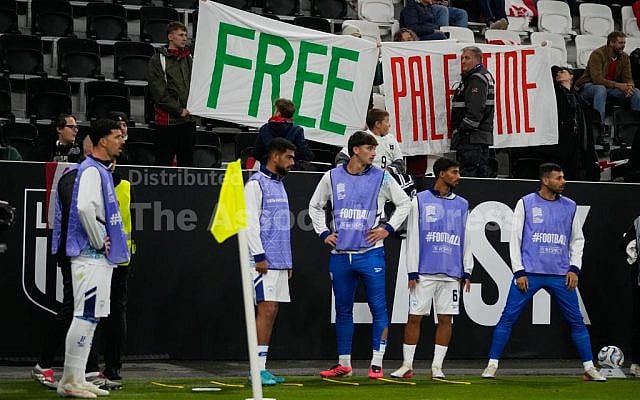
The one precedent critics do reach for is Russia’s swift suspension after invading Ukraine in 2022. Which is instructive precisely because of how selectively it’s deployed. Former Manchester United forward Eric Cantona invoked it at an Amnesty International event, asking why the same speed hasn’t applied to Israel. It’s a fair question about consistency, but it cuts in an uncomfortable direction for the boycott movement too: Russia was suspended for a war of unprovoked territorial conquest against a state that never attacked it. Israel fought a war that began when Hamas gunmen crossed their border fence on October 7, 2023, killing roughly 1,200 people and taking about 250 hostages. The last of them, dead and alive, were only returned in January 2026, three months after a ceasefire finally took hold. A ceasefire that has remained fragile and repeatedly violated ever since, with sporadic strikes and clashes continuing on both sides. Treating that sequence as morally interchangeable with an unprovoked invasion requires erasing October 7 from the story entirely – which is precisely what the Ireland coach’s and Irish Federation framing does. Let it also be known that this saga does not revolve around Israel playing Palestine. That has been dealt with decades ago by splitting them into different continental confederations. This saga revolves around a country not at war with its opponent objecting to playing them.
UEFA and FIFA have, to their limited credit, resisted the pressure so far, telling reporters that pairings are decided on security grounds rather than politics. That restraint should be recognised rather than assumed. In September 2025, eight independent UN human rights experts publicly urged both bodies to suspend Israel, and UEFA reportedly came close to an emergency vote on expulsion before the effort was shelved following the ceasefire and diplomatic pressure from Washington, a co-host of the 2026 World Cup. The machinery for expelling Israel from European football – wound up by the FAI’s own general assembly, which voted in November 2025 to petition UEFA for Israel’s suspension before its delegates voted 75-32 in July 2026 to fulfil the fixtures anyway rather than risk “significant and lasting harm” to Irish football – has not been dismantled. It has simply been paused.
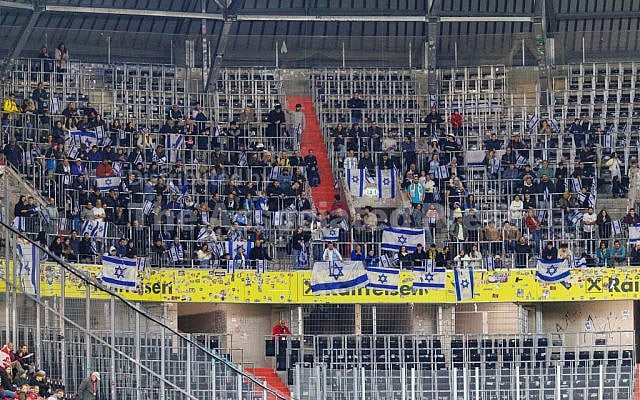
The football: A contest beyond the headlines
For all the political noise, Ireland and Israel still have a football match to play.
The timing is significant. Both teams entered this international window with great ambitions in a competitive Nations League group that also includes Austria and Kosovo. The opening fixtures have already demonstrated how little room there is for complacency. Ireland lost 1–0 away to Kosovo on 24 September, Vedat Muriqi scoring the only goal with seven minutes left, while Israel suffered a 3–1 defeat away to Austria the same evening, undone by two goals in stoppage time after Saied Abu Farchi’s equaliser was followed by his own second-half red card. Those results leave both sides with a sporting reason to respond, independently of the political controversy surrounding their meetings.
Ireland’s squad includes forward Troy Parrott, in form for Real Betis, whose movement and finishing will be important if the team can create opportunities in the final third. Alongside fellow forwards Adam Idah and Chiedozie Ogbene. The absence of defender Nathan Collins through injury is also significant, given the importance of defensive organisation against Israel’s attacking players – while Gavin Bazunu’s withdrawal leaves Caoimhín Kelleher as Ireland’s senior goalkeeping option for both fixtures.
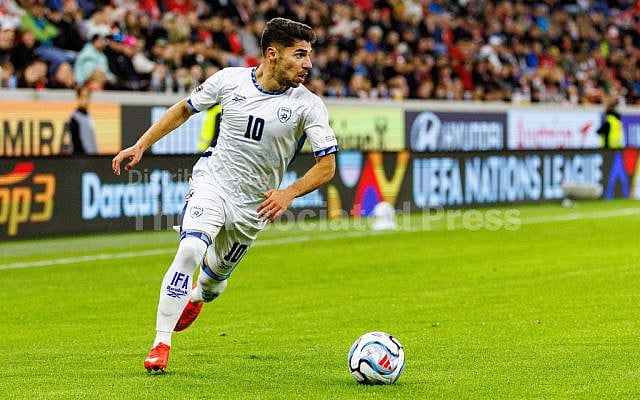
Israel have attacking options capable of troubling Ireland. West Ham United’s Manor Solomon offers pace and directness on the wing, while Ajax playmaker Oscar Gloukh can provide creativity between the lines. Liel Abada and Tai Baribo add further attacking options, with Anan Khalaili offering another outlet able to stretch the opposition and create space for teammates. The tactical contest may come down to whether Ireland can disrupt Israel’s possession and limit the space available to its creative players, or whether Israel can exploit transitions and find opportunities behind Ireland’s defensive line.
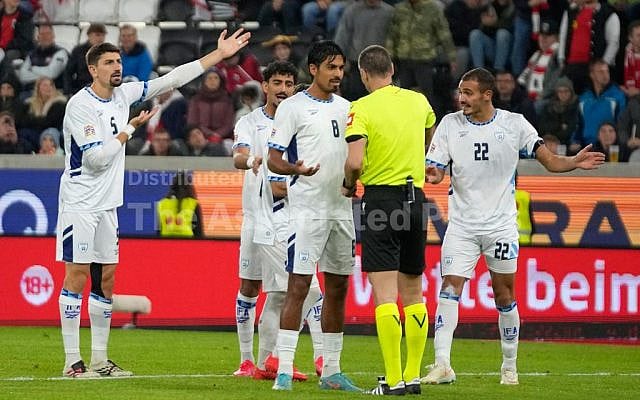
The first match is officially Israel’s home fixture, despite being played in Hungary. The return match, officially Ireland’s home fixture, will be held in Serbia. Neither side will enjoy the familiar advantage of playing before its own supporters.
That unusual arrangement makes the contest less predictable in atmosphere, but it does not diminish its competitive importance. The result will still affect the group standings, and the players will still be judged on what happens over 90 minutes. Australian audiences can follow the match via beIN SPORTS, which is carrying every fixture of this Nations League campaign through beIN SPORTS CONNECT, Amazon Prime Video and Fetch TV.
None of this means every criticism of Israel’s conduct in Gaza is made in bad faith, or that humanitarian concerns about the war’s toll should be dismissed as reflexive antisemitism – that charge, too, gets thrown around too loosely from time to time by Israel’s defenders, and serious critics of the war deserve to be heard rather than waved away. But a coach who singles out one team, from one country, as too morally contaminated to share a pitch with – while his own federation happily fields sides against nations very deserving of boycotts, waging their own wars, or running internment death camps and/or flagrant human rights violations – isn’t taking a principled stand. He’s choosing which victims count.
| Game Times | |
| Hungary (Local Time) | 7:45 PM – Sunday 27th, September |
| Tel Aviv | 9:45 PM – Sunday 28th, September |
| New York | 2:45 PM – Sunday 28th, September |
| Sydney | 3:45 AM – Monday 28th, September |
Related Topics
Related Posts