English Professor; Executive Director, Writing on the Wall
Poetry After Auschwitz?
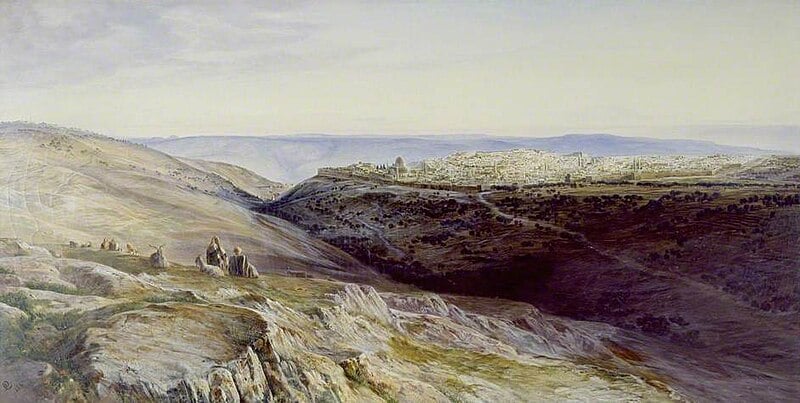
Edward Lear, Jerusalem, 1865 (Wikimedia)
No Poetry After Auschwitz.
Or so they say.
Silence in the face of tragedy goes back to Leviticus and the response of Moses’ brother Aharon as his sons are dragged out of the Temple’s Holy of Holies: ‘And Aharon remains silent.’
For Isaiah, however, there is only one response to catastrophe: Poetry.
The Infinite God does not require a philosophical treatise, a logical solution, or a religious manifesto, but leads inevitably to poetry. God’s incomparability demands layered metaphors; the people’s changeability demands endless adaptation.
For Isaiah, it’s exhausting. He is spat on and humiliated. But he has the divine gift, a responsibility he cannot shirk – he has words to comfort the weary.
He must speak.
A Drama in Seven Acts
Isaiah is a poet, and so are the Rabbis of the Talmud. They create the Seven Act Drama, the seven haftarot of consolation Jews read from the 9th of Av to the New Year.
To read the Prophets as we do great literary works is not to diminish them, but to recognize that prophecy is also poetry, and that our sacred books deserve the same attention we give to the most enduring works of the human imagination.
In Act II of our drama, the silence of Act I breaks; Zion speaks for the first time, with an angry accusation: ‘God has forsaken me, forgotten me.’ Not exactly a conversation starter.
Isaiah responds to Zion’s cry of abandonment – with images, metaphor, poetry. God in different aspects: as shepherd, mother, lover, father.
First, the prophet compares God’s bond with Israel to a mother’s primal relationship with her child: that divine bond is unbreakable even if human mothers sometimes forget. Then, Isaiah shifts to the language of lovers, with God saying: ‘I have engraved your name on my palms.’ With open hands mirroring the tablets of Sinai, Isaiah shows the intimacy of a lover’s promise fused with the permanence of covenant.
From here, Isaiah pivots again. Without warning, God’s voice breaks in with a new vision: ‘Your children are coming!’
This scene opens with Zion bewildered, not recognizing the children for whom she has longed: ‘but these, where have they come from?’ There is, however, is a logic to Isaiah’s poetry: the return must be imagined before it can be believed. As Shakespeare knew, a dream can grow into ‘something of great constancy.’
But not yet.
The dream dissolves, and the prophet-poet moves from the intimacy of homecoming to the confrontation of God’s unanswered call. No longer a loving mother, God is now an uncompromising father who in a flare of divine pique, demands accountability.
‘When I called, why did no one answer?’ In this guise, God, boasts of His power: ‘I can dry rivers so the fish rot, and clothe the heavens with darkness.’ The darkness of mourning returns, not incidental nightfall, but a deliberate act of cosmic will.
False Fires
The darkness God claims sets the next scene: Isaiah walks in it, knowing the divine source. He rejects those who ‘kindle their own fires’ – the blaze of false prophets and political plotters — and turns instead to the true light: the mind trained to see beyond the literal.
God becomes the model reader, ending Act II with a lesson in how to read: ‘Look to the rock from which you were hewn,’ God says to the people of Israel, and to the quarry from which you were dug.’ Not a guided tour of Biblical Israel, but a riddle whose answer God supplies: the rock is Abraham; the quarry is Sarah. Not just stones, but Zion’s history writ large.
Revelation lies not only in the words themselves, but in the capacity the prophet cultivates — to see God’s handwriting in creation and to recognize the story written as their own.
Only poetry is suitable for the unrepresentable God, keeping Israel, and us, reading toward what words reveal yet leave unseen. Because the Infinite can never be contained in a single image, God teaches through a chain of metaphors, training Israel to read poetically.
And finally — a happy ending! Or so it seems: ‘Thus the Lord has comforted Zion.’
The desert transformed into paradise, the ruins of the Temple into ‘the garden of God’ reads at this stage like a messianic fantasy, or the forced ending of a Greek drama, a Hebrew deus ex machina.
The people of Israel are not there yet; they remain in Act II, despondent, unredeemed.
To be continued.
Like in Act I, the curtain falls with Zion still rebellious, unconsoled. The lesson in reading has begun, but the story of comfort is still unfinished.
Related Topics
Related Posts