


Poor Jews’ Temporary Shelter – London’s East End
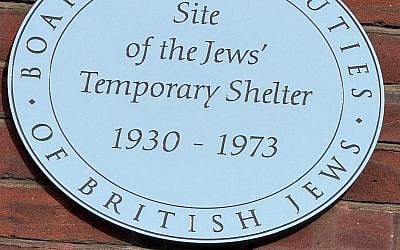 Photo: Sam Jacobs
This week an important link in the chain of British and Jewish history was commemorated and celebrated. The Board of Deputies unveiled a plaque at 63 Mansell Street in London’s East End.
This is the building occupied from 1930 until 1973 by the Jews Temporary Shelter. The charity was first set up by Simcha the Baker who offered lodging on sacks of flour at the back of his Bakery in 1885.
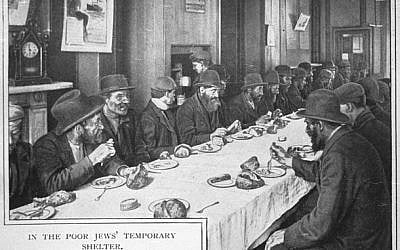
Within a short while the authorities closed down this accommodation as substandard and unhygienic. Jewish community leaders then set up the Poor Jews Temporary Shelter in Leman Street.
The aims of the charity were to help new arrivals with modest dormitory accommodation and food for two weeks and help in finding work. They had to pay for this and there’s always been an ethos that the UK government should not have provide a subsidy.
The charity is based near Irongate docks ( today’s Tower hotel) where many boats carrying hopeful immigrants arrived. This was the gateway to the vibrant Jewish East End, famous for Petticoat Lame market, the clothes business, smoked salmon, herring, bagels and rye bread and much more.
Writers such as Zangwill, Wesker, Litvinoff and Berkoff have immortalised the old Jewish East End. Some of its most distinguished inhabitants included the historian Jacob Bronowski, the poet Isaac Rosenberg and the painter Mark Gertler.
The Ashkenazi immigrants arrived in the area where the first Spanish and Portuguese synagogue opened in 1656 during the time of Oliver Cromwell’s commonwealth. This was the time of the readmission of Jewish people to England.
People from many lands have lived in the East End since Roman times. They include Irish, German, Indian Lascar, Africans, Sylhetis, Somali and French Protestant Huguenot people. Indeed, it was the Huguenots in the 1680s who first coined the word refugees following their flight from France to Whitechapel and Spitalfields.
The arrivals were often met at the docks by criminal gangs who wanted to rob and exploit them. In the early days of the Shelter most of the new arrivals were from Eastern Europe and came with a fear of authority and the police. They were targeted by criminals. The charity stepped in, meeting people at the docks, helping with paperwork and pointing them in the right direction.
Drawing: Wikipedia Ellen Gertrude Cohen – Illustrated London News in 1891
The arrivals received a mixed reception from British society with fears about competition for work, foreign ways, and outright prejudice. The 1905 Aliens Act limited the flow into the UK. And it was in opposition to that act that Winston Churchill wrote that it “would appeal to insular prejudice against foreigners, to racial prejudice against Jews, and to labour prejudice against competition” and expressed himself in favour of “the old tolerant and generous practice of free entry and asylum to which this country has so long adhered and from which it has so greatly gained.”
Otto Schiff worked extensively with the Shelter during both world wars and pledged that no refugees would be a burden on the state. He was made life president of the charity in 1948 and awarded both an OBE and CBE.
By the 1930s the charity had helped over 1.2 million people of many and no faiths. Many of these people passed through to the United States, South Africa and other countries.
The Austrian writer Stefan Zweig described the Shelter as offering “the wanderer, the emigrant, who comes here to seek rest and respite…. In the midst of the vast and dread uncertainty that now hangs like a chill cloud of fog over the lives of thousands, he feels for a few days the warmth and the light of human kindness, …., he feels that he is not alone and lost in a foriegn land, but that he is bound to the community of his people and to the higher community of mankind. …” and as an “unknown and incomparable monument of Jewish and human solidarity!”
Originally the immigrants came from Eastern Europe facing poverty and discrimination. By the 1930s refugees were flooding in from Belgium, Austria and Germany, escaping the Nazi threat. After the war, survivors of the concentration camps – including children from the displaced persons camps – passed through the shelter.
In later years refugees from Aden, Hungary, Iran, Egypt and India have arrived.
Today, the charity exists, offering advice and financial help to those facing housing difficulties.
Over the years HIAS, the Jewish soup kitchen, Board of Guardians, 45aid , Bachad and others have worked with the shelter.