Bridging faith. Defending truth. Confronting hate
Pope Leo, Robert Jeffress, Protestant Realism, & Iran
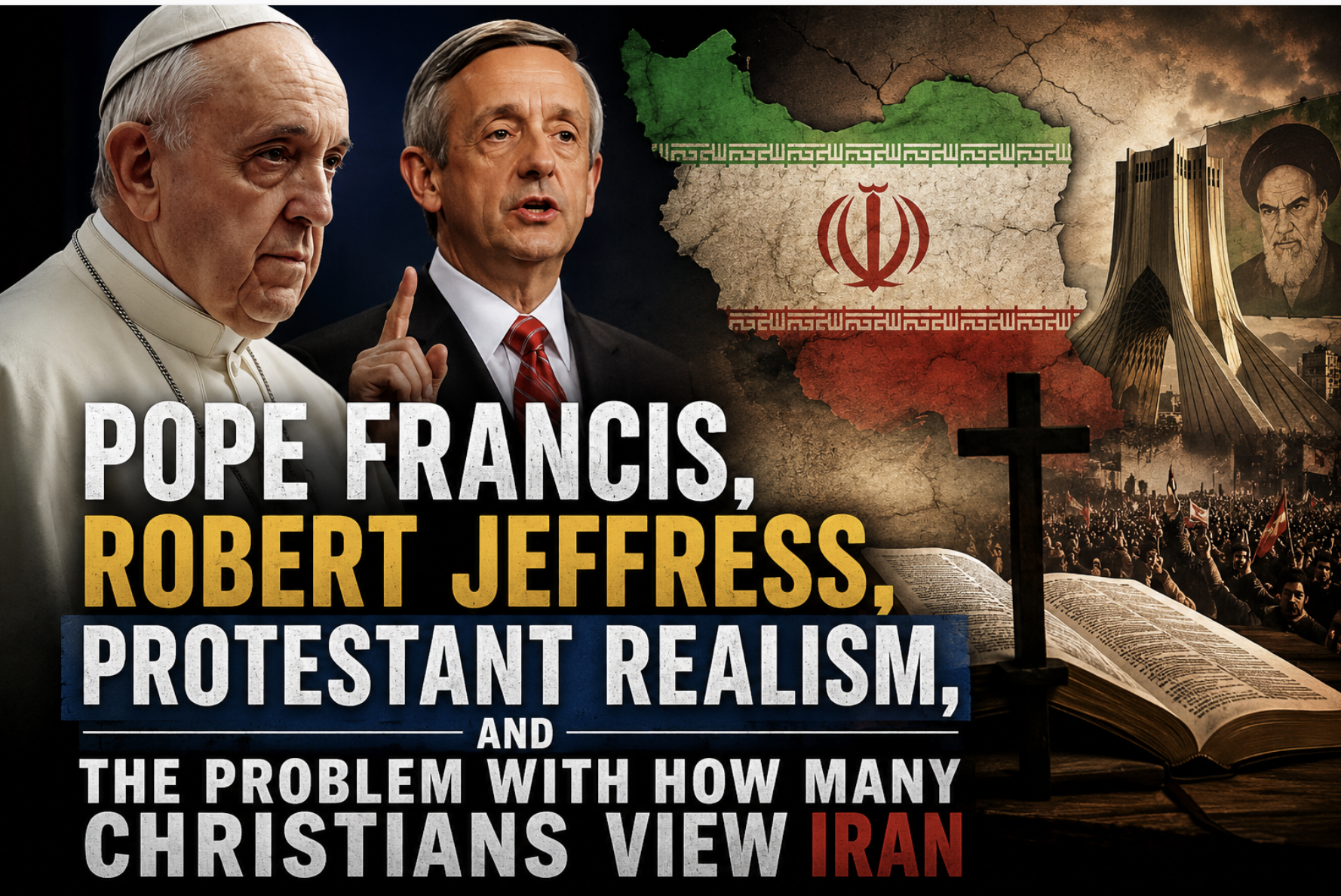
Image created from ChatGPT by Tim Orr
The growing divide between Pope Leo and many conservative Protestants over Iran, Israel, and war is about much more than politics. Underneath the disagreements are two very different ways of seeing human nature, evil, power, and history itself. Pope Leo tends to approach the world through the language of reconciliation, human solidarity, dialogue, and restraint. Many conservative Protestants approach the world through a far more tragic understanding of human nature, one shaped by sin, power, ambition, and the reality that some regimes and ideologies genuinely desire domination. The issue is not simply compassion versus aggression. The deeper issue is whether compassion by itself is enough to interpret the world accurately.
Leo’s worldview makes sense when you understand where it comes from. His thinking has been shaped deeply by Catholic social teaching, by Europe’s memory of nationalism and war, and by a desire to prevent the kinds of catastrophes that devastated the twentieth century. His language constantly returns to fraternity, encounter, dialogue, and the dignity of every human being. He sees diplomacy and reconciliation as morally serious responses to a fractured world. There is something admirable about that. In an age filled with outrage and ideological hatred, Leo often sounds like one of the few global leaders still trying to call people back to basic human decency.
At the same time, I think Leo has difficulty interpreting certain kinds of regimes and ideological movements. It is not that he is unaware of evil or unwilling to condemn it. He has spoken strongly against terrorism, antisemitism, extremism, and violence many times. But his broader instincts seem to rest on the belief that shared human dignity ultimately runs deeper than ideological or civilizational conflict.
In some situations, that approach can be deeply admirable and even effective. But it becomes much harder when dealing with revolutionary systems that do not see conflict as a tragic breakdown to overcome, but as something spiritually meaningful and historically necessary. In those cases, the belief that dialogue and reconciliation will eventually dissolve ideological hostility can start to feel less like wisdom and more like a serious misreading of the situation.\
That problem becomes especially clear when talking about Iran. A great deal of Western commentary treats Iran mainly as a nation reacting to sanctions, instability, Western intervention, or Israeli and American power. Those factors matter, but they do not explain the deeper structure of the Islamic Republic. Iran is not simply a normal nation-state with ordinary geopolitical interests. It is also a revolutionary theological state shaped by Twelver Shiʿi theology, martyrdom narratives, sacred resistance, and ideas tied to the Hidden Imam and revolutionary legitimacy. Theology is not some decorative layer sitting on top of politics in Iran. It is one of the things driving the political imagination of the regime itself.
The Islamic Republic does not think of itself as just another country pursuing normal political interests. The regime sees itself as part of a much bigger sacred and historical struggle involving legitimacy, resistance, sacrifice, and divine purpose. That larger worldview shapes how it understands politics, conflict, and even its own place in history.
The position of the Supreme Leader only makes sense inside that theological framework. He is not viewed merely as a president, prime minister, or political administrator managing a government. His authority is tied to the idea of guardianship during the occultation of the Hidden Imam, which gives the entire system a religious and ideological depth that many Western observers tend to underestimate or misunderstand.
That is also why concepts like martyrdom, suffering, and resistance carry so much weight inside the revolutionary culture of the regime. These are not viewed merely as tragic realities to avoid whenever possible. They are often treated as morally meaningful and spiritually significant within the system’s imagination. At the same time, the regime is still capable of strategic restraint, negotiation, and political calculation when it believes those things serve its long-term interests. The mistake many Western analysts — including many Christians — make is assuming that theology is mostly symbolic or secondary. In reality, theological ideas still shape how the regime thinks about power, legitimacy, conflict, and history itself.
I think this same blind spot shows up in the way many Western Christians talk about antisemitism connected to the Islamic Republic. A lot of the discussion gets filtered almost entirely through categories like colonialism, oppression, and Palestinian suffering. Those realities are obviously part of the broader conflict, but they do not fully explain the kind of rhetoric and ideology that has developed inside Iran’s revolutionary system.
Inside the Islamic Republic, hostility toward Israel often becomes tied to much larger theological and ideological narratives about sacred history, revolutionary identity, and resistance itself. In that framework, Israel is not simply viewed as a political opponent. It becomes symbolic of a deeper challenge to the revolutionary vision the regime believes it is defending. That is one reason Holocaust denial, conspiracies about Jewish influence and power, and even rhetoric calling for the elimination of Israel have appeared so regularly within Iranian revolutionary discourse. Those patterns point to something deeper than ordinary geopolitical disagreement.
What many Western Christians miss is that, for the Islamic Republic, Israel is not viewed as just another country involved in a regional dispute. Israel carries symbolic and theological weight inside the revolutionary imagination of the regime. A sovereign Jewish state in the middle of the Middle East cuts against deeper assumptions about Islamic civilizational authority, sacred history, and the ideological vision the revolution is trying to uphold.
That is why anti-Zionism within the Iranian revolutionary framework often becomes something far more intense than ordinary political disagreement. Israel is frequently treated as a kind of theological problem — an intrusion into what the regime believes history and sacred order are supposed to look like. Once you understand that, it becomes easier to see why anti-Zionist rhetoric inside Iran so often bleeds into antisemitic imagery, conspiracies about Jewish influence, and language that goes well beyond criticism of Israeli policy. At that point, the issue is no longer mainly about borders, settlements, or diplomacy. The deeper issue is that Jewish sovereignty itself becomes unacceptable within certain revolutionary theological visions.
This is where many conservative Protestants approach the issue differently. Their instincts are shaped by a much darker understanding of human nature and political power. That perspective comes partly from older Augustinian and Reformed traditions that emphasize the fallen nature of humanity. Human beings are not simply misunderstood creatures longing for reconciliation. They are also prideful, self-justifying, power-seeking, and capable of building entire ideological systems around domination and coercion. Nations do not merely misunderstand one another. Sometimes they pursue fundamentally incompatible visions of order because they believe their own vision deserves victory.
That same realist impulse also affects the way many Protestants think about authority. The Reformation was about far more than church structure or fights over institutional control. Underneath it was a deep suspicion of concentrated moral authority, especially when too much authority was centered in the papacy. Protestants did not reject theology, moral reasoning, or political reflection, but they were cautious about treating any one office or religious leader as though their judgments carried unquestionable authority for the entire Christian world.
Because of that background, a lot of Protestants have no problem respecting Leo personally while also thinking he gets major geopolitical questions wrong. They may genuinely appreciate his compassion, humility, and moral concern for people, yet still believe he does not fully understand the nature of revolutionary ideology, modern antisemitism, or how power functions in conflicts like these.
This difference becomes very clear when discussing deterrence and military force. Leo tends to see escalation primarily as a moral failure produced by dehumanization and failed diplomacy. Many Protestant realists see deterrence differently. They believe peace is sometimes preserved not simply through goodwill or reconciliation but through strength, leverage, and credible force. Weakness can invite aggression just as easily as aggression can provoke conflict. That does not mean realism is morally perfect. Realism can become cynical, militaristic, or overly nationalistic very quickly. But realism does possess one advantage over moral idealism: it takes seriously the possibility that some regimes and ideologies are deeply committed to conflict and domination.
That is one reason many conservative Christians were willing to support Donald Trump’s posture toward Iran despite being fully aware of his personal flaws and rough edges. Trump did not treat Iran as a regime that simply needed more understanding, dialogue, or diplomatic goodwill. He viewed it as a revolutionary government driven by ideology, regional ambition, and a long-term struggle for influence in the Middle East.
A lot of progressive Christians saw his approach as reckless, simplistic, or morally abrasive. Conservatives often saw it differently. They believed Trump understood something basic about power that many Western religious leaders no longer seem willing to acknowledge: revolutionary regimes rarely give up their ambitions because they are asked nicely. His reliance on sanctions, deterrence, pressure, and leverage came out of a much more realist view of politics and ideological conflict.
At the deepest level, the disagreement here is theological. Pope Leo represents a form of Christianity that places enormous emphasis on empathy, solidarity, reconciliation, and human fraternity. Protestant realism begins with the assumption that history is tragic because humanity is fallen. One framework tends to interpret conflict mainly through suffering and exclusion. The other interprets conflict through sin, ideology, ambition, and power. One fears realism because it appears harsh and insufficiently compassionate. The other fears idealism because it appears insufficiently serious about evil.
The irony is that Leo is probably the more intellectually polished figure. He sounds compassionate, thoughtful, and morally grounded, and there is a real strength in that. But being intelligent and morally sincere does not always mean someone sees geopolitical conflict more clearly, as mt argument shows. History is full of highly educated people who badly misunderstood ideological movements because they believed empathy, dialogue, and good intentions were enough to explain what they were facing.
I think a lot of modern Western Christianity has drifted in that direction. Compassion has become so dominant that, at times, it almost functions as a substitute for careful judgment, and looks more like an idolatrous form of empathy. Compassion is essential, of course. Christianity without compassion would lose something central to the gospel itself. But compassion by itself is not enough to understand a world shaped by ideology, power, religious conviction, and competing moral visions. A person can genuinely care about human suffering and still completely misunderstand the deeper forces driving a conflict.
Endnotes
- Leo repeatedly emphasizes fraternity, dialogue, encounter, and social friendship as central categories for addressing global conflict and political fragmentation.
- Islamic Government by Ruhollah Khomeini. This text remains foundational for understanding wilayat al-faqih (guardianship of the jurist) and the theological architecture underlying the Islamic Republic.
- The Crisis of the Islamic Republic by Ali Ansari. Ansari explores the ideological and theological dimensions of the Islamic Republic alongside its political development and revolutionary identity.
- Moral Man and Immoral Society by Reinhold Niebuhr. Niebuhr’s work remains one of the foundational texts for Christian realism and the argument that political life must reckon seriously with power, collective egoism, and coercion.
- Anti-Defamation League, “The Islamic Republic of Iran: Exporting Antisemitic Hate and Terror Since 1979.” The report documents repeated examples of Holocaust denial, eliminationist rhetoric toward Israel, and antisemitic narratives within Iranian revolutionary discourse.
Related Topics
Related Posts