
Writing on Jewish life, relationships, trauma, and resilience
Power without the Tablets

Illustrative. AI image created by the author.
Thomas Friedman says AI demands that we detribalize, depolarize and detoxify. The Jewish tradition, and the kitchen table, already know where to start.
Thomas Friedman reaches for our story to describe our moment.
In his new video essay for The New York Times, “We Just Set Off the Second Big Bang,” he argues that artificial intelligence and humanity’s other new powers have made us, in his word, “godlike.” We now have the power to part the Red Sea, he says, but without the Ten Commandments: without the rules, norms and institutions to govern what we have built. “Moses ain’t coming down with the two tablets.”
His prescription is that we must “detribalize, depolarize and detoxify ourselves,” and do it faster than humanity has ever had to.
There is a moment in the video that Israeli readers will notice. Friedman pauses to ask his producer the date. The answer is October 7. He uses it to make a point about how quickly the world is changing: next October 7 will look different, and the one after that he cannot imagine.
For us, that date already carries its own meaning. It is a reminder of what happens when hatred is given modern tools and no restraint. It is also a reminder of what Israelis did in the hours and weeks that followed, when people who had been shouting at one another in the streets for months showed up for each other without asking how anyone had voted.
Both of those truths belong in any honest conversation about tribalism, polarization and toxicity. So does a third: the solidarity of crisis does not last on its own. It has to be learned, practiced and passed on.
We Have Been Here Before
The Jewish tradition is not naive about what divided people can do to themselves. The Talmud teaches that the Second Temple was destroyed because of sinat chinam, baseless hatred, at a time when people studied Torah and performed good deeds. Knowledge and piety were not enough. The failure was relational.
The tradition also offers a model for doing better. The schools of Hillel and Shammai disagreed for generations. The Talmud says of their arguments, “These and these are the words of the living God.” It also explains why the law usually follows Hillel: his students were gentle and humble, and they taught Shammai’s view before their own.
That is an extraordinary standard. Hold your conviction. Understand the other side well enough to state it first. Stay in relationship while you disagree.
Friedman is calling for something close to that standard at global scale. The question is where people learn to meet it.
Where the Skills Are Learned
My late mother, Lori Heyman Gordon, created PAIRS, and with my stepfather, Rabbi Morris Gordon, founded the organization that has carried it forward for decades. Drawing on Virginia Satir, Daniel Casriel, George Bach and others, PAIRS teaches people how to remain human to one another when they are hurt, frightened, angry, or certain they are right.
Those moments rarely begin in parliaments or on cable news. They begin at home, when a teenager says, “You never listen to me,” and a parent has to decide whether to defend himself, punish the tone, walk away, or say, “Tell me what you wanted me to understand.”
Friedman’s three verbs map directly onto skills people can practice.
Detribalize: Replace Verdicts With Questions
Tribal thinking reduces a person to a category. Families have their own versions: the difficult child, the selfish partner, the impossible in-law. Once a label takes over, every new interaction becomes more evidence for a verdict already reached.
The PAIRS Dialogue Guide interrupts that cycle by helping people separate what they observe from what they assume, explore their feelings, and say what they want. “You don’t respect me” is an interpretation. “When I was speaking, you turned away and began looking at your phone” describes something two people can actually discuss.
The Daily Temperature Reading, adapted from Satir’s work, builds the same habit into everyday life. Family members share appreciations, new information, puzzles, concerns with recommendations, and wishes, hopes and dreams. The “puzzles” step invites us to check something out rather than silently decide what another person meant.
None of this asks us to stop belonging. Peoplehood, memory and loyalty to our own sustain us. We can love our own people and recognize the humanity of another. What we cannot afford is to let belonging harden into contempt.
Israelis know how quickly a neighbor becomes “them”: secular or religious, left or right, Ashkenazi or Mizrahi, Jew or Arab. Before deciding who someone is, make room to learn what they are experiencing. That is not surrender. It is the precondition for any agreement worth having.
Depolarize: Understand Without Surrendering
Imagine parents who disagree about how much freedom their teenager should have. Soon each is defending an identity as the responsible parent. A different conversation becomes possible when they name the fears underneath: “I’m afraid something will happen and we won’t be there.” “I’m afraid we’re teaching our child to hide things from us.”
They still have a decision to make. But now they are solving a shared problem.
PAIRS gives people a structure for that next step through Fair Fight for Change, drawing on Bach’s work: focus on a specific behavior, explain its impact, ask for a specific change, and work toward an agreement, without turning the conversation into a prosecution of the other person’s character.
Understanding is not the same as approval. Understanding a grievance does not establish its legitimacy. Recognizing fear does not justify what someone does with it. Listening to an explanation does not turn it into an excuse. Those distinctions matter wherever safety, power and moral responsibility are at stake, and nowhere more than here.
Listening does not obligate us to agree. It clarifies what we are agreeing or disagreeing about. That is the discipline of Hillel’s students, and it is exactly what Friedman says nations will need when they sit down to negotiate guardrails for technologies none of them fully control.
Detoxify: Feelings Deserve Attention, Behavior Requires Responsibility
Toxicity becomes concrete through humiliation, contempt, threats and character attacks. PAIRS uses the metaphor of the Emotional Jug to help people recognize the hurt, fear and anger they carry, and how unspoken feelings can spill onto the people closest to them. Recognizing those feelings creates a chance to respond differently. It never excuses mistreatment.
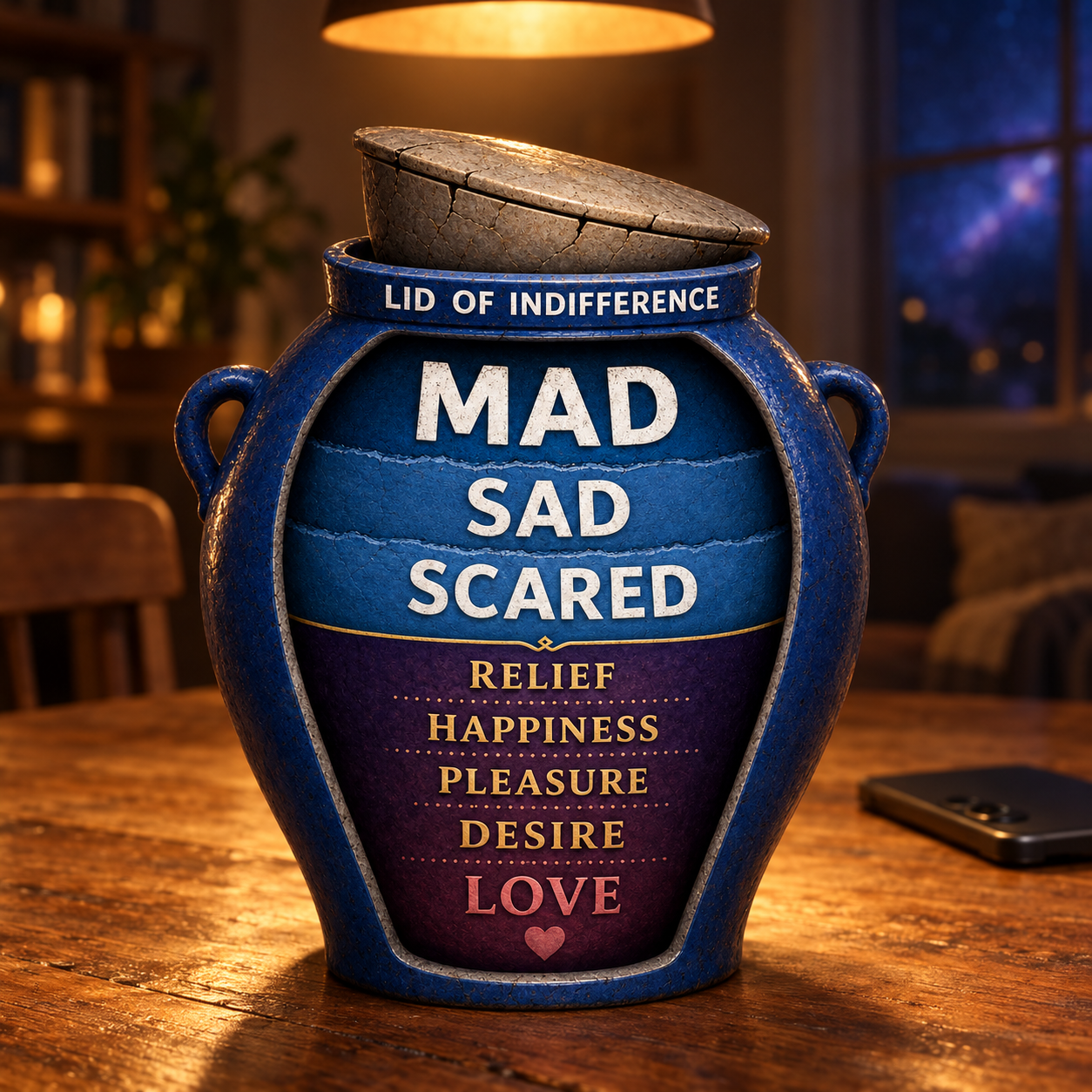
The difference shows up in language. “You only care about yourself” attacks. “When our plans changed and I didn’t hear from you, I felt unimportant. What I’m asking for is a call when you know you’ll be late” names a behavior, its impact and a request.
Repair needs the same specificity. “I’m sorry you got upset” leaves responsibility with the person who was hurt. “I raised my voice and called you a name. That was wrong. Next time I need a break, I’ll say so before I reach that point” names the harm and a change. Our tradition calls that teshuvah: not just regret, but a different response the next time the same moment comes.
These practices require safety. Where coercion, abuse or intimidation is present, protection comes first. Relationship skills must never become one more demand that a harmed person accommodate mistreatment.
What Families Can, and Can’t, Do
Families cannot negotiate international AI agreements. Relationship education is no substitute for responsible governments, credible deterrence, enforceable protections or ethical technology design. Israel, one of the world’s great centers of AI innovation, has a particular stake in getting those institutions right.
But institutions are made of people. The engineers, diplomats and legislators who will shape these technologies were once children at someone’s kitchen table, or someone’s Shabbat table. What they learned there about listening, fairness, boundaries and repair will shape what they are capable of agreeing to.
That is why these skills belong wherever people can reach them before a crisis: in schools and pre-army programs, in workplaces and yeshivot, in services for soldiers, reservists and their families, and in every community trying to hold together after grief.
Na’aseh V’nishma
At Sinai, our ancestors said, “Na’aseh v’nishma,” we will do and we will understand. The order matters. Some things are understood only by practicing them.
Relationship skills work the same way. No one becomes a better listener by agreeing that listening is important. We learn it one conversation at a time.
Friedman warns that we will either rise together by building healthy interdependencies or fall together. Moses is not coming down with new tablets. We will have to write the norms for this age ourselves, and we will write them out of the habits we practice with the people closest to us.
The technological future can feel impossibly large. A parent can still make a consequential choice tonight. Put down the phone. Ask a question. Hear the answer. Own something that needs to change.
Our children are entering a world of extraordinary power. They need adults who can show them how to handle it, and how to treat the people whose lives it touches.
Related Topics
Related Posts