


Progressive Realism©? Same old same old
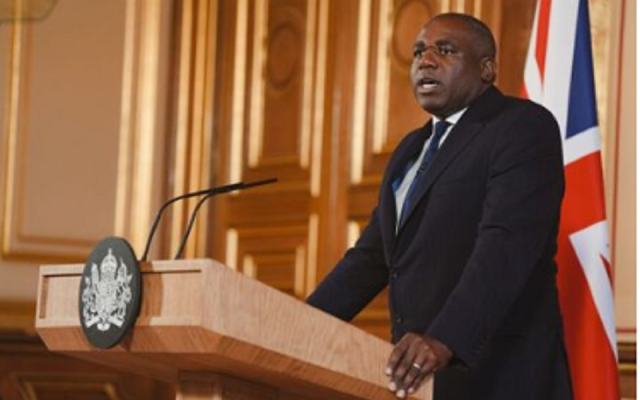
The UK has a new approach to Foreign Policy, which, as the Attorney General Lord Hermer made clear last week, is not like the Nazis. He also made it clear that anyone who thinks differently may, or probably does, think like Nazis. After some people mysteriously found this offensive, the Prime Minister’s office (not him) clarified his words, which they described as “clumsily expressed” but rejected any criticism.
Hermer noted that he was drawing on the intellectual underpinnings of Foreign Secretary David Lammy, and their government’s principled approach of “Progressive Realism”. This groundbreaking approach, which sets the UK above the world in moral and ethical clarity was heralded by a speech, which also, according to the UK Foreign Office, has a name to be set in the annals of history; The Locarno Speech, setting it apparently alongside perhaps Churchill’s speech in Fulton Missouri and Lincoln’s Gettysburg Address. Only Lammy’s speech was named after a room in his office. It was also launched with an article in the authoritative journal Foreign Affairs.
Let’s start with the triviality – naming a doctrine yourself, before you’ve seen how it works takes some moxy. Or hubris. Lammy can lay some claim to intellectualism; degrees from London and Harvard, but those feeling less than generous to the Foreign Secretary may think back his appearance on the popular intellectual tv quiz show Mastermind where he was, and still is, widely mocked for his answers, and where his specialist subject was not Clausewitz or the Treaties of Westphalia, but boxer Muhamed Ali.
Worse than that perhaps, despite Lammy stating “I call our new approach Progressive Realism.” It is not his phrase.
As public intellectual Robert Wright notes in the Washington Post:
“‘Progressive Realism,’ according to Wikipedia, is a foreign policy paradigm largely made popular by Robert Wright.’ That’s me!”
Wright is critical of Lammy’s understanding of Progressive Realism.
The Locarno Speech© on Progressive Realism© is a very political speech, so political that large parts had to be redacted before it could be posted on a government site. It bigs up past Labour achievements and covers all aspects of government.
Labour Prime Minister Tony Blair gets a mention, as a moderniser, not for his, and then Foreign Secretary Robin Cook’s, Ethical Foreign Policy© which dragged the UK into the Iraq War, universally considered now not to have been very ethical. Or clever.
So what is Lammy’s Progressive realism? In his words it is “Taking the world as it is not as we wish it to be. Advancing progressive ends by realist means.”
But that is not really a summary of the rest of the speech; the rest is a fudge about taking the world as how we perceive it and wish it to be.
Take the section of most interest to readers here;
“…restoring funding for UNRWA, standing up for international courts, taking tough decisions on export licences.
But not flinching from defending Israel against an Iranian regime that wants to destroy it, while at the same time working for that ceasefire in Gaza so we can surge in the aid and bring all the hostages home and advance a two-state solution.”
Take it apart and it loses any meaning.
Restore funding for UNWRA – without addressing or overcoming any of the issues within UNWRA and its founding principles or more importantly how it is supposed to operate in an area under the control of a power that regards it as aligned with hostile actors. That would be realism, David.
Standing up for international courts – shouldn’t we be standing up for the principles behind the institutions not problematic institutions themselves deviated by political pressures from the powers that dominate them, and when crucial powers refuse to engage with them. That’s progressive realism, David
Taking tough decisions on export licenses – By which he must mean taking decisions based on political interest rather than the law, which is the basis those decisions regarding Israel were made in the UK parliament. Gesture politics trumping legal principles is not progressive realism.
Not flinching from defending Israel against an Iranian regime that wants to destroy it – if you do virtually nothing to combat the proxies that Iran uses to achieve that goal and criticise Israel for attempting to undermine that goal, believe me David, you’re flinching and there is no realism.
At the same time working for that ceasefire in Gaza so we can surge in the aid and bring all the hostages home – if you are unwilling to engage in the fundamental problems in the functioning of Gaza, the circumstances that created the monstrous events of October 7, are not prepared to engage constructively in creating a Gaza where the people who live there can thrive, you are not being progressive or realist.
I won’t engage with his following the perpetual need to link the fate of hostages with other interests in perceived balance, beyond noting it happening. And noting it is distasteful.
Wright himself, father of Progressive Realism, notes that the Lammy policy as set out “is pretty much the same vision that has long guided his party” and more uncomfortably for Lammy is “not very different from the neoconservatism that has dominated Republican policy” which have together “played such a big role in creating the mess we’re in”.
He says “Lammy is telling us to keep doing what we’ve been doing but to start calling it progressive realism.”
Wright spots what seems to be a misunderstanding of ‘realism’ in international relations. It’s not being ‘realistic’; it’s literally taking states as you find them – hold them accountable for their engagement with other nations but do not attempt to impose ethical norms within them.
My own issue with Lammy’s thesis is that it is not coherent. You cannot seek to be realistic about how states are, and seek to uphold international law and institutions, without being realistic about those institutions and how states bend them to their own purposes.
Which brings us back to Hermer’s speech. He said that that those critical of Lammy’s doctrine advocate a policy “that Britain abandons the constraints of international law in favour of raw power.” He goes on to say that is a doctrine that is a derivation of “early 1930s “realist” jurists in Germany, most notably Carl Schmitt, whose central thesis was in essence the claim that state power is all that counts, not law.”
And in a sentence anyone who critiques David Lammy’s policy of Progressive Realism © set out in his Locarno Speech© is hanging out intellectually with the Nazis.
As Professor Richard Ekins KC of Policy Exchange notes:
“Carl Schmitt is not, mercifully, a household name in Britain but he does still feature in scholarly debate, often when an academic lawyer wishes to smear his or her opponents without evidence or argument.”
Hermer didn’t retract or apologise because it’s what he thinks and it is what Lammy thinks and it is what has underpinned centre left thinking the UK for decades, drawing on the legacy of Blairism. It can be summed up as follows; we are good people who know what we are doing, we want good outcomes and what we do to achieve those outcomes will be good. And anyone who opposes us in these noble ambitions must be bad.
Progressive? Depends how you define the word. Realist? Absolutely not.
h/t to Joshua Rosenberg whose article drew my attention to some elements of this post.