Pronouns Are Idols: Stop Using Them for God and Each Other
Pronouns Are Idols: Stop Using Them for God and Each Other
If monotheism rejects idols, why do we keep worshiping the idol of grammar?
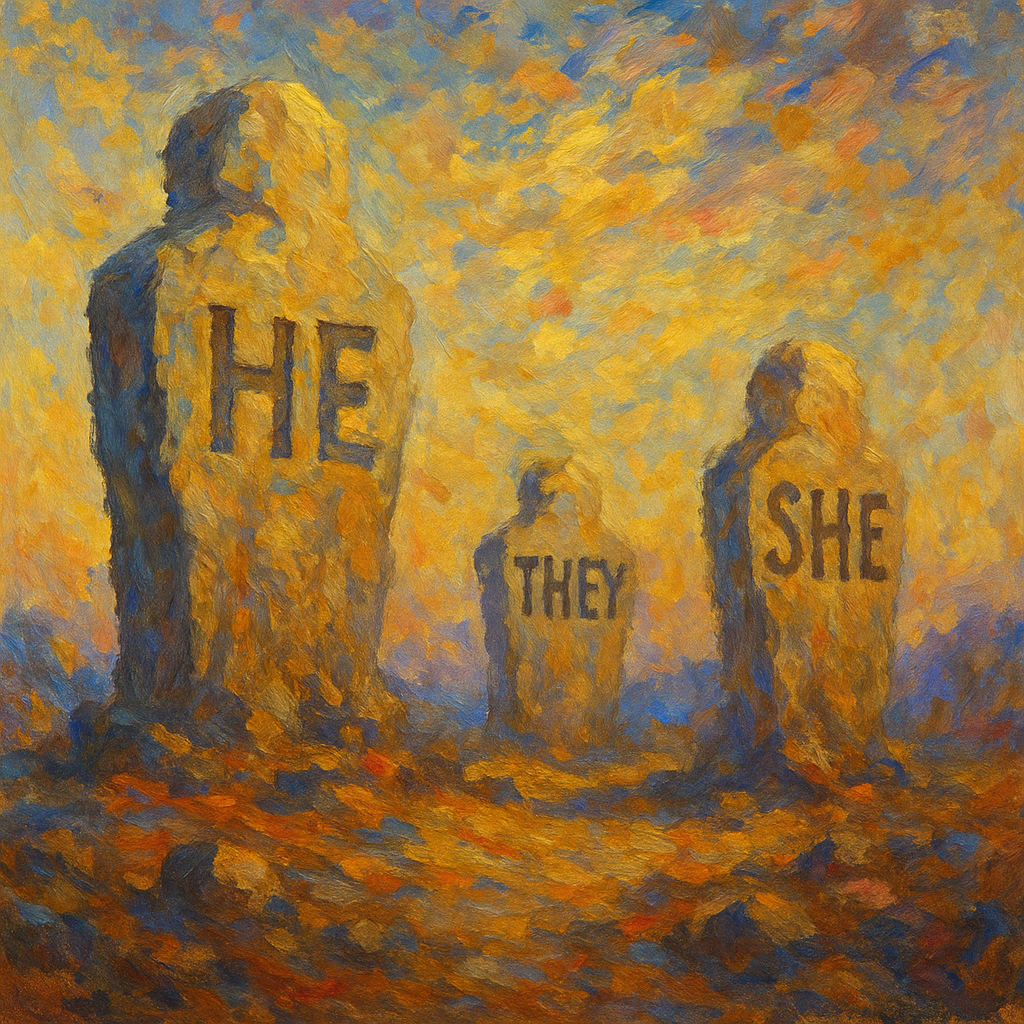
Pronouns may look harmless, but they carry the weight of idols. They reduce the Divine to gender and number, and they shrink human beings into grammatical categories. Monotheism teaches us to reject false images of God, yet our everyday speech traps the Infinite in linguistic molds. In the same way, our cultural reliance on pronouns risks reducing people to abstractions rather than honoring them as full selves.
Pronouns and Monotheism
At the heart of monotheism is the claim that God is One, transcendent, and beyond human category. Yet when we refer to God as He, Him, or His, we pin the Infinite to a human frame. In Hebrew, Greek, Latin, and English alike, grammar forces God into gender. Shifting to She simply flips the problem, while They risks undermining the singularity of God.
If God is beyond all form, why do we persist in boxing the Divine into pronouns designed for creatures like us? For centuries, mystics and philosophers have warned against the idolatry of language. Maimonides insisted that we can never describe what God is, only what God is not. In this light, pronouns become subtle idols: attempts to carve out a human shape for the formless. Names, attributes, or metaphors—The Eternal, The Holy One, The Merciful—honor God without forcing God into gendered or plural categories.
Pronouns and People
This insight extends directly into our cultural struggles today. In an age of heightened awareness around gender and identity, pronouns have become a flashpoint. People rightly insist that their chosen identity be respected. Misgendering is not simply a slip of the tongue; it feels like erasure.
But the problem with pronouns goes deeper. Persistent reliance on them reduces people to categories rather than recognizing them as full persons. A pronoun is not a human being; it is a stand-in, a shorthand, a token that replaces the complexity of the person in front of us. Over time, habitual use of pronouns can subtly dehumanize, training us to think of people as “he’s” and “she’s” rather than as Yosef, Fatima, or Alex. It replaces real humans with notions of humans—less worthy of consideration, less deserving of attention.
The most respectful solution may also be the simplest: use people’s names. Names carry the dignity of selfhood. They are chosen, shared, and unambiguous. Just as we call on God by Name rather than by limiting pronouns, we can honor people by the names they bear.
The Practical Exception
Of course, there are moments when we do not know someone’s name and cannot be expected to. In those cases, neutral placeholders such as they serve a temporary function. But the ethical path is clear: once a name is known, use it.
How We Can Begin the Transition
For many, the idea of eliminating pronouns may feel overwhelming. But change begins in small, deliberate steps:
- Practice in writing: When drafting an email or a note, replace pronouns with the person’s name. Notice how it sharpens clarity and increases respect.
- Practice in speech: In conversation, repeat names more often than you might think natural. Instead of “He said,” try “David said.” It may sound formal at first, but it affirms the presence of the person.
- With God-talk: In prayer or study, substitute God’s Name or attributes—The Eternal, The Merciful, HaShem—where habit might insert “He.”
- With others: When you meet someone new, take care to remember and use their name. If forgotten, ask again rather than defaulting to a pronoun.
This is less about policing language than about cultivating a habit of reverence. Over time, it changes how we perceive others—not as pronoun-shaped categories, but as unique beings with names and stories.
A Shared Act of Reverence
Seen this way, theology and culture converge. Whether we are speaking of God or of one another, pronouns are blunt instruments. They classify where classification may be misleading or disrespectful. Names, by contrast, affirm the irreducible reality of the one addressed.
Perhaps it is time to recognize that avoiding pronouns is not just a concession to political correctness, but a shared act of reverence. Reverence for the Divine, who transcends all human categories. Reverence for people, who deserve to be recognized not as abstract pronouns but as unique beings worthy of attention.
If we keep talking about one another and about God through pronouns alone, we will keep seeing shadows instead of persons, idols instead of the Infinite. So here is a challenge: in your next conversation, in your next prayer, in your next piece of writing—try it. Drop the pronouns. Use names. You may be surprised at how much more human—and more holy—your words become.
Addendum: A Practical Prompt
If you’d like to test this in your own writing, here’s a ready-to-use prompt for AI or editing assistance:
Prompt (Theologically Inclusive, Flow-Preserving):
“Please carefully edit the following text to replace pronouns with names wherever possible. For human references, use the actual person’s name or role instead of ‘he,’ ‘she,’ ‘they,’ ‘him,’ ‘her,’ or ‘them.’ For references to God, replace pronouns like ‘He,’ ‘Him,’ or ‘His’ with inclusive Divine names or attributes such as ‘God,’ ‘The Eternal,’ ‘The Merciful,’ or ‘HaShem,’ depending on context.
When revising, prioritize:
- Clarity and respect: always make it clear who is being referred to.
- Minimizing repetition: alternate between names, roles, or Divine attributes to preserve flow.
- Faithfulness to meaning: never change the intent of the text.
- Natural grammar: ensure the revision reads smoothly in English, as if it were originally written that way.
The goal is to minimize pronouns and maximize meaningful names or attributes while maintaining readability, dignity, and theological integrity.”
Before-and-After Examples
1. Non-Religious (Conversation)
| Before | After |
|---|---|
| Maria said she would meet David at the café. He told her he would arrive early, but she didn’t trust him to be on time. | Maria said Maria would meet David at the café. David promised to arrive early, but Maria doubted David’s punctuality. |
2. Religious (Prayer Translation)
| Before | After |
|---|---|
| Blessed is He who spoke, and the world came to be. Blessed is He who says and does. Blessed is He who decrees and fulfills. | Blessed is The Eternal, who spoke, and the world came to be. Blessed is The Eternal, who speaks and acts, who decrees and fulfills. |