Prophets, Counter-Myths, and Rediscovering MLK Jr.
One of the stranger developments of the modern American political landscape is that both the activist left and the activist right increasingly approach history through the same structure.
They begin with a legitimate observation: the simplified civic mythology taught to children often omits complexity, contradiction, hypocrisy, and conflict. From there, however, they move toward total inversion. The heroes become villains. The covenant becomes fraud. The nation becomes either irredeemably evil or irredeemably corrupted.
Howard Zinn did this from the left. Increasingly, figures on the modern right are doing the same thing in reverse.
That realization hit me while listening to Matt Walsh’s “Real History” series. My immediate reaction was that it sounded like right-wing Howard Zinnism. The same narrative structure was present beneath the ideological reversal. The audience is told that they have been lied to by institutions, that official history is propaganda, and that the hidden truth overturns the moral legitimacy of the public narrative itself.
There is often truth inside these critiques. American schools do sanitize history. They simplify the Founders. They flatten the Civil Rights Movement into moral cartoons suitable for elementary school posters. But there is a difference between restoring complexity and destroying proportion.
The modern tendency is flattening.
The Founders become nothing but slaveholders. The Civil Rights Movement becomes the origin point of modern ideological excess. Great figures are stripped down into either mascots or frauds. Complexity becomes impossible because ideological systems require moral totality.
Ironically, it was through this backlash environment that I rediscovered Martin Luther King Jr.
Like many Americans, I had inherited the flattened version of King. The civic mascot. The generic preacher of kindness. The “be nice to people” version of American memory. I respected him in the abstract, but I did not understand him.
That changed when I reread Letter from Birmingham Jail after spending time reading the Hebrew prophets and Abraham Joshua Heschel.
Suddenly the entire text transformed.
King no longer appeared as a generic activist appealing to empathy. He appeared as something much older and much more dangerous: a prophetic figure operating within the covenantal tradition.
The structure was unmistakable once seen through that lens. The moral indictment of a society betraying its own principles. The distinction between legality and justice. The critique not merely of overt evil, but of moderates who prefer order to righteousness and procedural delay to moral urgency. The insistence that a nation can violate its covenant while still being called toward redemption.
This was not modern activist language. This was prophetic language.
The prophets of Israel were never merely “nice.” Isaiah, Amos, Jeremiah — these were figures of confrontation, moral urgency, and covenantal accusation. They spoke not as nihilists trying to annihilate their society, but as witnesses calling it back to its obligations.
That was what King was doing.
And it was impossible to fully understand this without also encountering Abraham Joshua Heschel.
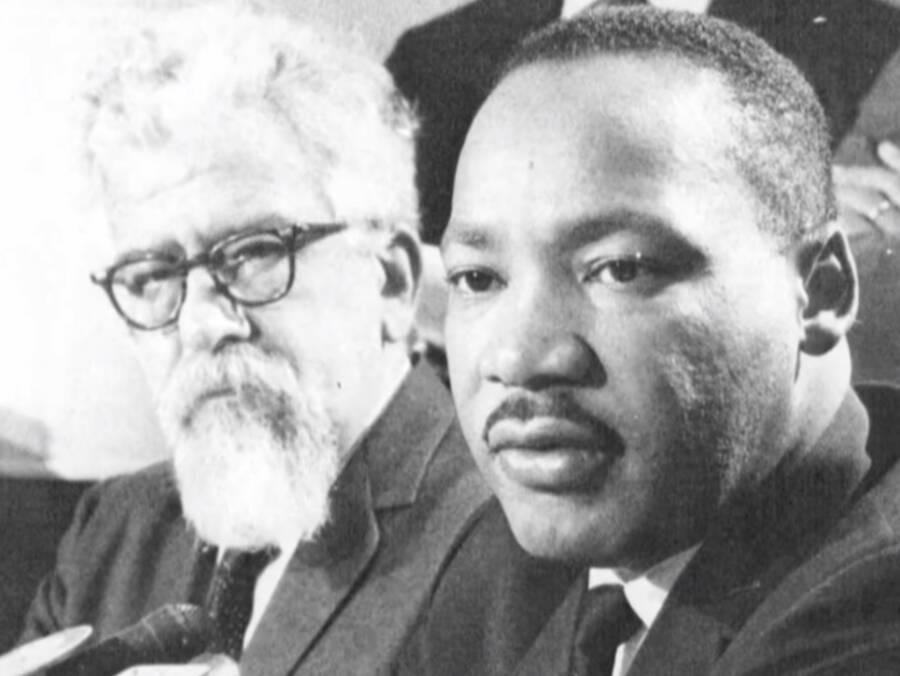
Modern America often remembers the famous image of Heschel marching beside King in Selma, but the deeper connection is theological and philosophical. Heschel’s work The Prophets describes the prophet as the person who cannot become numb to injustice, indifference, or cruelty. The prophet experiences moral reality with unbearable sharpness. Heschel called this divine pathos.
Once I encountered Heschel, King’s rhetoric suddenly became intelligible in a new way.
King was not merely a political reformer. He was functioning as a prophet of the American covenant.
He was appealing simultaneously to scripture, natural law, the Declaration of Independence, the Constitution, and the moral conscience of the republic itself. He was not rejecting America wholesale, nor was he sanctifying it. He was accusing it of violating its own promises.
This also clarified why modern ideological frameworks so often misunderstand him.
The activist left criticizes King as insufficiently revolutionary. The activist right increasingly attempts to recast the Civil Rights Movement as the root of modern decay. Both approaches flatten him because both require him to fit into contemporary tribal categories.
But the real King exceeds those categories.
What finally shattered the flattened image entirely for me was reading Where Do We Go from Here?
There, King revealed himself not merely as a prophetic preacher, but as an intellectual heavyweight of extraordinary synthesis. One passage in particular struck me with almost frightening clarity:
“Power without love is reckless and abusive, and love without power is sentimental and anemic.”
In a single sentence, King synthesized Christian ethics, political realism, moral psychology, and the problem of power itself.
This was not shallow moralism. Nor was it naïve pacifism. King understood something many modern ideologies fail to grasp: moral systems that reject power become impotent, while power detached from moral ends becomes monstrous.
What astonished me was not simply the wisdom of the statement, but the compression. The ability to bring together so many tensions — strength and compassion, justice and force, morality and political reality — into language that was simultaneously accessible and philosophically rigorous.
For the first time, I realized I had mistaken King for a symbol when he was in fact a formidable thinker.
And perhaps that is the deeper problem with how modern America engages its historical figures.
We no longer know how to recognize greatness without demanding perfection. We either canonize people into harmless mascots or destroy them through total moral reduction. The result is a culture increasingly incapable of serious inheritance.
The prophets understood something different.
A covenantal civilization does not require flawless heroes. It requires figures capable of calling a society back toward its highest obligations without collapsing into either idolatry or nihilism.
King belonged to that tradition.
And perhaps the greatest irony of modern ideological history is that in attempting to expose false myths, it often blinds us to genuine greatness.