


Proudly Zionist: Alicia Post Builds Bridges Between America and Israel
The Jerusalem Post Conference in New York brought together an extraordinary lineup of leaders, innovators, advocates, and change-makers from across the Jewish world. While the speakers on stage shared powerful insights and inspiring stories, some of the most meaningful conversations happened away from the spotlight.
One of those conversations was with Alicia Post.
I’ve known Alicia for more than two decades, and throughout that time she has consistently stood out as one of the most dynamic, resourceful, and dedicated professionals in the Jewish community. Whether building bridges between American Jews and Israel, mentoring the next generation of leaders, or championing Religious Zionism with passion and conviction, Alicia has devoted her career to strengthening the Jewish people.
After years of trying to pin down time for a full interview, we finally found a quiet moment amid the energy of the conference to reconnect. What followed was a candid and insightful conversation about leadership, Jewish identity, Israel advocacy, and the important work she is leading as Executive Director of Religious Zionists of America–Mizrachi.
When someone glanced at Alicia Post’s business card recently and suggested she might want to drop the word “Zionist,” her response was immediate and unequivocal. For Post, that word is not a liability — it is a declaration of identity, one she has built a 26-year career around defending, amplifying, and living out.
Post is the Executive Director of the Religious Zionists of America – Mizrachi, a movement that strives to build a strong bridge between Israel and the American Jewish community, support the state of Israel, and ensure that American Jews are connected to and taking responsibility for the state of Israel and the future of the Jewish people. She holds the distinction of being the first woman — and first non-rabbi — to lead the organization in its history.
Courtsey of Aaron Herman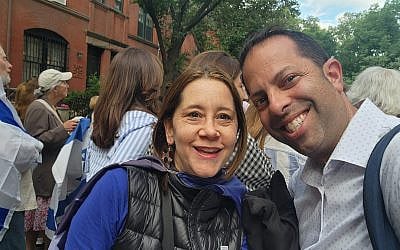
Breaking the Mold
The milestone is not lost on Post. She has navigated rooms that were not always designed with her in mind, and done it with enough grace that the rooms themselves begin to change.
“I’m the first female, first non-rabbi. Of course, my joke is — if I was a rabbi, I wouldn’t be a female.”
Her path to the role began at the very founding of Birthright Israel, an organization that has since become a cornerstone of American Jewish identity. She has spent more than two decades in advocacy, organizing, and community building.
“I have worked for Israel and the Jewish people for 26 years — not to date myself.”
What makes Religious Zionists of America – Mizrachi, she explained, is the fusion of Zionism with Torah-centered identity. For Post, the organization’s mission is inseparable from both its love of Israel and its grounding in Jewish law and tradition.
“It’s not just Israel and the Jewish people, but it’s the Torah and it’s Religious Zionism — that’s really the essence of who we are and what makes us who we are.”
The Next Generation on the Front Lines
Under Post’s leadership, Mizrachi has invested heavily in connecting with younger American Jews at exactly the moment antisemitism and anti-Israel sentiment are surging on college campuses and in public life. The organization runs a college fellowship program in partnership with Yavneh, training student leaders across the country, and a Maslul program in Israel.
“We have amazing college fellows around the country that we’re helping to train. We’re really trying hard to connect to younger generations.”
She is not speaking abstractly. Post is herself on the younger end of executives who have run the organization, and she is acutely aware of where the battles of this moment are being fought.
“Not only am I the first female, but probably on the younger side of people that have run the organization as well. And it’s just so important now more than ever.”
The stakes feel personal to Post. She has watched the landscape shift: a generation of young Jews facing hostility on campuses, navigating social media pile-ons, and asking questions their parents never had to ask. Her answer is to meet them where they are and to equip them.
Social Media, Strategy, and the 80/20 Rule
Post was an early adopter of social media — she jokes about having “six degrees of Alicia Post” — and she has thought carefully about how advocacy organizations should use these tools in an era of silos and viral moments no one planned for.
“Every day when I see comments, it’s so hard not to reply — but you have to put your efforts in the right place.”
Her guidance for young Jewish advocates navigating hostile comment sections comes down to a principle she absorbed years ago in the Israel advocacy world: the 80/20 rule. Not everyone can be reached, and trying to reach those who cannot is a waste of limited energy.
“You’re never going to convince certain people and it’s not worth it. Let’s engage the people who understand, who have a little bit, who just need the right wording, who need the right connection, who need the community.”
On her own social media presence, Post is candid. Her camera roll contains far more documentation of her work than her audience ever sees.
“Somebody came up to me the other day and said, ‘Thank you, you do so much.’ And I said, ‘Oh, I don’t even post like an ounce of what I’m doing.’ I have a roll of photos of all the people I’ve seen and the events I went to — but I’d rather be out there doing it.”
For Post, the platform question cuts deeper than timing or frequency. It is also a question of voice and purpose.
“Do I post things that are just entertaining and people are going to engage with? Or am I really sharing content that matters, even if it doesn’t get as many views because it’s not that entertaining bit, but it’s important?”
Fear, Pride, and What It Means to Go Viral
On the question of Jewish pride and public expression — particularly for young people asking whether to speak up or stay silent — Post offers something more nuanced than simple encouragement. She affirms the importance of showing up loudly and joyfully as Jews, but she does not pretend the stakes are cost-free.
“There is a hesitancy. Every time I think about posting something — first of all, is it on my personal account or my work account? And there is that fear.”
She named the anxiety that many feel but few leaders admit to openly. The permanence of social media weighs on her.
“You don’t know the one thing you’re going to post that’s going to really take off. It could be the best thing — but it also may not be the thing you want to be known for. And people don’t realize that social media lives on. Like, even when it’s gone, you know that it’s there.”
And yet, Post does not counsel silence. She counsels wisdom, strategy, and showing up with intention. Jewish joy, she insists, matters.
“Show your Jewish pride, your Jewish joy. It’s okay to be loud and proud — we don’t realize how important that is.”
It is a rare thing: a leader who names the anxiety many feel but few admit to, and who nevertheless shows up fully — for the campuses, the colleges, the high schoolers, the fellows, the future. That candor, honest about difficulty and clear-eyed about the work, is perhaps what has defined Post’s quarter-century of service.
Twenty-six years in, she is not slowing down. There is, she says, a lot to do.