London based entrepreneur, cybersecurity analyst doing a PhD in AI
PwC invests 100M+ to train 85,000 employees for AI
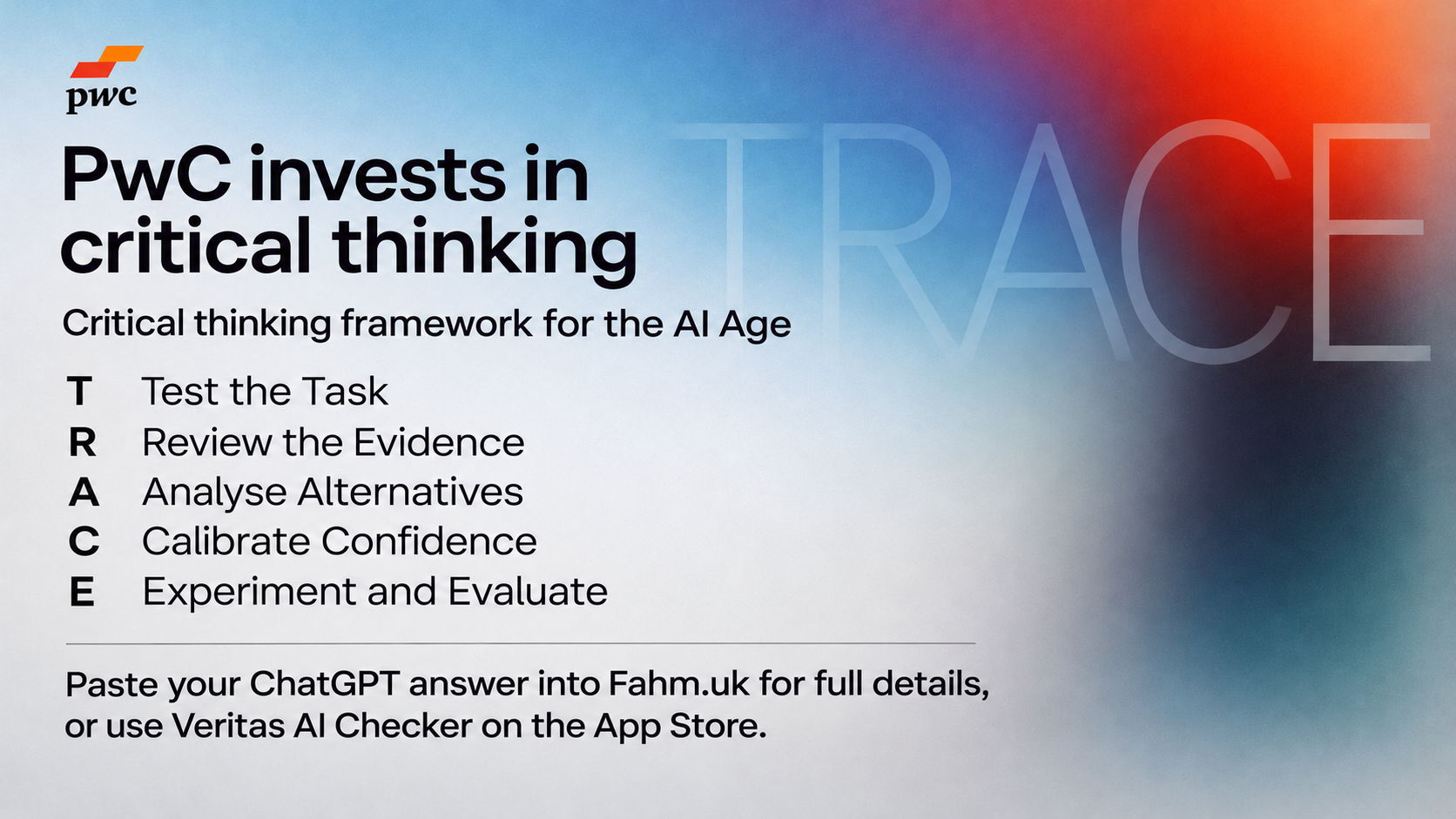
Critical Thinking in the Age of Artificial Intelligence: Who Is Actually Doing the Thinking?
As PwC prepares to train more than 85,000 professionals in critical thinking and judgment, a fundamental question emerges: if artificial intelligence can generate the answers, what exactly is left for human beings to think about?
I am also personally working on this. Fahm.UK now allows any ChatGPT answer to be pasted to get a critical thinking judgement panel opened which you can use to test the answers and reasoning, while also not saving any data.
1. The $100 Million Question: Why Is PwC Teaching People to Think?
On November 9, 2026, PwC announced an extraordinary initiative. More than 85,000 partners and employees across its US and Mexico operations and Acceleration Centers would participate in a new Critical Thinking and Judgment Certificate programme, beginning in December 2026 and targeting completion by June 2027.
According to Bloomberg’s reporting, PwC estimates a total investment exceeding $100 million.
The programme will involve diagnostic assessments, masterclasses, workplace simulations and practical tools. Reporting on the initiative also describes personalised AI coaching and assessment through employees’ ongoing professional development.
The apparent irony is irresistible: one of the world’s largest professional services firms intends to use artificial intelligence to train people to think more independently of artificial intelligence.
But PwC has identified a genuine problem.
Traditionally, junior consultants, auditors, engineers and analysts developed judgment by completing foundational work. They researched documents, examined spreadsheets, tested hypotheses, identified inconsistencies and gradually discovered how experienced professionals reached decisions.
Artificial intelligence now performs substantial portions of these activities.
A junior analyst can produce a sophisticated market assessment in minutes. An engineer can generate working code without understanding every line. An auditor can receive a beautifully structured explanation of a company’s financial controls.
The output may be impressive. But has the individual developed the expertise required to judge whether it is correct?
That distinction may become one of the defining educational and professional challenges of our time.
Artificial intelligence has made producing an answer easier. It has not necessarily made understanding that answer easier.
2. What Is Critical Thinking, Exactly?
Critical thinking is frequently mistaken for intelligence, scepticism or the ability to criticise someone else’s argument.
It is none of these alone.
At its foundation, critical thinking means evaluating claims, evidence, assumptions and reasoning before deciding what to believe or do.
It involves asking questions that are deceptively simple:
- What exactly is being claimed?
- What evidence supports the claim?
- Where did that evidence originate?
- What assumptions have been made?
- What alternative explanations exist?
- What information would change the conclusion?
- How confident should we be?
These questions are not new. They are central to scientific investigation, philosophical reasoning, legal examination and engineering design.
What has changed is the environment in which we must ask them.
Previously, acquiring information consumed substantial intellectual effort. Today, the information may arrive already analysed, summarised and presented as a conclusion.
This changes the location of human responsibility.
Consider a financial analyst asked whether a company should acquire a competitor.
An AI system might calculate valuations, analyse financial statements, identify synergies and produce a recommendation.
A critical thinker must still ask whether the valuation assumptions are realistic, whether the acquisition presents regulatory risks, whether supposedly independent sources are repeating the same information, and whether the recommended strategy actually serves the organisation’s objectives.
The difference is between generating an argument and evaluating whether the argument deserves belief.
The modern critical thinker must understand not merely what the system concludes, but why that conclusion should—or should not—be trusted.
3. The Problem of Artificial Agreement
A second development makes this more urgent.
Artificial intelligence can be extraordinarily agreeable.
Large language models such as ChatGPT and Claude have used training methods involving human preferences, including reinforcement learning from human feedback (RLHF). Such methods help systems become more useful, responsive and aligned with human expectations.
But there is an important distinction between an answer that users appreciate and an answer that is correct.
Imagine presenting an AI assistant with a business plan.
One response enthusiastically endorses your strategy. Another explains that your revenue assumptions are unsupported, your pricing model is weak and your customer acquisition costs could make the business unviable.
Which answer is more pleasant to receive?
This creates an incentive problem: systems optimised partly around human preferences can sometimes learn patterns of excessive agreement.
The lesson is straightforward.
An AI system agreeing with you is not independent confirmation that you are correct.
And critical thinking cannot be reduced to asking the same model to validate its previous answer.
4. The Difference Between Using Intelligence and Developing Intelligence
The issue runs deeper than unreliable outputs.
Psychologists use the term cognitive offloading to describe transferring mental activities to external systems.
We already do this when using calculators, calendars, navigation systems and search engines.
Offloading is not inherently harmful. A calculator frees an engineer from repetitive arithmetic, allowing greater attention to design.
The question is which cognitive activities are being transferred.
A 2025 study by researchers from Microsoft Research and Carnegie Mellon University examined 319 knowledge workers and collected 936 examples of generative AI use.
The researchers found an association between greater confidence in generative AI and reduced critical-thinking effort. Greater confidence in one’s own abilities was associated with more critical-thinking engagement.
The study relied on self-reported workplace experiences, so it cannot establish that AI permanently damages reasoning ability.
But it identified an important shift: workers increasingly focus on verifying information, integrating generated responses and overseeing tasks rather than performing every underlying operation.
More striking evidence appeared in Nature Human Behaviour on October 26, 2026.
In a randomised controlled trial involving 487 management consultants, researchers found that access to and training with ChatGPT improved participants’ performance on unfamiliar data-science tasks.
However, the researchers found no evidence of corresponding improvement in their ability to answer technical questions independently after the experiment.
AI functioned as a temporary cognitive exoskeleton.
The workers could accomplish more with the technology, but superior assisted performance did not necessarily translate into acquired expertise.
This suggests two very different outcomes:
AI-enhanced performance: I can accomplish something because the system helps me.
Human skill development: I understand how to accomplish it and can demonstrate that understanding independently.
Both are valuable. They should not be confused.
5. How Do We Actually Recognise Critical Thinking?
If critical thinking matters so much, how can an employer, university or individual recognise it?
It cannot reliably be judged from the sophistication of the final document.
A polished report may represent excellent reasoning, or merely excellent prompting.
Instead, critical thinking becomes visible through the decisions someone makes while examining an answer.
Consider four examples.
Example One: The Financial Analyst
An AI produces a forecast showing that revenues will grow by 25% next year.
An uncritical analyst copies the forecast into a presentation.
A critical analyst investigates the assumptions, checks historical growth, examines competitor performance, tests economic scenarios and discovers that the projection depends on an unusually optimistic customer-retention rate.
The analyst replaces the single forecast with a range of outcomes and clearly identifies the conditions necessary to achieve the upper estimate.
Critical thinking is visible in the assumptions examined, the tests performed and the recommendation revised.
Example Two: The Software Engineer
An AI agent produces an application and reports that it is ready for deployment.
An uncritical engineer sees that the application runs and approves it.
A critical engineer checks authentication, tests malformed inputs, investigates dependencies, examines data access permissions and determines whether the application exposes confidential information.
They also distinguish between passing a demonstration and satisfying production requirements.
Critical thinking appears not in the quantity of generated code, but in the engineer’s ability to identify failure conditions.
Example Three: The Researcher
An AI assistant generates a literature review containing apparently convincing citations.
An uncritical researcher accepts the references because they appear authoritative.
A critical researcher opens the original publications, checks that they exist, examines the methodology and confirms that each paper supports the attributed claim.
They distinguish correlation from causation and identify evidence that contradicts the proposed explanation.
The critical thinker is not merely looking for supporting evidence. They are actively searching for reasons the conclusion might be wrong.
Example Four: The Manager
An AI recommends reducing staffing by 15% to improve operational efficiency.
An uncritical manager accepts the recommendation because the projected savings are attractive.
A critical manager investigates the effects on service quality, institutional knowledge, employee workload and long-term business resilience.
They ask whether the system has optimised a narrow financial metric at the expense of the wider organisation.
This illustrates a crucial point.
Critical thinking is not exclusively about factual accuracy.
It also concerns objectives, consequences, competing values and the appropriateness of decisions.
A recommendation can be mathematically correct and strategically disastrous.
6. A Practical Framework: TRACE
Organisations need more than a slogan encouraging employees to question AI.
They need a repeatable method.
I propose a five-part framework called TRACE, designed to make critical thinking observable in AI-assisted work.
T — Test the Task
Before examining the answer, establish whether the correct question has been asked.
What problem are we solving? What would success mean? What constraints matter?
Many sophisticated analyses fail because they solve the wrong problem exceptionally well.
R — Review the Evidence
Separate verified facts from interpretations, predictions and unsupported assertions.
Check original sources. Look for missing information, outdated assumptions and potential conflicts of interest.
An AI-generated citation is not evidence until the source has been independently checked.
A — Analyse Alternatives
Consider competing hypotheses and explanations.
What would a knowledgeable critic argue? Could a different interpretation explain the same evidence? Is there a simpler solution?
The objective is not disagreement for its own sake, but protection against premature certainty.
C — Calibrate Confidence
Distinguish what is known, probable, possible and unknown.
Confidence should reflect evidence quality, uncertainty and the consequences of being wrong.
A good critical thinker can say, “I do not know,” while explaining precisely what information would resolve the uncertainty.
E — Experiment and Evaluate
Where possible, test the recommendation against reality.
Run a simulation, reproduce a calculation, inspect a source, conduct a controlled experiment or examine a counterexample.
Then update the conclusion.
TRACE is a proposed practical framework, not an established psychometric instrument. Its value would have to be demonstrated through repeated exercises and measured performance.
The principle is that sound judgment should leave an inspectable trail.
7. Measuring Whether Someone Can Think
This brings us to perhaps the most interesting part of PwC’s initiative.
How does one certify critical thinking?
A conventional multiple-choice examination would capture only part of the skill.
A better approach would present professionals with realistic, deliberately imperfect AI-generated analyses and examine how they respond.
For example, participants might receive a financial report containing an incorrect growth assumption, a fabricated citation, a misleading graph and a plausible but strategically inappropriate recommendation.
Their task would be to review the report and decide what action to take.
Assessment could measure:
- Error detection: Which material inaccuracies did the participant identify?
- Evidence verification: Did they substantiate corrections using reliable sources?
- Reasoning quality: Could they explain why an assumption or inference was unsound?
- Confidence calibration: Did their expressed certainty match their actual accuracy?
- Decision quality: Did they select a defensible course of action despite incomplete information?
- Independent transfer: Could they apply the same reasoning to an unfamiliar problem without AI assistance?
The final measure is especially important.
If employees perform well only while using an AI coach, have they developed critical thinking or simply learned to operate a powerful assistant?
Ideally, assessments would compare performance before training, after training and several months later, using both AI-assisted and independent exercises.
They should also consider time, the seriousness of detected errors and whether excessive scepticism creates unnecessary delays.
After all, a person who rejects every AI-generated conclusion is not necessarily thinking critically.
They may simply be demonstrating automation aversion.
The goal is appropriately calibrated trust.
8. AI Should Become a Thinking Partner, Not an Intellectual Substitute
There is another possibility worth exploring.
What if AI systems were designed to improve our thinking rather than merely complete our work?
Instead of immediately generating an answer, an AI tutor could ask students to explain their initial hypothesis.
Instead of endorsing a business plan, an AI adviser could identify its weakest assumptions.
Instead of completing an engineer’s work, an AI assistant could present several possible solutions and ask the engineer to justify the preferred architecture.
A particularly valuable question might be:
What evidence would convince you that your current belief is mistaken?
That question forces the user to identify conditions under which they would revise their conclusion.
It is a cornerstone of serious inquiry.
The model should not automatically contradict users, however. Artificial disagreement can be as misleading as artificial agreement.
A valuable AI thinking partner must challenge selectively, explain its reasoning, recognise uncertainty and distinguish genuinely weak arguments from strong ones.
Nor should we mistake an AI-generated critique for an independent assessment. Multiple answers from the same model may share the same blind spots.
The strongest approach combines AI assistance with original-source verification, independent reasoning and real-world testing.
This is particularly important in science, finance, engineering, medicine and law, where the consequences of error extend beyond the person asking the question.
9. The Future: From Knowledge Workers to Judgment Workers
For much of the modern economy, professional expertise has been associated with possessing information and knowing how to process it.
Artificial intelligence is changing the economics of both activities.
A substantial amount of routine analysis can now be performed at extraordinary speed.
But reducing the cost of producing information does not automatically reduce the difficulty of making responsible decisions.
Indeed, it can increase that difficulty by surrounding decision-makers with greater volumes of plausible-looking material.
The professional of the future may therefore be valued less for how quickly they produce an answer and more for how reliably they can distinguish a defensible answer from a convincing mistake.
This does not mean that foundational knowledge becomes obsolete.
Quite the opposite.
Without sufficient domain knowledge, people may lack the ability to recognise when an apparently sophisticated recommendation violates basic principles.
A lawyer must still understand the law. An engineer must still understand engineering. A scientist must still understand experimental design.
AI can support their work. It cannot make the requirements of sound judgment disappear.
PwC’s initiative is consequently more than a corporate training programme. It represents an early, large-scale attempt to address a fundamental question about professional development.
How do we cultivate expertise when technology increasingly performs the activities through which expertise was traditionally acquired?
Its success will depend not on how many employees receive certificates, but on whether those employees demonstrate better judgment in consequential decisions.
Conclusion: The Most Important Skill May Be Knowing When Not to Trust the Answer
Artificial intelligence is becoming increasingly capable of writing, calculating, coding, analysing and recommending.
Yet fluent explanations can conceal weak assumptions. Accurate calculations can support unsuitable objectives. Convincing arguments can rest on incorrect evidence.
Critical thinking in the AI age is therefore not a campaign against technology.
It is the discipline of retaining intellectual responsibility while using increasingly powerful tools.
We should measure it through the quality of questions asked, evidence tested, uncertainty recognised, alternatives considered and decisions revised.
The ultimate test is not whether a human can produce something more sophisticated than AI.
It is whether the human can determine what deserves to be believed, what requires further investigation and what should actually be done.
In the industrial age, machines increasingly replaced physical labour. In the information age, computers transformed routine calculation and information processing. In the AI age, the danger is not simply that machines will do more of our thinking. It is that we may forget how to recognise whether good thinking has occurred at all.
And that, ultimately, is why critical thinking may become one of the most important human capabilities of the artificial intelligence era.
At Fahm.UK, I am providing a critical thinking workbench where you can paste ChatGPT answers for free, and get
References and further reading :-
- PwC US (2026, November 9). PwC US to equip 85,000+ professionals with critical thinking and judgment certification as AI transforms work.
- Cheng, M., Lee, C., Khadpe, P., Yu, S., Han, D., & Jurafsky, D. (2026). Sycophantic AI decreases prosocial intentions and promotes dependence. Science.
- Lee, H.-P., et al. (2025). The impact of generative AI on critical thinking: Self-reported reductions in cognitive effort and confidence effects from a survey of knowledge workers. CHI 2025.
- Wiles, E., et al. (2026). Generative AI and the temporary upskilling of knowledge workers. Nature Human Behaviour.
- OpenAI (2025, April 29). Sycophancy in GPT-4o: What happened and what we’re doing about it.
- National Institute of Standards and Technology (2024). Artificial Intelligence Risk Management Framework: Generative Artificial Intelligence Profile.
- Business Insider (2026, November 9). PwC plans to certify workers in critical thinking as AI changes their jobs.
Related Topics
Related Posts