"These fragments I have shored against my ruins"
Queueing for Auschwitz
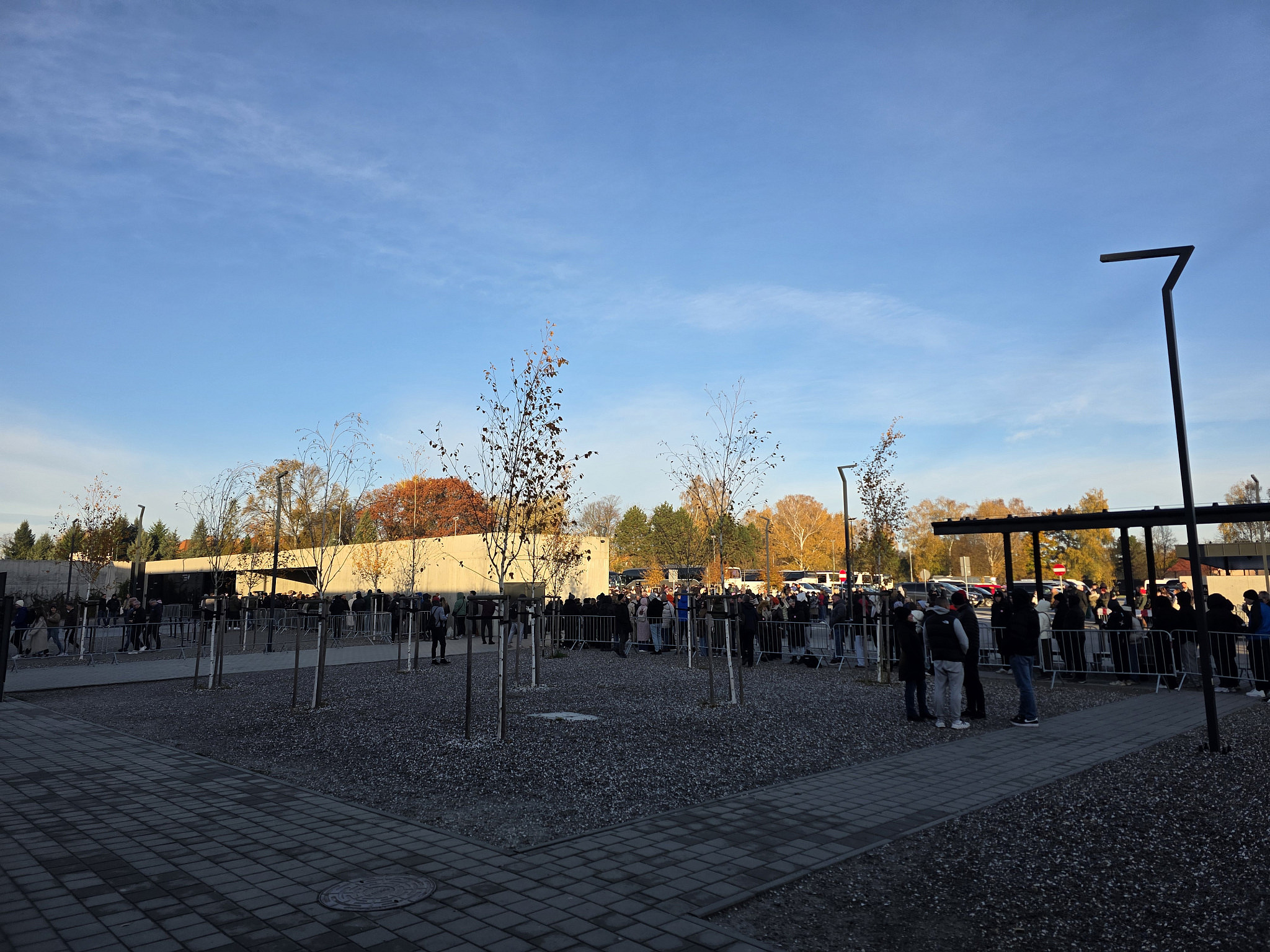
Visitors queueing for Auschwitz (Image courtesy of author)
On the first morning of a seminar at the Auschwitz Memorial, I stepped out of the guesthouse to get breakfast and found myself staring at something my mind simply refused to process: a queue. Not a small line, not a manageable cluster of early visitors, but hundreds, perhaps thousands, of people waiting in a long, controlled formation to get into Auschwitz.
It was one of those moments when the brain protects itself by assuming a mistake in perception. Certainly, this was some temporary irregularity. Certainly, the structure I was seeing did not mean what it appeared to mean. But no; it was exactly what it looked like: a normal queue, stretching calmly towards the gates of a death camp. It is now an ordinary sight: Auschwitz has a queue.
I was not naïve; I knew the statistics, the security protocols, the inevitability of crowds. But no preparation can blunt the moment when data turns into bodies, when the abstract queue becomes a line of living people waiting to enter Auschwitz. Of course there is a queue; millions visit every year. Overtourism affects everything, crowds are a modern fact, not a moral category. But some places simply should not have a queue. And Auschwitz is one of them.
The problem is not only practical, though the practical problems are real. The camp was never meant for visitors; its corridors and barracks cannot absorb the pressure of mass tourism. When thousands arrive every morning, the experience necessarily turns into crowd management: “Keep moving”, “Don’t stop here”, “Stay with your group”, “The next group is coming”. At a site where stillness is essential, stillness becomes forbidden. Reflection becomes a logistical bottleneck, prayer becomes an obstruction, grief becomes an inconvenience whilst Auschwitz begins to dictate the rhythm of one’s body: move, move, move.
There were days when one could stand alone in a barrack and feel the cold settle into their bones. One could look at a child’s shoe and let their mind slow into the uncomfortable space where thought becomes memory and memory becomes responsibility. One could pray without being pushed forward. One could cry without being in someone’s way. One could remember their family, their neighbor, their doctor, their favorite professor. That possibility has almost vanished. What has replaced it is a carefully regulated procession. People are slowly shuffling forward, unable to stop, unable to linger, unable to pause in front of the barracks or the suitcases or the hair, because behind them another group was coming, and behind them the next, and the next. A conveyor belt of remembrance.
Auschwitz today embodies a no‑win paradox: remembrance must remain open to all, yet mass access transforms grief into logistics. The queue itself becomes a symbol of how overtourism distorts memory, collapsing depth into breadth and silence into shuffling movement. It is overtourism, yes. But it is something deeper as well: a queue in Auschwitz is wrong in a way that is difficult even to articulate.
There are queues that belong to terror: lines of men, women, and children waiting at the ramp, waiting at the riverbank, waiting at the edge of a pit, waiting for the march that ends in smoke. And there are queues that belong to desire: the restless shuffle towards a concert hall, the bright impatience outside a shop, the easy excitement of going somewhere new. The queue at Auschwitz belongs, unbearably, to the latter. At Auschwitz, the queue no longer recalls terror; it recalls spectacle; and that inversion is disfiguring.
To wait as if for spectacle, to move forward as if towards entertainment, is to overlay the rhythm of leisure onto the architecture of loss. A line of bodies at the gates of Auschwitz should recall only tragedy — never attraction — yet today it echoes the wrong world. That resemblance marks the moral inversion that defines the modern visit, one feels it first as choreography, not thought; what was once procession towards death has become passage towards spectacle.
Queues like this belong to places like the Louvre, where people line up to take selfies with the Mona Lisa, where the artwork becomes secondary to the mechanics of crowd control. The difference is that in front of the Mona Lisa one is allowed to stop and take a photo. In Auschwitz, one often is not. Everyone shuffles forward. No one is allowed to stop. And although that comparison feels indecent, it is also the only one that captures the absurdity of what is happening, and the physical sensation is identical. And in Auschwitz, it is unbearable. Because whilst the Mona Lisa is a cultural attraction, Auschwitz is a moral encounter. And whilst one can survive seeing a painting without contemplation, one cannot meaningfully “visit” Auschwitz without it.
Queues, guided-flow paths, restricted pauses — these things belong to the world of entertainment and efficiency. To see them overlaid on a landscape of mass murder is to witness a distortion that most first-time visitors cannot identify but can instinctively feel. The form is wrong. The symbolism is wrong. The emotional consequences are wrong.
And the tragedy is that the more people try to remember, the more remembrance begins to resemble a system for processing the living: an echo, however distant and unintentional, of a structure that once processed the dying.
This is not about nostalgia for some imagined golden age of Holocaust remembrance. It is about the conditions under which remembrance is still possible.
We agree, at least rhetorically, that remembrance matters. But we rarely ask the deeper questions: Should remembrance be private or communal? Jewish or universal? Can those who do not share the trauma participate meaningfully in its memory, or does the ritual flatten when it becomes universalized? And what can be done with the people who arrive as dark tourists, whose motivations are not reverent but voyeuristic? Who would even have the authority to judge?
If memory is to be shared, then crowds are inevitable. If crowds are inevitable, then the experience changes. And when the experience changes, something essential risks being quietly lost, and without most people ever realizing it was there in the first place.
I do not propose a simple solution. Auschwitz cannot close its doors to millions who wish to learn, to mourn, to witness. The alternative — empty space, fading attention, historical amnesia — is also unthinkable.
But we should at least name what is happening. We should acknowledge that remembrance under pressure becomes something thinner, faster, and shallower. We should admit that overcrowding changes not only the visitor’s experience but the moral atmosphere of the place itself. We should recognize that something that mattered has already been lost, because a queue can manage bodies but cannot manage meaning. And meaning is the one thing Auschwitz cannot afford to lose.
Queues reveal an unresolved crisis in Holocaust remembrance: who it belongs to, what it is for, and how many bodies a single moral landscape can bear. Auschwitz is collapsing under the weight of competing philosophies of memory, and the queue is simply the most visible symptom.
The coexistence of private or communal remembrance is the core question. Holocaust remembrance has always existed uneasily between private grief and public moral responsibility. Auschwitz embodies this conflict. Private remembrance demands stillness, time, silence, the ability to stop and let the mind unfurl into pain. Communal remembrance demands access. The moment one says, “the Holocaust belongs to everyone,” the gates must remain open to everyone. And then everyone arrives. Auschwitz cannot support both at scale.
The queue is not just overtourism; it is a spatial expression of the philosophical conflict of what Holocaust memory is for. A conflict between private and collective modes, depth and breadth, stillness and flow.
Jewish remembrance is intimate, ritualized, and quiet; rooted in family lines of loss, bound to a specific historical and religious world. It cannot be performed amidst the crush of 30,000 tourists on a peak day. Universal remembrance, by contrast, is civic rather than familial; it gravitates towards spectacle, guided education, and structured experience. The tension is not abstract but architectural. A site once suited for small Jewish acts of remembrance has been overwhelmed by its own universalization. Auschwitz is used for moral education, yet for many it remains ancestral grief. Those two modes cannot coexist under crowd conditions.
Can people be excluded from shared trauma? This is an impossible question. If one says yes, they create a hierarchy of grief and declare some groups unfit to remember. If one says no, they allow literally everyone in, including the curious, the emotionally unprepared, the morally indifferent, the unintentionally disrespectful and yes, the dark tourists. Dark tourism, and the impossibility of judging motivations is a real issue. Every large crowd includes people who are all from different backgrounds, and motivation cannot be screened, only behavior. The current system screens neither. It simply funnels all bodies forward at the same pace, regardless of intention.
So, Auschwitz becomes a place where the devout mourner, the history major, the man from the other side of the world, the bored teenager, the influencer, the woman who wants a selfie next to barbed wire, all move at the same regulated speed. The queue is a moral leveler — and that is precisely the problem.
It’s impossible to gatekeep trauma without becoming absurd, but it’s also impossible to open it to absolutely everyone without distorting it. Auschwitz is trapped in an ethical paradox: open the gates, and remembrance gets diluted; close the gates, and remembrance becomes exclusionary.
The Auschwitz Memorial now offers online tours, and in theory this solves part of the problem. People who wish to “learn” rather than “feel” can do so from home. In practice, though, the digital version cannot convey the weight of the place, the cold, the distances, the textures, the disorientation. It transmits information but not the moral temperature.
Online tours could reduce overtourism, restore Auschwitz as a site for those who genuinely need to be there, create tiers of access, prepare visitors better, offer high-quality educational content, separate education from encounter. But they are underused and undervalued, because people want the experience; even if they do not understand what that experience is supposed to be. Right now, online tours are seen as a supplement, although they could be the key so the site can breathe again.
So, we are caught in a paradox. Auschwitz must remain open to the world; otherwise, we hand victory to forgetfulness. Yet, the world arriving in such numbers threatens the very conditions that make remembrance possible.
This tension cannot be solved with better scheduling or new infrastructure. It is not a logistical problem. It is a philosophical one.
And perhaps that is the real task of Holocaust remembrance in the twenty-first century: not merely preserving the site, but preserving the possibility of an encounter: with history, with human limits, with ourselves, that is not reduced to a crowded corridor of people moving forward because the next group is already behind them.
I miss the silence of the place. But more than that, I fear that future visitors will not even know what has been lost.
Related Topics