Rabbi Sacks zt”l: The Role Model I Resisted
From scepticism to gratitude: how Rabbi Lord Jonathan Sacks zt’l changed the kind of Jew I want to be.
Over the past few months I have written about role models, often through the lens of the weekly parsha.
This coming Shabbat there is no weekly parsha. There is Rosh Hashanah.
And as someone who, G-d willing, will stand before my community and lead the prayers using Rabbi Lord Jonathan Sacks’s Rosh Hashanah Machzor, there is one person I particularly want to write about this week.
Rabbi Sacks zt”l is not simply someone I admired. He has become, perhaps more than anyone else, my role model. That is a surprising admission because my journey to that conclusion was a long one.
It was never that I doubted his brilliance. I met him, knew his work and knew people close to him. His intelligence, scholarship and accomplishments were obvious. Yet, if I am honest, I struggled with aspects of his approach.
Coming from a more black-and-white outlook, I found his willingness to engage with philosophy, science and other faiths uncomfortable. Judaism, to me, seemed clearer when the boundaries were sharply drawn. Rabbi Sacks seemed to inhabit the spaces in between.
Today, I believe I misunderstood him.
Daf Yomi changed me
The thing that ultimately helped me understand Rabbi Sacks was not Rabbi Sacks at all. It was the Talmud.
Many years ago, while maintaining a demanding career, I completed a full seven-and-a-half-year cycle of Daf Yomi. I cannot pretend that I remember every page. I most certainly do not. But I remember what those years did to me.
Unlike the selected passages of Talmud I had studied for years, day after day I now watched the Rabbis argue. An opinion. Another opinion. A challenge. A contradiction. An answer. Another challenge. Majority positions. Minority positions. Sometimes a resolution. Sometimes no neat resolution at all.
More striking still, they never hid from difficult questions. They confronted human life in all its complexity. Even opinions ultimately rejected were preserved within our sacred tradition.
Sometimes the Gemara simply ends with teiku: let the question stand unresolved. A later Jewish tradition beautifully interprets the word as suggesting that Elijah will one day resolve such difficulties.
But for now, the question stands. There is something profoundly beautiful about that. Gradually I came to see that complexity is not a flaw in Judaism. Sometimes complexity is Judaism.
After all, we are finite human beings trying to understand an infinite G-d and apply His Torah to an extraordinarily complicated world. Living in Israel today should surely remind us of that every day.
Why should we expect any of this to be simple?
That realisation opened the door through which Rabbi Sacks entered my life in a completely different way.
What I once saw as compromise, I now increasingly see as confidence. He never ran away from complexity. More than anyone I know, he tried to articulate it with wisdom, dignity, and faith.
Science and religion. Faith and uncertainty. Jewish particularity and universal human dignity. Israel and responsibility to humanity.
He did not always make those tensions disappear. Often he did something far more valuable. He taught us how to live with them.
Faith and understanding are not the same thing
The most important lesson Rabbi Sacks taught me is one I misunderstood for years. I have faith, of that there is no question in my mind. I believe in G-d. What has changed over the years is not my belief in G-d. It is my understanding of myself. That does not, however, erase the uncertainty and the fear of suffering, with which I am in constant battle.
I do not understand suffering. I do not understand why some people endure terrible tragedies while others do not. I certainly do not understand why I have PSP, a progressive neurological disease for which there is currently no cure.
Yet my inability to understand something does not prove that there is nothing to understand.
I believe there is an answer. I simply no longer assume that I am capable of knowing it.
Rabbi Sacks put this beautifully:
“Faith is not certainty; it is the courage to live with uncertainty.”
The older I get, the less certain I am about my own answers and the more certain I am about G-d. My faith in G-d has become stronger precisely because my faith in my ability to understand everything has become weaker. I used to think faith meant having all the answers. Today I increasingly think faith means trusting the One who does.
Science and meaning
Especially with a currently incurable disease, science has become critical for me.
So has faith.
One of the things I once found uncomfortable about Rabbi Sacks is now one of the things I most admire. He refused to accept the assumption that science and religion must be enemies.
He expressed it beautifully:
“Science takes things apart to see how they work. Religion puts things together to see what they mean.”
That sentence means considerably more to me today than it would have twenty years ago.
I spend an extraordinary amount of my life thinking about symptoms, progression, medicines, research, clinical trials, mobility, speech, swallowing and prognosis. I want the science. I need the science. I am grateful for the science. I am also angry that science does not yet have the answers I need. But science alone cannot answer the questions that now matter most.
What should I do with whatever time remains? What responsibility do I have towards my family, my community and other people? How should I confront my own mortality?
Those are questions of meaning.
Rabbi Sacks taught me that I do not need science and Torah to compete with one another. The G-d of creation is also the G-d of revelation. Scientific discovery does not make G-d smaller. It can make our understanding bigger.
Hope, not optimism
Another distinction Rabbi Sacks made has profoundly shaped the way I try to live.
“Optimism is a passive virtue, hope an active one.”
Optimism believes things will get better. Hope believes we can help make things better. Living with PSP, I do not need false assurances that everything will be fine. It may not be. What I need is hope.
Hope says there is still work for me to do, people to love, prayers to lead, words to write and kindness to share. There is still purpose. There is still responsibility.
Hope does not deny reality. Hope looks reality directly in the face and asks:
What can I do next?
That is a Judaism I need desperately. The Judaism I now aspire to. Rabbi Sacks has also helped shape the vision of Judaism that inspires me today.
I chose to live in Israel. My son fought in the kibbutzim on October 7. I lost people I knew, and my son lost friends alongside him.
I defend the legitimacy, necessity and extraordinary achievement of the State of Israel without hesitation. Rabbi Sacks loved Israel deeply and defended it unapologetically.
For me, that does not mean believing that everything done in the name of Israel or Judaism has to be defended. Loving something does not require closing your eyes to where it can be better.
I want to be very careful here. I am not writing this to criticise a single fellow Jew. Not Haredi, religious Zionist, secular or otherwise.
But I do worry about tendencies that can exist within religious life: certainty becoming rigidity, extremism being mistaken for conviction, resistance to change becoming a virtue in itself, separation from the wider world becoming confused with holiness.
Judaism is about Shabbat, kashrut, tefillah and halachah.
Those matter enormously to me. But Judaism is also about responsibility, dignity, justice and chesed. It is measured not only by what happens in the synagogue but by how we treat other human beings and what we contribute to G-d’s world.
Rabbi Sacks called for a Judaism strong enough in its own beliefs that it need not fear difficult questions, scientific inquiry or encounters with people who think differently. As he wrote:
“The world needs the Jews and Jews need the world.”
That is increasingly the Judaism I want. Not Judaism watered down. Not Judaism embarrassed by itself. A Judaism confident enough in its Torah that it does not need to be frightened of a laboratory, a university, a secular Jew, a Christian, a Muslim or an uncomfortable question.
Being a light unto the nations cannot simply mean telling ourselves that we are a light unto the nations.
We actually have to produce some light. More kindness. More responsibility. More dignity. More morality. More hope. We have to leave the world slightly better because we were in it.
He was not perfect, but he was a man of real integrity
None of this means Rabbi Sacks was beyond criticism. Like any major public leader, especially one occupying such a complex religious role, he faced criticism from different sides. Some criticism of how he handled difficult communal controversies was fair. But I no longer need my role models to have been perfect. I need my role model to help me become better. Rabbi Sacks does, and the way his thinking evolved reminds me that I, too, can grow.
He was, as far as I could see, a man of the utmost integrity. That matters enormously to me in a world where integrity has become rarer than it should be.
G-d is bigger than my understanding of G-d
Perhaps this is the greatest religious change Rabbi Sacks helped bring about in me.
I once thought admitting complexity weakened faith. Today I think almost exactly the opposite.
If G-d is actually G-d, why should I expect Him to fit neatly inside my brain? Why should the Creator of an unimaginably complex universe conform perfectly to categories I find easy to understand?
The older I become, the more comfortable I am acknowledging the limits of my own understanding.
Paradoxically, Rabbi Sacks helped make me believe in G-d more strongly by teaching me how much larger G-d is than my understanding of Him. He helped me understand that awe begins where certainty about ourselves ends.
And now Rosh Hashanah
In a few days, G-d willing, I will stand before my community as shaliach tzibbur on Rosh Hashanah.
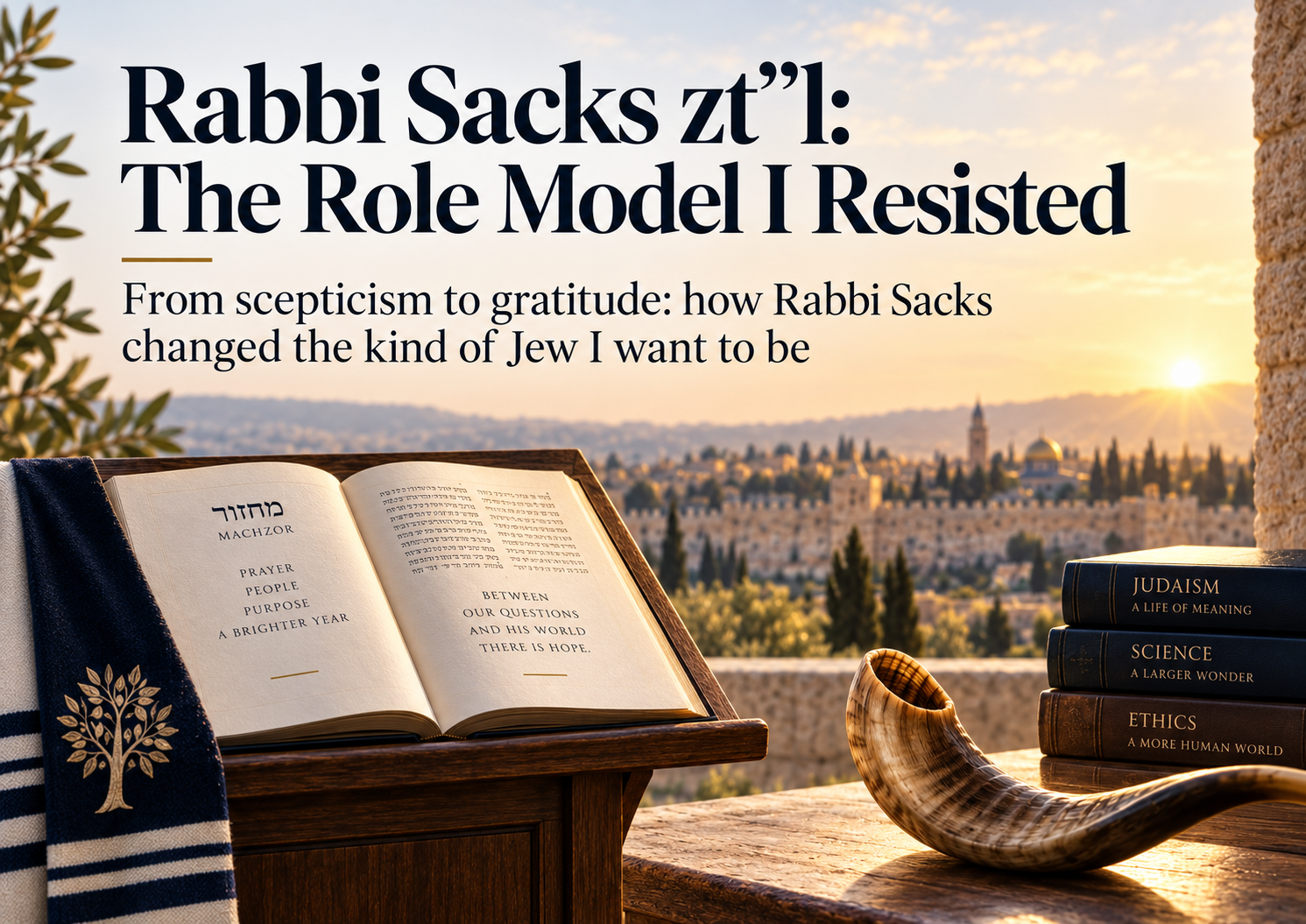
I will be praying from Rabbi Sacks’ Machzor. It is a beautiful commentary built upon a beautiful text.
Rosh Hashanah is fundamentally about the kingship of G-d. A G-d we cannot fully comprehend. A world we cannot fully understand. Lives we certainly cannot completely control. And yet we stand before Him.
Rabbi Sacks didn’t fear the spaces in between because, like the Sages of the Gemara, he knew that living with unresolved tension is a profound part of the human and Jewish condition.
Towards the end of his introduction, reflecting on the shofar, Rabbi Sacks writes about human life as breath and about the breath that G-d breathed into humanity. Then comes a sentence that, since my diagnosis, has never left me:
“For we defeat death, not by living forever but by living by values that live forever.”
Rabbi Sacks has left a set of values and teachings which will live forever and impact people like me and countless others for a very long time. I thank him for that. I am incredibly grateful that someone like him came along in my time and showed us a Torah that is not only relevant to our age but deeply rooted in what I believe G-d is asking of us in this world.
Shana Tova