The Third Story
Rebranding the Temple of Tomorrow
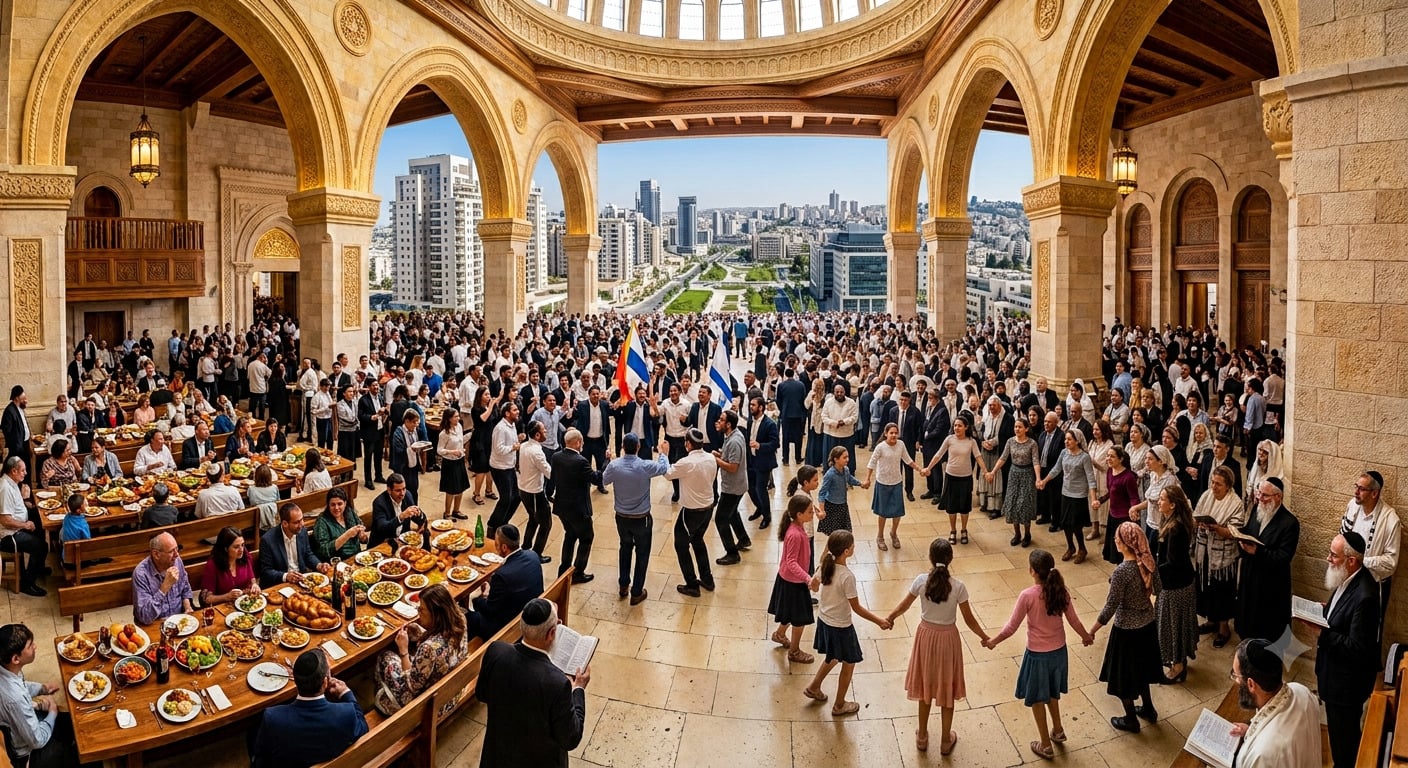
Created by Gemini AI, 7.20.26
In just two days, we will sit on the floor, dim the lights, and enter the quiet grief of Tisha B’Av. We will recite Kinot (lamentations) and mourn the loss of the Temple in Jerusalem.
But if we are honest with ourselves, many modern Jews face an uncomfortable barrier to this grief.
Our world today is vastly different from the world that existed the last time a Temple stood in Jerusalem. Expecting that our society will simply rewind the clock to an era where animal sacrifices are seen as an essential part of divine worship is simply not realistic. With all due respect to those who suggest we will return to that ancient norm, the vast majority of Jews do not view a return to the altar of slaughter as a step forward.
We desperately need a rebrand of the Temple – one that honors our tradition while speaking to the maturity of the modern soul.
The Retaining Wall Stand-In
About 25 years ago, I traveled with a group of colleagues on a one-day gibush (bonding trip) to Haifa. We visited the grounds of the Bahá’í Gardens, which cascade down the slopes of Mount Carmel. As we stood atop the mountain, one of my colleagues stared out, completely struck with awe by the magnificent shrine and its pristine, breathtaking grounds.
I asked her what she was thinking. She looked at me and said, “Looking at the grand majesty of that building, you can imagine the majesty of their faith.”
I nodded and responded, “And that is precisely why we need to rebuild the Temple.”
For years, I have watched tourists from every corner of the globe travel thousands of miles to Jerusalem. They tour the Kotel, perhaps walk up to the Temple Mount, and view the remnants of Jewish history – they come to marvel at ruins.
What is the message they get about Judaism? Where is the majesty?
We are a thriving state. We are the living fulfillment of the return to Zion. And yet, when it comes to the house of our God, we offer a collection of recollections, broken stones, and archaeological sites. We stand before a retaining wall – not even a wall of the Temple itself, but a support structure built to hold up the mountain – and we pray there because we have no physical sanctuary. How tragic it is that for so many, an ancient retaining wall has become the permanent stand-in for the Temple itself.
“Does the Lord Delight in Burnt Offerings and Sacrifices?”
If we look at our tradition through the lens of Depth Theology—peeling back the surface ritual to uncover the subterranean intent—we realize that a rebuilt Temple was never meant to be a nostalgic return to blood and smoke.
The Abarbanel (Don Isaac Abravanel, commenting on Yirmiyahu 7:22) drops a theological bombshell. He notes that before the Sin of the Golden Calf, the concept of elaborate animal sacrifices barely existed in the Torah’s commands. The extensive sacrificial system described in Vayikra (Leviticus) was actually a pedagogical “remedy” – a concession to a people who needed tangible, ancient forms of worship to heal from Egyptian idolatry. Rambam in his Moreh Nevuchim (Guide for the Perplexed) says the same thing.
It was a temporary bridge for a specific era of spiritual infancy.
Our Prophets saw this clearly. Shemuel (Samuel) famously challenged the people with the fundamental question: “Does the Lord delight in burnt offerings and sacrifices as much as in obeying the voice of the Lord?” (Shemuel I 15:22). Yeshayahu (Isaiah) echoed this sentiment, screaming against the delusion that God takes pleasure in animal offerings: “Why do I need your numerous sacrifices? … I have had enough of burnt offerings of rams and the fat of fed beasts” (Yeshayahu 1:11).
The physical blood was never the ultimate goal.
The Sanctuary vs. The Sacrifice
In the 20th century, the former Sephardic Chief Rabbi of Tel Aviv, Rabbi Hayyim David Halevi, articulated a crucial distinction:
The Sanctuary is one thing, and the sacrifices are another.
The core purpose of the Temple was never slaughter; it was Hashra’at ha-Shekhinah – creating a physical home on earth for the Indwelling Divine Presence.
Even Theodor Herzl, the visionary of the modern state, shared this deep intuition. In his utopian novel Altneuland, Herzl imagined a rebuilt Temple in Jerusalem as a global “Temple of Peace” – a magnificent sanctuary of light, dignity, and universal human brotherhood, rather than a place of blood.
Herzl was tapping into an ancient prophetic truth: the Temple was meant to be a living beacon of divine majesty for all of humankind, not an echo chamber of ancient rituals.
Reimagining the Altar: The Great Feast of Gratitude
So what happens when the “remedy” is no longer needed, and humanity reaches moral maturity?
The Midrash in Vayikra Rabbah (9:7) makes a striking statement: In the future to come, all sacrifices will be nullified – except for the Korban Todah, the Thanksgiving offering.
When you look closely at the Korban Todah, it wasn’t an altar-bound ritual of atonement or guilt. It was essentially a grand, communal banquet. A person who experienced a miracle or divine protection brought the offering, but the altar received only a symbolic token. The vast majority of the food – including forty loaves of bread and the meat – had to be consumed within 24 hours. Because of that tight time limit, no one could eat it alone. You had to invite your family, friends, neighbors, and strangers to join you in a feast of gratitude. It was less like a ritual sacrifice and more like a magnificent, catered celebration – a holy BBQ banquet where the entire point was sharing a meal, telling your story of gratitude, and celebrating God’s goodness together.
If modern meat-eaters want a paradigm for the future Temple, this is it: not an altar of guilt, but a world-class hall of celebration and thanksgiving.
Refocusing Our Grief
This Tisha B’Av, let’s stop letting an outdated image of the past hijack our longing for the future. And let’s stop settling for a retaining wall as a substitute for divine splendor.
We are not weeping for the loss of the altar. We are weeping for the loss of the Mikdash – the global epicenter of God’s holy presence. We are mourning the fact that our world remains fractured, lacking a physical space where all of humanity can gather in shared awe and recognize the majesty of our faith.
As Rav Avraham Yitzchak Kook envisioned, as humanity matures morally, our spiritual service must evolve. We aren’t mourning in longing for a return to the past. We are mourning the delay of our future – a future where the Third Temple stands not as a house of slaughter, but as a “House of Prayer for All Nations.” (Yeshayahu 56:7) A sanctuary of peace, gratitude, and tangible presence for all humankind.
The building of the Third Temple begins with a renewed and rebranded vision: a sanctuary not for sacrifice, but a holy gathering place for the Jewish People and all of humankind.
This year, let’s not just fast for what was destroyed. Let’s champion an inspiring, modern vision for the majestic, holy sanctuary we are destined to build, speedily in our days.
Related Topics
Related Posts