
Humble with a declining sense of humor.
Rebuke Is Not a Mandate: What Two Elections Reveal
AI-generated graphic
On November 3, American voters told pollsters what mattered most to them: the cost of living, healthcare, and the war with Iran. On all three, their dissatisfaction led to the same place, Donald Trump. Democrats flipped both the House and the Senate, and the scale of the result goes beyond a routine midterm correction. It was a verdict on Trump’s leadership and on the instability his decisions have produced at home and abroad.
But a verdict against an incumbent is not an endorsement of the alternative. Millions of Americans voted against Trump rather than for the Democratic Party, and the distinction matters. A party that wins by default inherits power without a clear instruction. What the Democrats actually stand for, and what they intend to do with two years of control, remains unanswered. Voters have said what they are tired of. They have not said what they want.
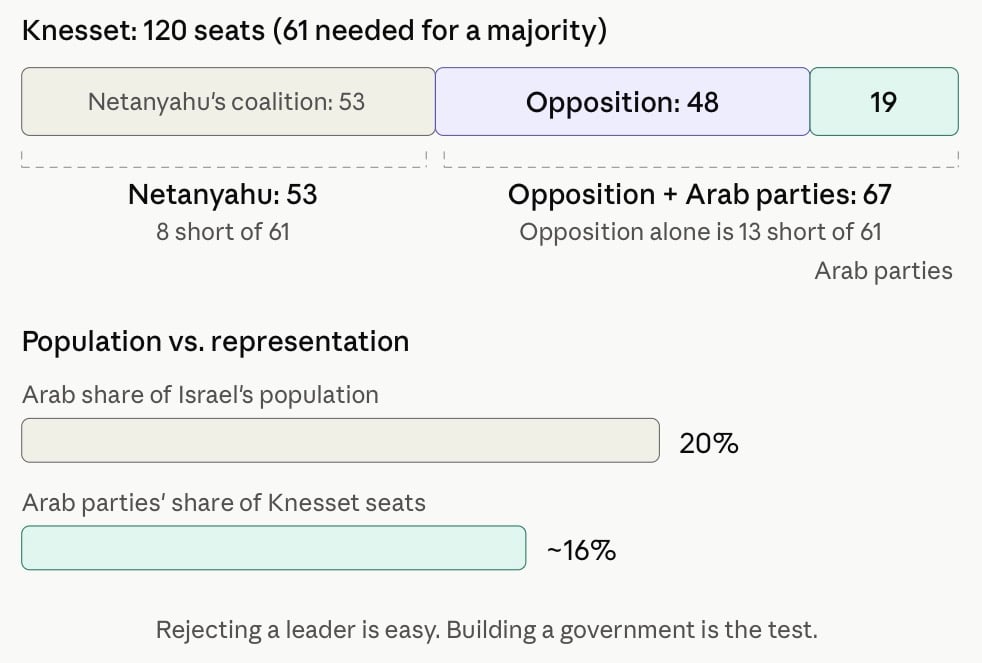
Israel’s election, held less than a week ago, produced the same kind of signal with a less clear result. Voters rebuked Benjamin Netanyahu, and his coalition lost its Knesset majority. Yet where America’s outcome was decisive, Israel’s is unresolved. Netanyahu has no visible path to 61 seats. The opposition has rallied behind Gadi Eisenkot, leader of the Yashar party, as its choice for prime minister. But agreement on a candidate is not agreement on a government.
The arithmetic is what makes this a test rather than a formality. Israel’s Arab parties won 19 seats, and those seats are what turn an opposition plurality into a governing majority. There is no other route. Arab citizens make up roughly 20 percent of Israel’s population, and their parties now hold nearly 16 percent of the Knesset. By any democratic standard, a bloc of that size, elected by the same rules as every other, should be a legitimate coalition partner.
That is not how Israeli politics has traditionally treated them. For years, Arab parties have been treated as outsiders, tolerated at best and demonized at worst, whatever their electoral weight. Eisenkot and his allies now face a choice that exposes their own logic. If the voters’ will decides who governs, that principle cannot apply only to the voters who are convenient. If they want to replace Netanyahu, they will have to build a coalition that includes the electorate that made replacing him possible.
Israel and the US now face the same hard task. Rejecting a leader is the easy part of democratic politics. The harder part is turning a rebuke into a program. Democrats must show Americans what they are for. Israel’s opposition must show it can govern on behalf of the whole electorate, Arab citizens included. Neither task is optional, and in both countries voters will be watching to see who understands that a rebuke is not a mandate.
Related Topics
Related Posts