
Writer covering Israel–Africa, Jewish affairs, and Israel worldwide
Recognition from Ruins: Unrecognizable Regimes Judge Statehood
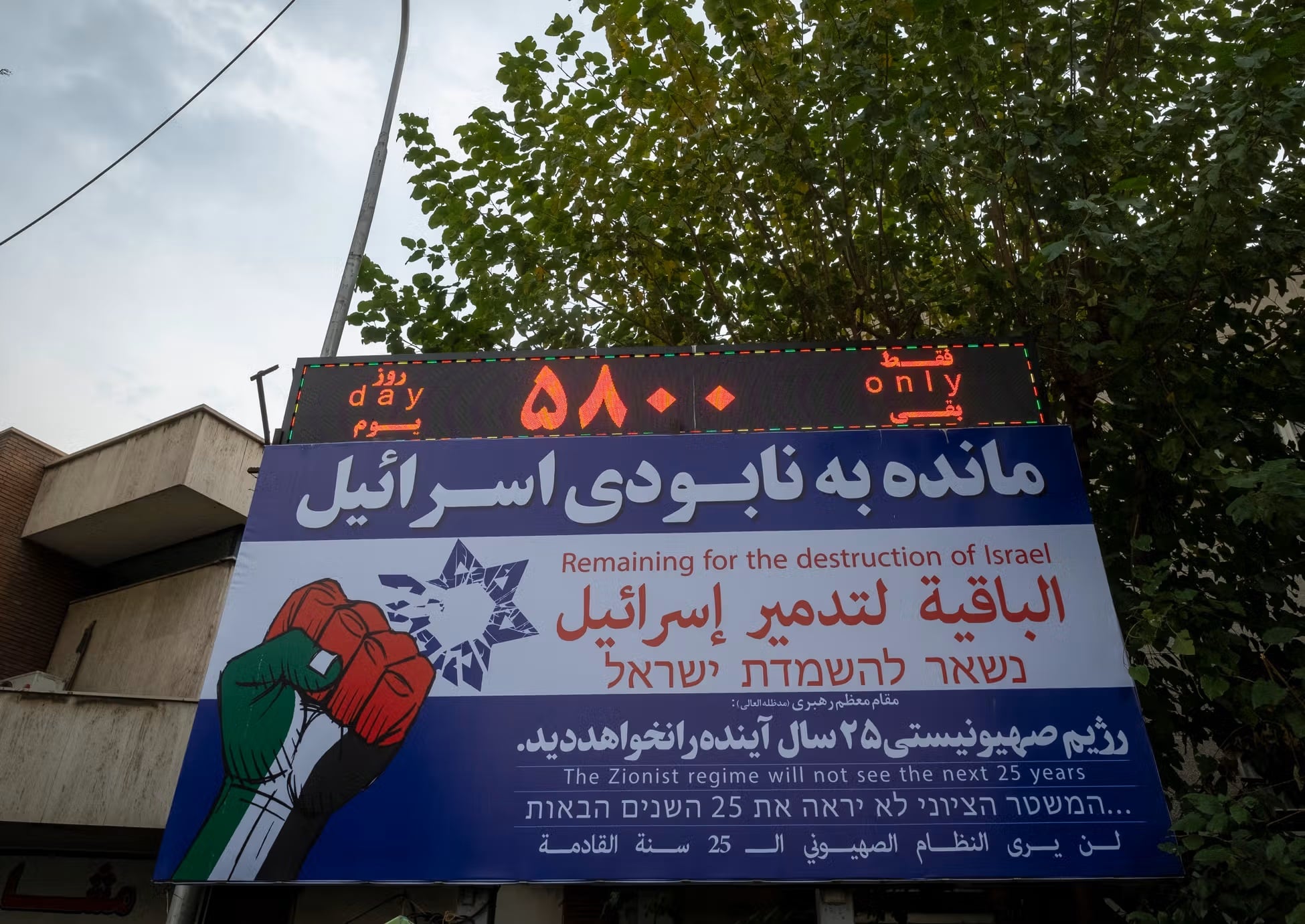
A billboard with the "doomsday clock," counting down the days until Israel's destruction, is pictured in downtown Tehran, Iran, on November 4, 2024. Israel bombed the clock in June, 2025. Morteza Nikoubazl/NurPhoto via ASSOCIATED PRESS
For decades, regimes barely recognizable as states have taken it upon themselves to decide which nations qualify as legitimate. From collapsing economies to clerical rule, the verdict is always delivered with confidence. Israel, apparently, fails the test. The irony, unfortunately for them, does not.
The Pageantry of Refusal
For decades, certain regimes—being generous, I’ll call them theocracies—have performed a ritual of remarkable consistency: declaring that Israel is “not a state” and will never be recognized. Pause for a moment and picture it: countries where state institutions are intermittent at best, where war, jihad, and collapse define the daily calendar, issuing verdicts on the legitimacy of a functioning modern nation. Iran, Afghanistan, Yemen, Iraq, Somalia—places that can barely keep the lights on—have taken it upon themselves to lecture Israel on what constitutes a sovereign state.
The beauty of this pageantry is in its irony. The speakers themselves are perpetually unrecognizable as functioning states: territories where law is scripture, governance is clerical, and collapse is routine. Yet from this very instability comes a solemn claim about the boundaries of legitimacy, as though the certificate of statehood could somehow be signed by a body that exists mostly on paper. This is less a diplomatic act and more of a performance piece, staged from a theater of dysfunction, with Israel cast unwillingly as the object of their critique. And like all good pageants, it is entirely self-referential: the participants declare authority they do not, and cannot, possess.
When Collapse Develops Opinions
Some regimes do not merely deny Israel’s legitimacy; they invest in the fantasy. Iran, for example, did not stop at rhetorical non-recognition. It erected a literal Doomsday Clock, counting down the seconds until Israel’s supposed disappearance. This was not metaphor. It was concrete, steel, and propaganda—time itself enlisted in the service of delusion. And then, in a moment of almost poetic efficiency, Israeli airstrikes obliterated the clock. The countdown ended not with Israel’s demise, but with rubble. Reality, as it turns out, does not respect stage props.
Yemen, never one to be outdone in symbolic audacity, has long joined the chorus declaring Israel “not a state.” This from a country whose own economy survives on humanitarian briefings and donor fatigue. A place where governance is episodic and infrastructure is optional nevertheless feels qualified to arbitrate statehood. Somalia follows suit, confidently announcing Israel’s illegitimacy from within a territory still negotiating whether it qualifies as a unified country at all. The pattern is hard to miss. The less functional the system, the louder the declaration. Collapse, it seems, breeds opinions—and not modest ones. These are not carefully reasoned diplomatic positions; they are ideological reflexes dressed up as policy. Non-recognition has become a substitute for competence, a way to signal relevance without earning it.
There is something almost admirable about the confidence. Failed states, war zones, and theocratic ruins standing upright just long enough to issue press releases on international legitimacy. It is as though dysfunction itself has been mistaken for moral authority. And so the announcements keep coming, each more solemn than the last, each floating further from reality. When collapse develops opinions, satire becomes unavoidable. The tragedy, for the authors of these declarations, is that the world has already recognized what they have not: legitimacy is not declared from the ruins—it is built, or it is absent.
Rule by Scripture, Judgment by Delusion
At some point, it becomes necessary to examine not just what is being said, but from where it is being said. These declarations of non-recognition do not emerge from constitutional democracies or functioning legal orders. They emanate from systems governed by scripture, enforced by clerics, and sustained through fear. This matters, because the speaker is the argument.
Take Iran, whose theocratic judiciary has turned execution into routine governance where women are sent to the gallows in alarming numbers, many condemned under religiously derived laws that treat autonomy as deviance and dissent as heresy. These are not rare miscarriages of justice. They are the logical outcome of a system where law is theology and mercy is optional. A society that marries off girls and then hangs women for attempting to escape abuse does not possess a legal code so much as a punishment manual.
This is not uniquely Iranian. In Syria, footage resurfaced showing a senior government official overseeing the execution of women accused of prostitution—public, theatrical, and justified through moral purification. The spectacle was not incidental; it was the point. In such systems, law is not meant to protect. It is meant to terrify, to remind the population that obedience is safer than existence. And yet, from within these arrangements comes the confident judgment that Israel is illegitimate. A country governed by courts, contracts, innovation, and civil institutions is dismissed by regimes whose primary administrative competence lies in religious enforcement. The irony is no longer subtle. It is structural.
These are systems where scripture substitutes for legislation, clerics substitute for judges, and divine authority substitutes for consent. Women are regulated, minorities are silenced, and dissent is criminalized—not as policy failure, but as policy design. And still, these regimes presume the authority to define what constitutes a state. At this stage, the satire writes itself. A judicial order that executes women, polices morality, and derives legitimacy from divine interpretation now presents itself as an arbiter of statehood. This is not moral judgment. It is delusion institutionalized.
The verdict, then, tells us nothing about Israel. It tells us everything about the systems issuing it: governments so entangled in medieval authority that modernity itself becomes unrecognizable. When rule by scripture meets judgment on statehood, the result is not critique—it is confession.
Economics as an Insult
Let’s talk numbers, because numbers do not negotiate, rationalize, or issue proclamations from the ruins. Israel, a country many of these regimes insist “does not exist,” sits at a GDP per capita of about $60,000, a hub of technology, innovation, and global enterprise. A functioning state, producing real wealth, exporting real goods, and generating human capital at a scale these self-proclaimed moral authorities can only fantasize about.
Contrast that with, let’s say, Yemen, whose economy is collapsing faster than its infrastructure, where GDP per capita is barely a few hundred dollars and food insecurity grips over two-thirds of the population. Governance here is sporadic, corruption endemic, and donor dependency institutionalized. Somalia? Slightly better in theory, worse in practice—where factions, militias, and chaos still compete to see who can claim authority while producing nothing.
And yet, from this landscape of famine, fiscal collapse, and institutional absence comes the confident assertion that Israel is illegitimate. The satire is almost painful. A state that struggles to feed itself, administer law, or maintain currency now thinks it has standing to lecture a country that engineers satellites, cures diseases, and launches start-ups from deserts. It is not merely irony. It is a civilizational slap: recognition cannot be issued from a system that cannot recognize itself. The economic contrast is devastatingly simple: one country builds, innovates, and thrives; the other survives at the mercy of aid and the luck of stability. Yet it believes its opinion on legitimacy carries weight. Numbers do not lie. And in this ledger, absurdity is balanced with cold precision.
The Recognition Reversal
Recognition is an administrative acknowledgment: a statement that a polity exists, functions, and governs. That’s it. Nothing more. Nothing less. And here is the problem: the regimes loudly denying Israel’s legitimacy are the very definition of what recognition presupposes they should be able to offer. Israel’s non-recognition of these regimes is coherence. You do not “recognize” chaos, you do not “acknowledge” a system that cannot administer law, deliver services, or enforce contracts without the threat of bullets or scripture.
Consider the absurd inversion. Countries where the state is intermittent, where clerics write laws and fear enforces obedience, assert the authority to determine what qualifies as a modern, functioning nation. This is not oversight; it is delusion institutionalized. They proclaim Israel illegitimate while failing to maintain electricity grids, currencies, or basic rule of law. The result is a comedy of epistemology. Recognition is assumed to be transferable—“we declare, therefore it exists”—but legitimacy is not conferred by decree. It is demonstrated, day in and day out, through coherent governance and productive institutions. To deny Israel this reality is to confess incapacity without realizing it.
Put bluntly: when a system that struggles to govern its own territory lectures a thriving, innovative nation on what constitutes statehood, the judgment is irrelevant. It carries no weight. It is not advice, critique, or policy—it is confession. Non-recognition is not a stance. It is an admission of irrelevance delivered with unwarranted solemnity.
It’s Not Refusal. It’s Inability.
At this point, let’s dispense with polite euphemisms: these regimes are not “refusing” to recognize Israel. They cannot. The problem is not ideology; it is comprehension. Recognition requires more than slogans and proclamations. It requires institutions, infrastructure, economic systems, and a concept of governance that operates beyond divine decree.
Israel is a country that builds, innovates, and sustains itself. It launches satellites, cures diseases, and powers technology hubs while these self-proclaimed arbiters issue verdicts from collapsing systems. Clerics, militias, and decrees may run their territories, but they cannot process a society in which law is written by humans for humans, rather than handed down from scripture. Modernity is an alien language—and their refusal is merely a grammatical failure masquerading as policy.
This is the civilizational mismatch laid bare. A functioning state meets a system still struggling to manage famine, currency, and civil order. The result is denial. Not because of principle, but because comprehension itself is impossible. Innovation, meritocracy, and legal accountability are beyond the horizon of what these regimes can digest, let alone recognize. In effect, their non-recognition is not defiance; it is confession. It admits, inadvertently but truthfully, that Israel’s existence exceeds the cognitive and institutional capacity of regimes still learning to govern themselves. Denial becomes doctrine because understanding is unavailable, and judgment becomes the only substitute for insight.
And so, the proclamations are honest in their own way. Not in the sense of morality or reason, but in the sense of revealing the stark incapacity of systems that cannot reconcile modern governance with medieval authority. Recognition, in these cases, is not withheld—it is simply impossible.
Recognition Starts at Home
Strip away the slogans and one truth remains: recognition is not declared—it is earned. And before a system can meaningfully recognize another state, it must first be recognizable itself. This is the step that keeps being skipped. Statehood is not a proclamation; it is demonstrated through institutions that function, laws that protect rather than terrorize, and governance that answers to citizens rather than scripture. Without these, recognition is meaningless. Loud announcements, solemn condemnations, and moral posturing cannot substitute for competence.
The fixation on denying Israel’s legitimacy reveals far more about the denier than the denied. A system that hangs women, suppresses dissent, polices morality, and survives on international aid has no authority to lecture a country whose existence is defined by innovation, law, and productivity. Every press release is less a critique and more a confession of incapacity. The lesson is simple, before telling the world who is legitimate, first make yourself recognizable as a state. Until then, all declarations of non-recognition echo from a theater of dysfunction, irrelevant and unpersuasive. Recognition, after all, begins at home.
And if there is one final barb to leave echoing in the corridors of delusion: systems still mired in chaos do not get to define legitimacy—they are merely observers of what they cannot comprehend.
Related Topics
Related Posts