Gratitude | Purpose | Renewal
Rededicate 250: When America Awaits G-d
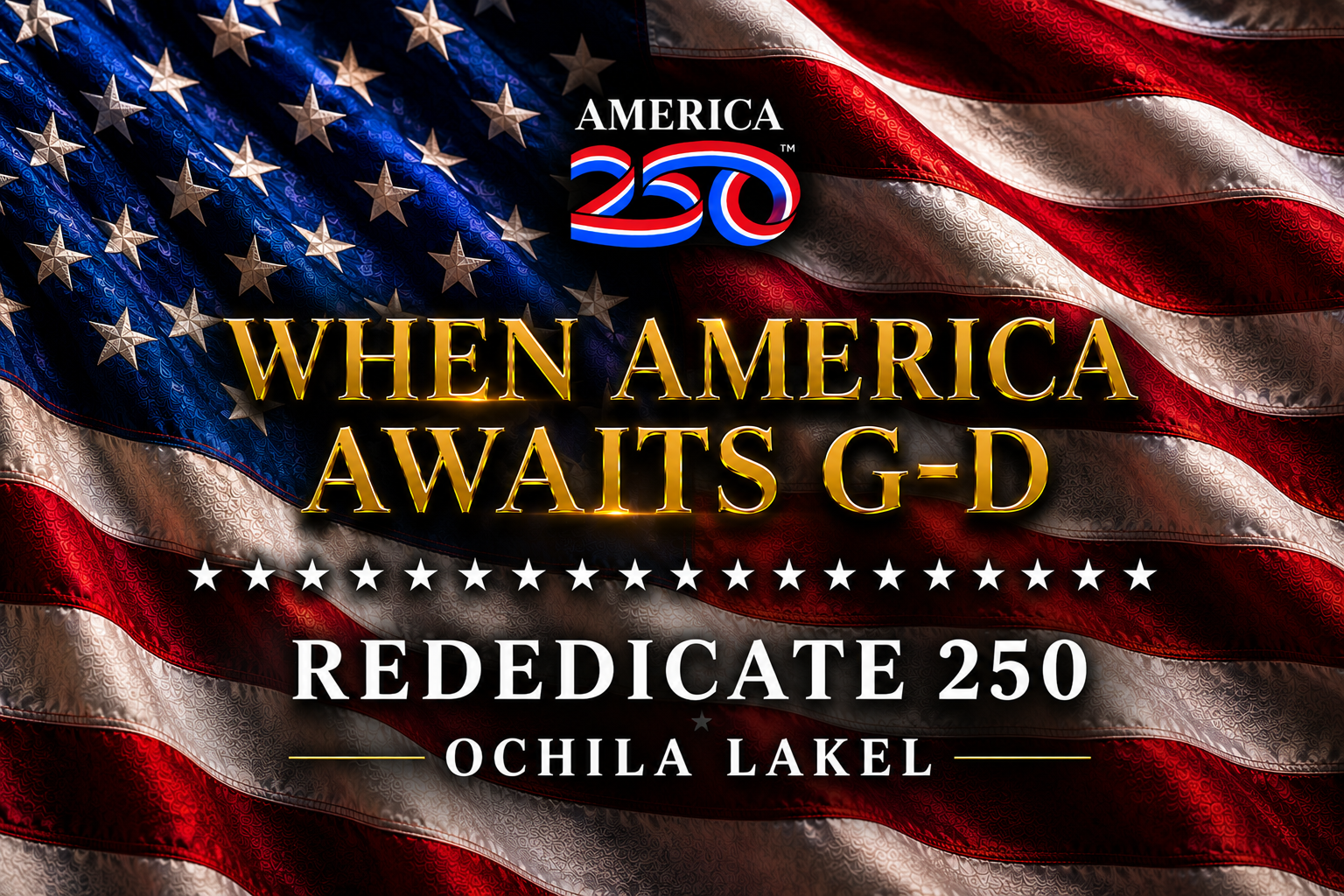
AI generated illustration
As America moves from National Shabbat into Rededicate 250 weekend, Ishay Ribo’s Ochila LaKel calls us to wait for G‑d, guard our words, and begin the work of renewal
When a Song Becomes a Mirror
There are moments when a song becomes more than a melody. It becomes a mirror; reflecting back who we are, what we long for, and the kind of people G-d is calling us to be. This weekend, as America marked National Shabbat and stepped into the Rededicate 250 season, I found myself listening again to Ishay Ribo’s Ochila LaKel — “I Shall Await the Lord.”
The song opens with a simple, ancient plea: “I shall await the Lord, I shall entreat His favor; I shall ask Him to grant my tongue eloquence.” It echoes the Psalmist’s cry: “O Lord, open my lips, that my mouth may declare Your praise” (Psalm 51:17). Hearing it, I felt something shift. The song is not only about waiting for G-d. It is about becoming worthy of being used by G-d. And that, perhaps, is the deepest message of this Rededicate 250 moment.
National Shabbat and the Courage to Wait
In Torah, waiting is never passive. Abraham waits for a child. Moses waits for redemption. Israel waits forty years in the wilderness. David waits to become king. Waiting is not weakness. Waiting is faith in motion.
When Ribo sings of awaiting G-d, he is giving voice to the same spiritual courage Moses expressed when he told the Israelites, “Stand still and see the salvation of the Lord” (Exodus 14:13). Waiting is the refusal to surrender hope, even when the world gives you every reason to. Rabbi Jonathan Sacks often taught that hope is a Jewish virtue, because it insists that tomorrow can be better than today; and that we have a role in making it so. National Shabbat reminded us that the Jewish people have always carried this kind of hope. And now, as America enters its 250th year, that hope becomes a national responsibility.
Grant My Tongue Eloquence: Rededicating Our Speech
The song’s second line; “I shall ask Him to grant my tongue eloquence”, is one of the most Jewish requests imaginable. In Judaism, words are sacred. G-d creates the world with words (Genesis 1). Israel becomes a nation through words; the covenant at Sinai (Exodus 19–20). The prophets shape history with words. Rabbi Sacks often said that speech is the bridge between the world as it is and the world as it ought to be. To speak is to build; to bless, is to repair. So, when we ask G-d for “eloquence,” we are not asking for poetry. We are asking for purpose.
We are asking that our words become instruments of healing, not harm; of truth, not distortion; of courage, not fear. In a time when public discourse is fractured, this prayer feels especially urgent. Rededicate 250 is not only about renewing a nation; it is about renewing the way we speak to one another.
A People Who Sing Together Become a Nation
The song continues: “In the midst of the congregated nation I shall sing of His strength; I shall burst out in joyous melodies for His works.” This is not private spirituality. This is public faith. Judaism has always insisted that holiness is not only found in the quiet of the soul, but in the shared life of a community.
We pray together. We mourn together. We celebrate together. We carry one another. National Shabbat reminded us that Shabbat is the heartbeat of Jewish time. It is the weekly reminder that we are more than consumers, more than workers, more than political tribes. We are a covenantal people. And when we sing together, we become more than individuals. We become a nation of faith.
The Thoughts of the Heart; And the Words G-d Gives
One of the most profound lines in the song comes from Proverbs: “The thoughts in a person’s heart are his to arrange, but the tongue’s eloquence comes from the Lord.” (Proverbs 16:1). This is classic Jewish theology.
We plan. We prepare. We think. We dream. But inspiration; the spark that turns intention into impact, comes from G-d. Rabbi Sacks often said that G-d writes the music, but we are asked to play it. We bring the instrument; G-d brings the breath. This line reminds us that we are not alone in our efforts. We do our part, and G-d does His.
Rededicate 250: Becoming Instruments of G-d
As America reflects on 250 years of nationhood, the question is not only what G-d has done for us, but what G-d is calling us to do for others. The Torah teaches: “You shall be holy, for I the Lord your G-d am holy.” (Leviticus 19:2). Holiness is not separation from the world; it is engagement with the world; with compassion, justice, and moral courage.
When we say, “O Lord, open my lips,” we are asking G-d to use us; our voices, our choices, our presence, as vessels of His light. To be used by G-d is not to be passive. It is to be purposeful. It is to live with the awareness that every conversation, every act of kindness, every moment of restraint, every word of encouragement, can become a small act of redemption. This is the heart of Rededicate 250: Not nostalgia for the past, but responsibility for the future.
Dedicated to the leaders who came before us; men and women who, in their time, did G-d’s work to lift America and the world toward justice, compassion, and hope.
To the memory of Rabbi Lord Jonathan Sacks, whose teachings continue to guide and inspire, and to the music of Ishay Ribo, which helps us draw nearer to G-d’s heart.
Related Topics
Related Posts