
Reese’s Pieces: the Legacy of the Jewish Diaspora
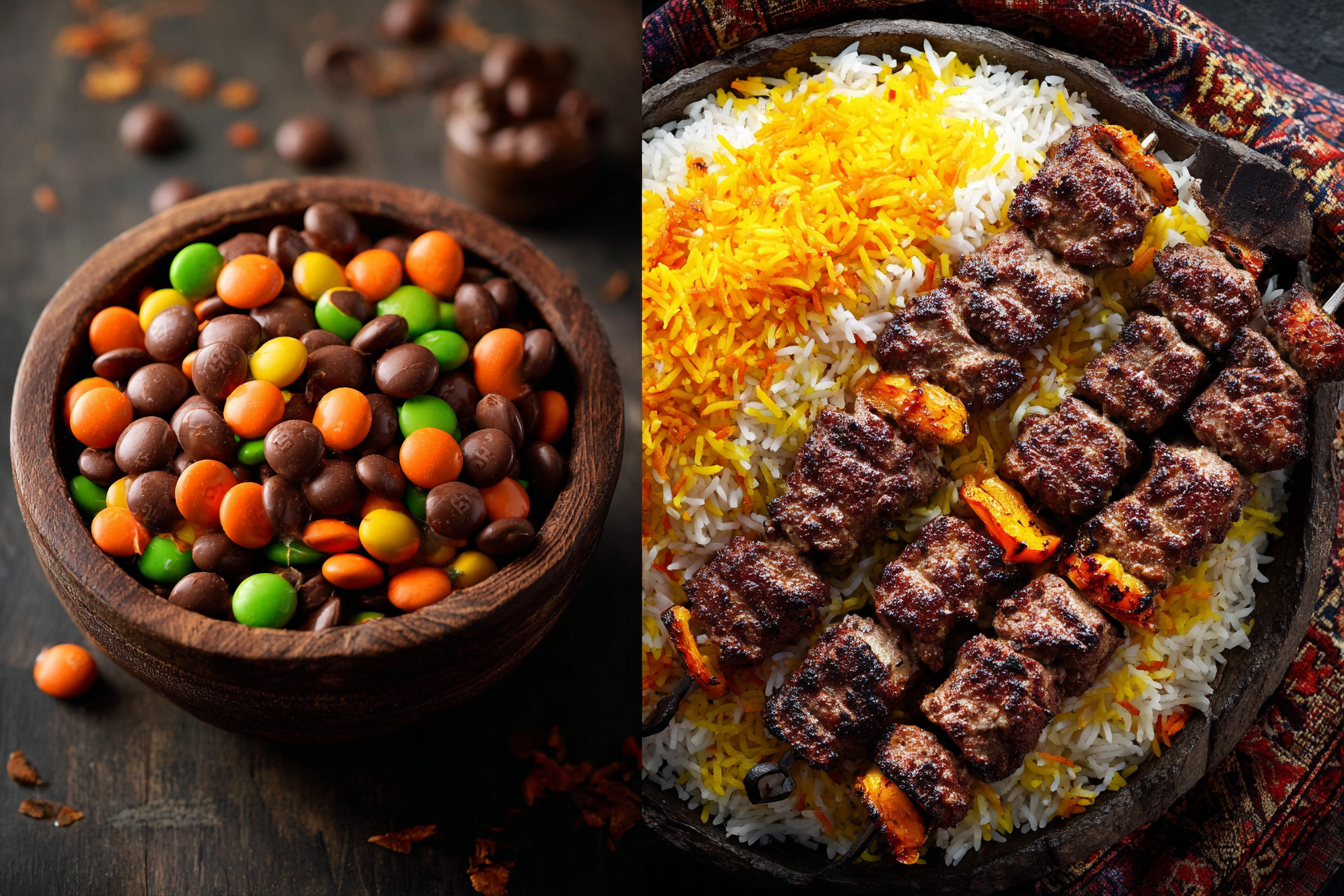
The Jewish narrative is often told through our tastebuds. In our home, a new custom has quietly taken shape over the past few years..
During the recent military campaigns against the various regimes that have sought to harm us, we found ourselves looking for outlets of positivity for our children. Instead of only experiencing these nations through the lens of hostility and threat, we began bringing elements of their cultures into our home – through food.
Persian dishes. Lebanese flavors, Yemenite delicacies.. Foods that, not long ago, might have felt distant or even foreign for a nice Ashekanzi family, began appearing on our Shabbat table.
It started almost as a joke, but quickly became something more meaningful.
If they define their relationship to us through conflict, we refuse to do the same. We will not only endure their hostility – we will also absorb, elevate, and enjoy the good that exists in the world around us. There is something deeply Jewish about that instinct. Like on Purim, where we celebrate even as we were nearly destroyed. Like on Chanukah, where we light specifically in the darkness.
We don’t survive history. We transform it.
While on this Shabbat we enjoyed Persian rice and Kabobs, I opened my phone after Shabbat to find a new culinary milestone occurred for the Jews of the Diaspora. The OU announced with much fanfare that Reese’s Pieces are no longer a “Dairy” food product. Congratulations!
And yet, once again, the widening divide between the Jewish Diaspora and those of us in Israel seems greater than ever before. Let me explain.
–––––-
For millennia, codified in Jewish law and practice, the experience of Jewish life has revolved around food. At a brit milah, at a mere eight days old, a Jewish boy customarily tastes from the cup of wine over which the mitzvah was performed. At three years old, he licks honey off the sacred letters through which the world was created.
Every Jewish boy and girl, before knowing how to perform even a single mitzvah from the Torah, knows how to express their love for challah on Friday night. They know how to delight in apples and honey on Rosh Hashanah and, as they grow older, to appreciate the finer things in life — like cheesecake on Shavuot.
Jewish life has always been shaped by cuisine. “They tried to kill us, God saved us, now we feast.” Every joke has a measure of truth. On Pesach, we eat matzah. On Purim, we eat hamantaschen. On Chanukah, we eat latkes. Our connection to the past is, proudly, a multisensory experience.
And yet, Jewish consciousness has always known that there are moments when “What’s on the menu?” is not the most important question. In times of war, in times of drought, in times of distress, our sages taught us how to navigate the delicate balance — when to partake in the goodness of this world, and when to step back and confront reality, entering a deeper frame of awareness.
—-
After the fourth Shabbat since the war with Iran began, we in Israel turned on our phones with a mix of urgency and apprehension, searching for the updates of the past 25 hours.
“Was anyone hurt?”
“Was anyone killed?”
“Is the war over?”
“Can our children go back to their friends and school?”
We have become accustomed to these questions. Accustomed to that moment of tension as the screen lights up, as we swipe through the flood of Home Front Command alerts that kept us awake the night before, trying to grasp some sense of clarity. Those few seconds can feel like an eternity.
There is a strange intersection between modern technology and Jewish life: the first information I receive after Shabbat is often the final updates from Jewish America before they turned off their phones. And so, as I searched for some measure of calm, for reassurance, for a sense of shared concern for the welfare of our people, I was met with a different kind of message echoing across Jewish media and chat groups.
Not messages of hope.
Not messages of concern.
Not messages of prayer.
Instead, a shared note of celebration: Reese’s Pieces are no longer dairy.
—-
The gravitational center of the Jewish future has shifted. It has shifted to a place that many of us are fortunate enough to call home, and one to which all of us remain deeply connected, no matter where we live. And with that shift comes an opportunity – for all of us.
Our generation is being handed a rare opportunity: to shape the menu of what future generations will partake in when they gather to remember what their ancestors lived through. To stand, in some sense, as chefs in the kitchen of Jewish history – crafting the legacy of this moment through flavor, through color, through the choices we make today.
The question we must ask ourselves is this: when our descendants sit down to commemorate this chapter, will they be celebrating yet another example of the Jewish people’s remarkable ability to make exile work? Or will they be celebrating a turning point – a moment that helped hasten our return to a fully realized Jewish destiny?
L’chaim – and b’teavon.