Reimagining Leadership: The WUPJ’s Youth-Driven Vision at the WZC
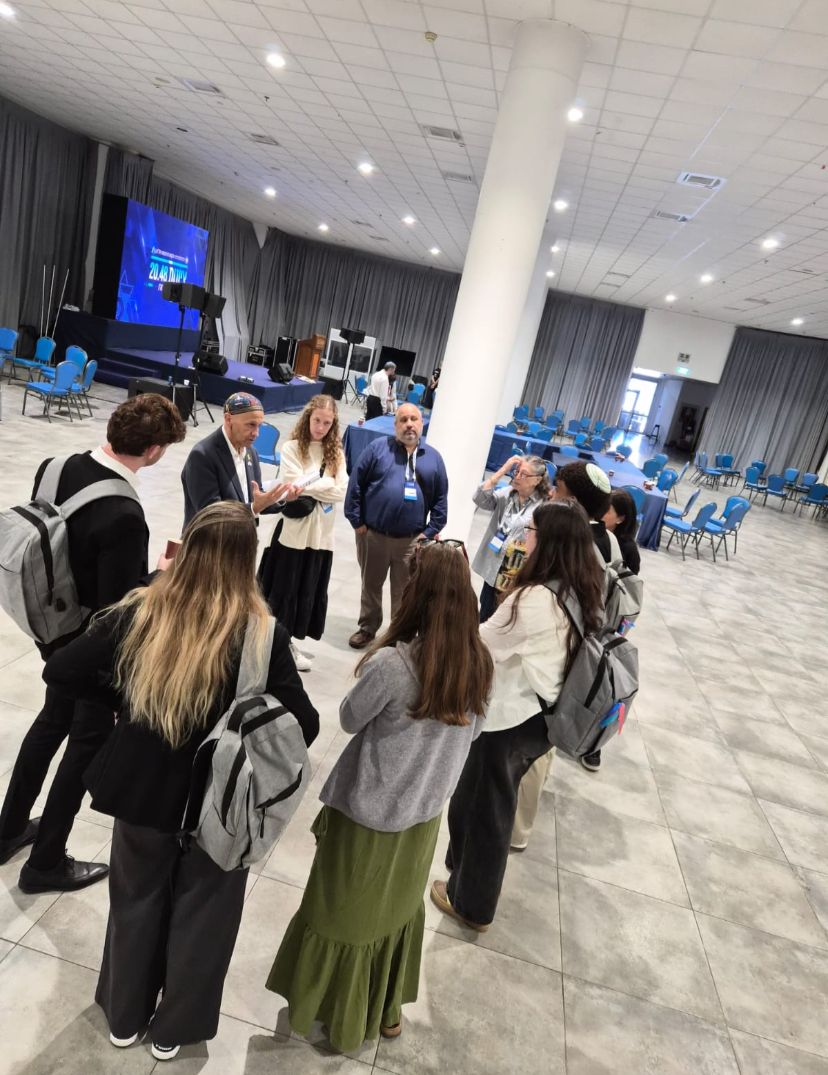
With members of TaMaR and Netzer leading its delegation at the WZC, the WUPJ showcased a new model of global Jewish leadership—pluralistic, intergenerational, and transformative.
At the largest Zionist gathering in recent years, the 39th World Zionist Congress brought over 700 participants from Israel and the Diaspora in Jerusalem at Binyanei HaUma on October 28–29, 2025. Across plenaries, committees, and working sessions, the WZC offered a forum to listen, debate, vote, and turn the global Jewish community’s priorities into concrete programs and resources.
Within this framework, the World Union for Progressive Judaism (WUPJ) chose a clear and distinctive path: entrusting young people not only with the stage, but with leadership. The WUPJ delegation consisted largely of activists and leaders from Netzer (the youth movement) and TaMaR (the young adult network), present not as “generational décor” but as protagonists in decision-making before and during the proceedings—from drafting resolutions to committee work and the plenary vote.
In the week leading up to the Congress, WUPJ participants were already actively engaged in the international Veidot of TaMaR and Netzer, as well as in Connections, the international conference of the World Union for Progressive Judaism (WUPJ).
The WUPJ’s young delegates—hailing from Netzer and TaMaR—authored the two resolutions submitted by the World Union. They took the lead on resolutions concerning youth movements, Magshimim, and informal education in the Diaspora, as well as on a resolution for budget transparency to implement an Equal Opportunity budgeting model, introducing impact assessments for every spending decision and a public annual report.
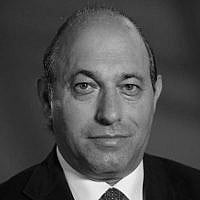
This leadership vision was articulated by WUPJ President Rav Sergio Bergman: “The substantial WUPJ representation of young leaders, comprising two-thirds of the WUPJ delegation to the WZC, marks a fundamental shift in the global leadership philosophy of progressive Judaism.” It is therefore not merely about youth participation, but about a governance model renewed from within: “This initiative transcends the creation of a mere youth department; it reflects a strategic decision to empower the next generation of leaders to guide us through emerging challenges, rather than imposing outdated paradigms.” The point, he stressed, is not chronological age, but instead “fostering a spirit of innovation, creativity, and relevance in addressing contemporary challenges.”
This same approach was confirmed in practice: the WUPJ’s young delegates contributed a progressive vision on the issues the WZC placed at the center of the global agenda, maintaining a focus on community impact in Israel and across the Diaspora. As Julia Ullman Hevron, TaMaR Global Coordinator, summarized: “We prepared a team of extraordinary leaders of TaMaR and NeTzeR from across the globe to represent the WUPJ at the World Zionist Congress. We strive in every aspect of our work toward the empowerment of young adults to be the leaders of today, not only of tomorrow. Their passion and commitment in writing and fighting for resolutions and tireless efforts in the long hours of the Congress were true testaments of their dedication to making an impact on Zionism across the world and bringing about an Israel that reflects our sacred values and ideals.”
The WUPJ style was evident in practice: pluralistic listening, intergenerational teamwork, and, above all, recognition of a youth leadership already established and robust within global Progressive Judaism. The goal is not to add just another voice, but to shift the center of gravity of leadership so that the energy and imagination of new generations inform strategic choices—from the wording of resolutions to programming priorities.
The 39th World Zionist Congress provided the ideal context for this qualitative leap. The assembly reaffirmed its character as a great laboratory of global Jewish life: a place where guidelines are set, directions are voted, and investments are planned to support education, the resilience of communities, and the strengthening of the bond between the Diaspora and Israel. The WUPJ seized the opportunity to present a revolutionary, innovative vision of governance: youth leadership is not a future to be awaited, but a present to be exercised.
If the Congress remains the meeting point where Zionism deliberates and builds, the WUPJ has signaled a clear path: to make leadership “young” not as a slogan, but as an idea of institutional architecture. In this light, Rav Bergman’s words stand as an operational roadmap for the years ahead: the goal remains “envisioning an institution that remains perpetually young and dynamic under the leadership of its younger members.” It is a goal already set in motion over the past few days in Jerusalem.