English Professor; Executive Director, Writing on the Wall
Rembrandt’s Disappearing Jews?
In 1648, Jews across Europe received devastating news of the Chmielnicki pogroms that swept through Ukraine and Poland, leaving tens of thousands dead. Amsterdam’s Jewish community, shaken and grieving, responded with public lamentation and fasting. Rembrandt, living among Amsterdam’s Jews, undoubtedly felt their anguish.
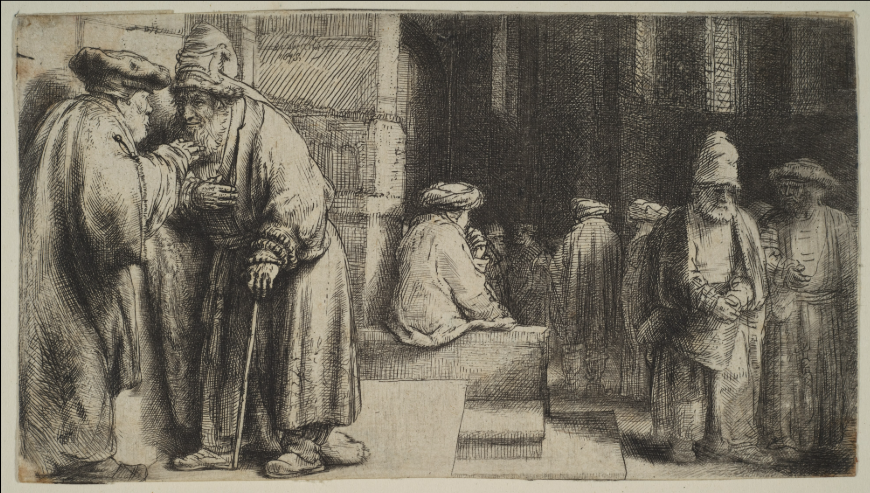
In his 1648 etching Synagogue, Rembrandt shows the fragility of Jewish existence at the outset of nearly a decade-long sequence of massacres of Jews. But the image reaches beyond the killing fields of 17th-century Europe—into the horrors of the 20th century, and into our own present as well.
Speech in the Temple, Silence in Exile
The etching is divided into contrasting spaces. In the illuminated left foreground, Rembrandt places figures rendered with precision: their clothing detailed, their fingers shaped, their eyes clear and alert. Lips move mid-sentence, hands gesture insistently. These hands do not simply accompany speech—they form it. The entire composition invites us into this exchange, into their space.
The backdrop of massive stonework—arched, weighty, architectural—led one contemporary to title the etching Pharisees in the Temple. Indeed, Rembrandt locates Jewish speech here—in the Temple. The men in the illuminated foreground are not just speaking; they are part of a conversation anchored in sacred space. This moment of shared presence, sharpened in gesture and detail, serves as contrast to what follows: the dark descent into exile.
On the right side of the image, figures dissolve into shadow, almost disappearing behind the lines that constitute them. They are paired off, yet not speaking—disconnected, inert, like mannequins arranged in parallel solitude, robotic, not human.
The pair on the right provide a bleak inversion of the conversation in the Jerusalem foreground. The figure at the far edge—more ghostlike, though etched in sharper detail—leans toward his companion and speaks. But this is not conversation, but coercion. The man beside him, silent, hands folded, immobile, sags under the weight of what’s been said. His posture is marked by despair and withdrawal. The speaker, his face darkened, gestures menacingly with his hand—drawing the other out of the scene, into a more permanent silence.
At the center of the image, with his back to Jerusalem, a man sits in-between, illuminated by the conversation behind him, but refusing to face it. Not in darkness, he has chosen disengagement. In Rembrandt’s visual theology, this posture is not neutral, but suggests that turning away from Jerusalem—from the humanity that animates this space—is another path toward silence.
From Chmielnicki to Auschwitz
Deeper into the abyss of the etching, stand two shadowy figures, their dark eyes almost indiscernible, but black with dread. Their garments evoke both prayer shawls and, to me, the striped caps and uniforms of Auschwitz. But Rembrandt is not a prophet, but a genius – who captures, with unsettling intuition, a terror felt centuries before its near-tragic fulfillment.
The 1648 etching—Rembrandt’s meditation on loss and exile—begins in Jerusalem, moves through Amsterdam, bears the weight of Chmielnicki, and reverberates, with fresh terror, into our post–October 7th present.
In Synagogue, Rembrandt shows a Jewish world balanced precariously between presence and disappearance. This vision beckons us today, demanding that we take up the responsibility to speak, to converse, to create together, or to vanish quietly into the shadows.
Related Topics