


Remember the heroes of the protest movement
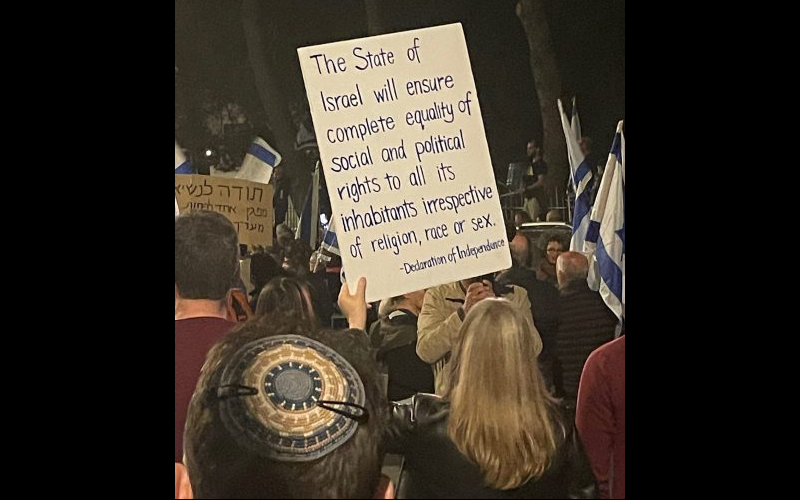
Today, January 7, is the anniversary of the birth of a movement of Israeli heroes.
Three years ago today, on a rainy Saturday night, hundreds of thousands of ordinary Israelis braved the weather and took to the streets to protest the announcement, three days earlier, of the new government’s “judicial reform” plans.
This would continue every Saturday night for nine months. At their peak, 500,000 Israelis demonstrated in cities across the country, with the main national protest taking place on Tel Aviv’s Kaplan Street. It would be exactly nine months later that the weekly protests ceased — October 7, 2023. The worst day in the history of the State of Israel put a stop — temporarily at least — to both the government’s push to overturn Israel’s liberal democratic system, and the protests against.
The leaders of the protest movement have been called “traitors” and worse by supporters of the government, but make no mistake, they are heroes. Without them, the judicial overhaul would have been implemented, and we would be living in a very different country. Here is a list of just some of the changes we would likely have seen in Israel had the “reform” been successful.
- Legislation would have been passed officially exempting most ultra-Orthodox from army service. The Supreme Court has been all that has stood in the way of the government passing such a law. After Justice Minister Yariv Levin’s “reform,” even if the Court blocked this law, the new “override clause” would have allowed the coalition to reverse the Court’s decision.
- The attorney general, long a thorn in the government’s side because of her insistence on the radical notion that the rule of law applies to government ministers no less than to ordinary citizens, would have been replaced. And she would almost certainly have been replaced by a political puppet of the prime minister, because after the “reform,” the Supreme Court would have no power to insist on a professional appointment. We can assume that this new, compliant A-G would cancel Netanyahu’s trial, as well as give a “legal” green light to whatever the government wished to do. (The news yesterday shows that the government remains very much committed to this idea.)
- Ronen Bar, the former head of the Shin Bet, would have been forced out before being able to begin the investigations into Qatari influence in the Prime Minister’s Office.
- National Security Minister Itamar Ben Gvir would be free to fulfil every authoritarian desire in his heart — from banning demonstrations, to creating a private militia within the police force, directly answerable to him, to arresting people for their views — without requiring legal experts to authorize this.
- A new media law would be passed, granting the government greater political control over media outlets.
- A new law would be passed, granting the government the power to ban parties from running in elections.
This is not an exhaustive list, but these are all legislative or policy proposals that the government or individual ministers have stated as goals — some have already been tabled as bills in the Knesset — which the Supreme Court would annul as unconstitutional, and which a Court neutered by the “reform” would be unable to block.
For good reason, Israel tends to envisage its heroes in the uniform of the IDF. And unquestionably, our soldiers, and the men and women of the Mossad, have made extraordinary contributions to our security these past two years. But without the protest movement that began three years ago today, our soldiers would today be defending a quasi-autocracy, a country where ordinary people’s rights were no longer protected by the rule of law, and where free and fair elections could no longer be guaranteed.
And lest we forget, the same people who were leading the protest movement up to October 6, 2023, were leading the civil society effort to help the survivors and internal refugees of the Hamas pogrom after October 7. The government was shell-shocked and hopelessly inept in those first days after the atrocities. Ordinary Israelis stepped up and stepped in, organizing food, childcare, counselling, and other services. And the most active organizations were those that had been coordinating the weekly anti-government protests. They pivoted, and they utilized the resources and organizational know-how they’d developed that year for a different challenge. These “traitors” were the best of us, helping their stricken countrymen while the prime minister was still trying to work out how he could avoid taking responsibility for the largest mass murder of Jews since the Holocaust occurring on his watch.
I joined the protests every week, in Jerusalem, I had no leadership role (except as one of the founders of a small group of mainly English-speaking immigrants called “Olim for Democracy“), and I can attest that the government’s constant labelling of the protesters as “leftists” was baseless. I saw right-wing Israelis at protests, including former Likud ministers, from a time, not so long ago, when the Likud was a proudly liberal party. What united us all was a commitment to the founding values of the State of Israel.
These were profoundly patriotic protests, with copies of the Declaration of Independence held aloft as banners and Hatikvah sung with pride and passion. Yale University political scientist Steven Smith, author of a book entitled Reclaiming Patriotism, wrote recently that American protesters could learn a lot from Israel’s patriotic protests:
In the summer of 2023, shortly before the Hamas attacks of October 7, I participated in a protest against the Israeli government’s proposed judicial reforms in Jerusalem. The protest was awash in Israeli flags, there was not a hint of violence, and some of the protesters even brought trash bags to clean up after themselves. American protesters might take a cue from their Israeli counterparts.
The fight is not over because the government has not given up its attempts to grab unrestricted power. Protests returned during the war — albeit motivated primarily by the issue of the hostages — and continue, focused mainly on the scandal of ultra-Orthodox exemption from army service, and on Netanyahu’s refusal to allow an independent commission of inquiry into October 7. But today is an anniversary to remember, for every Israeli who rejects the judicial overhaul and believes in a liberal democratic Israel — a majority according to every poll taken since the protests began.
And this year, 2026, that majority has a job to do, a job of existential importance: Vote with your values at this year’s election. Ensure that the next coalition contains only parties committed to the Zionist ideal of a Jewish and democratic state.