

Mathematics Teaching Professor, Author
Remembering History: Inside the Holocaust Resource Center of Las Vegas
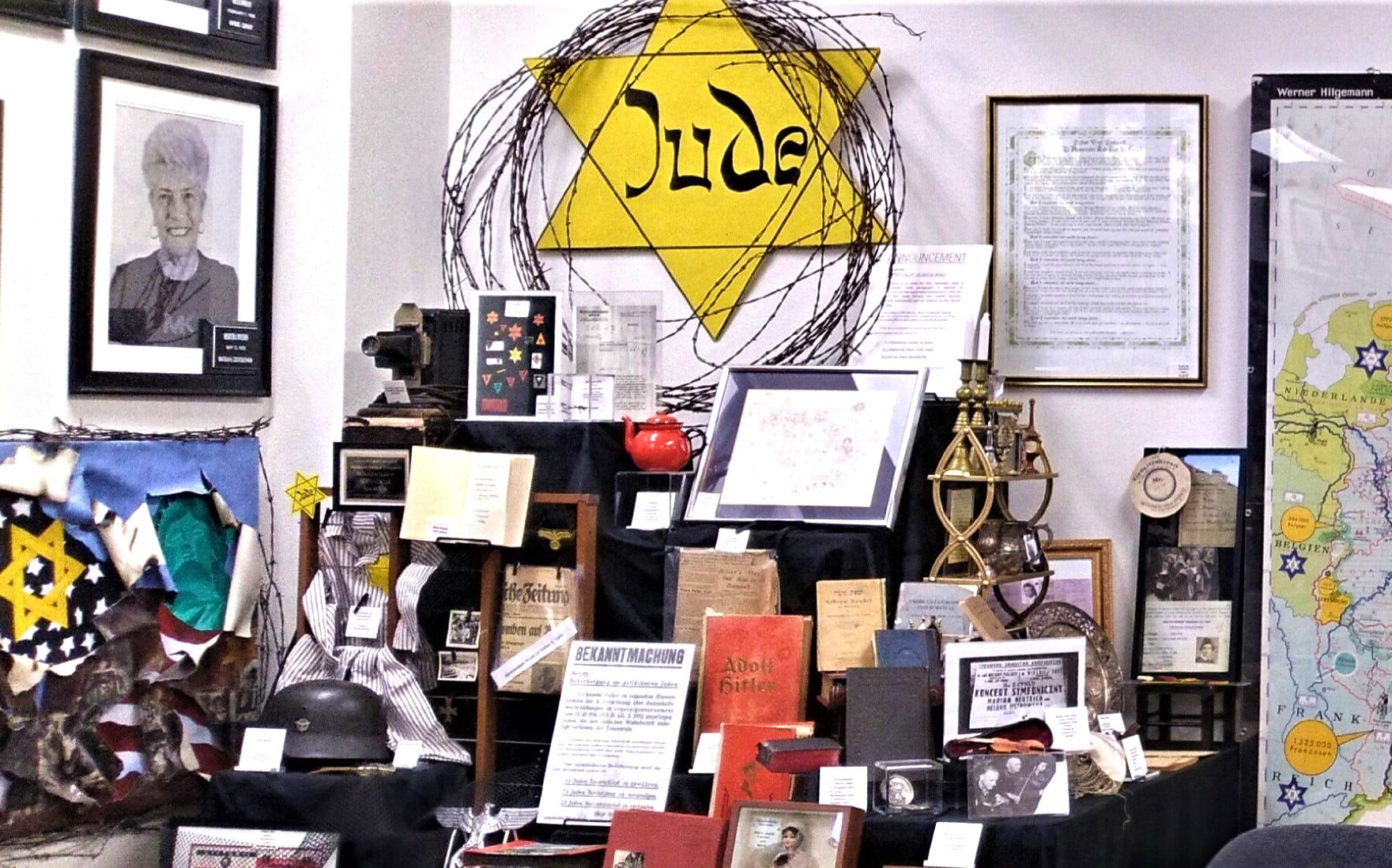
Artifacts (Source: Holocaust Resource Center, Las Vegas, Nevada)
The Sperling Kronberg Mack Holocaust Resource Center serves as Nevada’s central hub for Holocaust education, programs, and initiatives promoting tolerance and diversity. It supports the Nevada Governor’s Advisory Council on Education Relating to the Holocaust by providing print, nonprint, and electronic resources, along with educational programming for schools and the wider community.
The Resource Center is housed at Temple Beth Sholom in Las Vegas, with sister collections located at the Shia Szrut Holocaust Studies Memorial Collection in the Northwest Reno Library and the Holocaust Collection of Elko in the Elko County Library.
I would like to thank Susan Dubin, Library Director of the Sperling Kronberg Mack Holocaust Resource Center, for her guidance in preparing this article.
Sperling Kronberg Holocaust Resource Center

The Sperling Kronberg Mack Holocaust Resource Center is a specialized library with approximately 5,000 volumes focused on the Holocaust, World War II, and issues of prejudice and discrimination. It operates under the Nevada State Governor’s Advisory Council on Education Relating to the Holocaust, whose mission is to provide Holocaust education and information to people throughout Nevada.
Like a public library, the Resource Center allows patrons to check out books and other materials. One of its distinctive features is its collection of class sets which are multiple copies of the same book that educators can borrow so an entire class can read the same text simultaneously.
The Resource Center also offers an online catalog of its collection, with links to additional educational resources. In addition, the Resource Center offers Internet access for conducting online research and searching for information related to the Holocaust and related topics. These resources support students, educators, researchers, and community members seeking reliable materials on Holocaust history, World War II, and the consequences of intolerance and discrimination.
Artifacts
The Holocaust Resource Center houses not only an extensive collection of books and DVDs but also a variety of historical artifacts on display. Unlike a traditional museum, the artifacts are not kept behind glass. Instead, visitors are encouraged to handle and closely examine many of the items, providing a more personal and meaningful connection to the history and stories behind each artifact.

The Holocaust Resource Center library was founded by Edyth Katz in the late 1970s. Henry Kronberg and Judy Mack, two local Holocaust survivors, also helped fund the library and supported its mission for many years. Today, the library is located at Temple Beth Sholom in the Summerlin community of Las Vegas.
Outreach
A primary mission of the Holocaust Resource Center is to provide professional development in Holocaust education for educators throughout Nevada. The Resource Center currently offers 19 professional development courses, with eight to ten classes typically available each semester through the Clark County School District for professional learning credit. To date, more than 2,000 teachers have completed these courses.
In partnership with the Clark County School District, more than 40 educators have earned the designation of Holocaust Educator by completing at least six 15-hour courses in Holocaust education. These certified educators are qualified to provide Holocaust instruction at their schools or through the Clark County School District’s Professional Learning Department. One of the Resource Center’s goals is to have at least one qualified Holocaust educator at every middle school and high school campus in Nevada.
The Resource Center’s books, audiovisual materials, and other educational resources are available to the general public and may be borrowed for up to three weeks. In addition, the Center conducts teacher-training workshops on a variety of Holocaust-related topics in collaboration with organizations including the Holocaust Survivors Group of Southern Nevada, the Clark County School District, the Washoe County School District, the Elko County Library Holocaust Resource Center Collection, ADL’s No Place for Hate program, the Nevada Department of Education, and other local and national Holocaust education organizations.
Teachers who successfully complete a minimum of six 15 hour Holocaust education courses may qualify to receive a Holocaust Educator Certificate awarded by the Sperling Kronberg Mack Holocaust Resource Center and the Nevada Governor’s Advisory Council on Education Relating to the Holocaust.
Historical Background
In 1859, the United States was a divided nation of 33 states under the leadership of President James Buchanan. It was a period marked by rapid westward expansion, major mining booms, and growing conflict over the issue of slavery.
It was in this year, 1859, that the first Jewish settlers arrived in Nevada, drawn by the opportunities created by the Comstock Lode silver rush. Rather than working as miners, many of these early Jewish pioneers established themselves as merchants, traders, physicians, and other professionals who served the growing mining communities, particularly in Virginia City. By 1862, Nevada’s Jewish population had grown to approximately 200 people.
The first known Jewish person to visit what is now Las Vegas was Solomon Nunes Carvalho, an artist, photographer, and explorer who traveled through the area in 1853 as part of John C. Frémont’s expedition. When Las Vegas was founded in 1905 following the arrival of the railroad, Jewish merchants, including Adolph Levy, opened dry goods and grocery stores that helped serve the new community.
In 1931, approximately 20 Jewish pioneers organized the Sons and Daughters of Israel, gathering in storefronts for religious services and community events. During the 1940s, Las Vegas experienced another wave of Jewish migration as entrepreneurs, investors, and organized crime figures became involved in the city’s growing legalized gambling industry. Among the most notable was Benjamin “Bugsy” Siegel, who developed the Flamingo Hotel, while associates such as David Berman and Gus Greenbaum managed several of the city’s early casinos, contributing to the rapid growth of Las Vegas as a resort destination.
By 1980, both the United States and Las Vegas were undergoing significant change. Nationally, the country faced high inflation, economic uncertainty, and the ongoing Iran Hostage Crisis. The year also witnessed the “Miracle on Ice” at the Winter Olympics in Lake Placid and the election of Ronald Reagan, whose decisive victory marked the beginning of a new conservative era in American politics.
Las Vegas was also in a period of transition. With a metropolitan population of approximately 463,000, the city was expanding rapidly while remaining known for its inexpensive entertainment, iconic neon signs, and casino industry. The year was overshadowed by the tragic MGM Grand Hotel fire, which claimed 85 lives and remains one of the deadliest hotel fires in U.S. history. At the same time, increased law enforcement efforts and changing ownership patterns signaled the gradual decline of organized crime’s influence over the Strip.
Against this backdrop, the Jewish community in Las Vegas was growing at one of the fastest rates in the western United States. Although the city’s Jewish population numbered only a few thousand people in 1980, far smaller than the long-established Jewish communities of cities such as New York, Chicago, or Los Angeles, it was expanding rapidly as families and professionals relocated to Southern Nevada. This period of growth laid the foundation for the development of new synagogues, educational institutions, and community organizations that would support the city’s flourishing Jewish population in the decades that followed.
It was during this period of growth, in 1980, that the Sperling Kronberg Mack Holocaust Resource Center was established. Accredited by the International Association of Jewish Libraries, the Resource Center has become Nevada’s leading hub for Holocaust education, providing educational programs, professional development for teachers, historical resources, and community outreach dedicated to preserving the memory of the Holocaust and promoting the lessons of tolerance, justice, and human rights.
The Sperling Kronberg Mack Holocaust Resource Center continues to play an essential role in Holocaust education across Nevada by preserving history, supporting educators, and promoting understanding, tolerance, and respect within the community.
Contact Information:
Sperling Kronberg Mack Holocaust Resource Center, 10700 Havenwood Lane, Las Vegas, Nevada 89135
Phone: 702-433-0055
Email: susandubin48@gmail.com
Website: https://lvhresourcecenter.com/