
An archaeologist cynical of both archaeology and academia.
Repackaging an Old Blood Libel for a Modern Audience
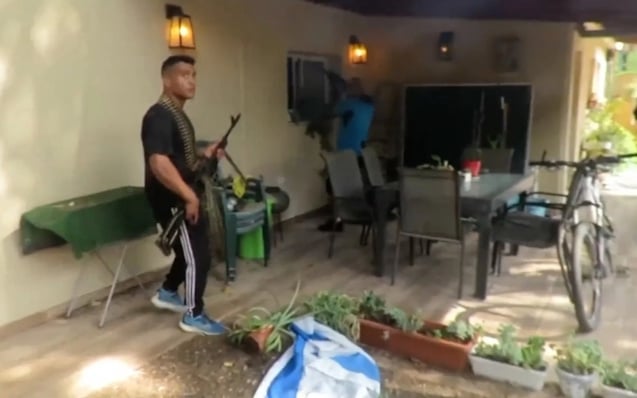
Armed men in civilian clothing, not military uniform, outside a private home in southern Israel during the October 7 attack. Body-camera footage still, Wikimedia Commons.https://time.com/6330005/the-oct-7-massacre-revealed-a-new-hamas-social-media-strategy/
In a December 2025 podcast, entitled “Why Are We Defending Mass Murder in Gaza? Because Our Greatest Ally Demands It,” Tucker Carlson advances a moral indictment of Israel founded on omission, hyperbole, and historical truncation. Carlson claims that the Jewish state is intentionally targeting and killing Gazan children. This essay demonstrates that Carlson’s narrative functions not as an analysis of war, but as a moral construction—one that isolates the Jewish state from historical context, strips Gazans of political agency, and ultimately echoes the logic, though not the historical form, of a modern blood libel.
Tucker Carlson has worked in media for more than 35 years and has done his “best to ignore what’s happening in Gaza.” Even so, he could not resist what he framed as moral outrage. With characteristic hyperbole, Carlson declared, “But among so-called civilized governments, none behaved like this, like Israeli government has behaved in Gaza, for a very long time, at least 80 years” (36:22-36:35).
What is unbelievable is not the emotional force of Carlson’s claim, but his historical illiteracy.
Eighty years before 2025 places us in 1945—when Gaza was not Egyptian or Israeli territory but part of the British Mandate of Palestine. The civil war between Arabs and Jews began in November 1947 and continued until May 14, 1948, when surrounding Arab states, including Egypt, invaded the newly declared State of Israel. From 1949 to 1967—nineteen years—Egypt, not Israel, exercised full control over the Gaza Strip. Under Egyptian rule, the movement and political rights of Gazans were restricted, and they were denied Egyptian citizenship. As a matter of policy, Gazans under Egyptian administration were territorially confined to the Gaza Strip, with exit subject to discretionary permits.
Israel controlled Gaza briefly during the 1956 Suez Crisis and again from 1967 until 2005. Carlson does not inform his audience that in 1994 the Palestinian Authority assumed responsibility for many civil functions under the Oslo process. He further omits that Israel—not Egypt—issued tens of thousands of Gazans revocable security permits allowing them to work inside Israel. This is not a trivial detail.
Prior to Hamas’s electoral victory in 2006, per-capita income in Gaza peaked in 2005 at approximately $2,500—nearly double Egypt’s $1,331 for the same period. These facts, and those above, are absent from Carlson’s podcast because they disrupt the scripted narrative he must maintain.
Tucker Carlson’s script intentionally erases civilian agency in Gaza. Carlson portrays Gaza’s population as politically inert while excluding the reality that some civilians—without implicating all—both supported Hamas electorally and participated in the October 7 attacks. Listening to Carlson’s podcast, one would not learn that Hamas came to power by winning a plurality of the Gazan vote in the 2006 Palestinian legislative elections.
Carlson’s narrative is likewise silent about the documented participation of Gazan civilians in the October 7 assault. Video and photographic evidence show civilians entering Israel alongside uniformed Hamas terrorists. Some civilians are seen carrying Kalashnikov rifles and wearing webbing. In one image, a Gazan civilian using crutches is shown at 0:32 entering Kibbutz Be’eri. This underscores that participation extended beyond able-bodied fighters. In multiple documented cases, able-bodied Gazan civilians transported Israeli hostages into Gaza, including Yaffa Adar, Noa Argamani, and Avinatan Or. Participation in the assault therefore extended beyond Hamas’s formal military wing to include some Gazan civilians.
Tucker Carlson’s script is also contradicted by polling conducted by the Palestinian PCPSR. In the weeks following October 7, this organization conducted a poll from 22 November to 2 December 2023. Their results demonstrate that 63% of Gazan respondents, and 82% of West Bank Palestinians, supported Hamas’s assault. This evidence does not imply collective guilt. At minimum, the polling data establish the presence of political judgment and moral evaluation among Gazan civilians—precisely the agency that Carlson’s narrative must exclude in order to portray Gaza’s population as wholly disconnected from Hamas.
When opportunities arose, some Gazans resisted Hamas and paid for it with their lives—further underscoring that political choice, moral judgment, and risk-bearing existed even under coercive rule.
Tucker Carlson repeatedly asserts that Israel is not merely responsible for civilian deaths in war, but that it is intentionally killing civilians, especially children. As he states, “Tens of thousands of children killed by a country with the most precise military technology in the world” (36:42). Moments later he reiterates this charge: “So the idea that they killed tens of thousands—tens of thousands of women and children, non-combatants—by chance is a lie. No, they kill them. They killed them. It’s just a fact. Call it what you want. Genocide. Fine. It doesn’t matter what you call it; it is murder” (37:12–37:30).
Tucker Carlson’s claim does not survive contact with the empirical realities of modern urban warfare. Hamas has systematically used Gaza’s civilian population as human shields since seizing control of the territory in 2007. John Spencer, a leading authority on urban warfare at West Point, has noted that “even if Hamas’s casualty figures were taken at face value—which they should not be—Israel would still have one of the lowest civilian-to-combatant casualty ratios in any comparable modern war.” Spencer further observes that civilian casualties in Gaza are comparable to, or lower than, those recorded during the Battle of Mosul (2016–2017). Carlson reserved the charge of genocide for Israel alone. He did not level it against U.S. or Iraqi forces in Mosul, nor did he accuse them of deliberately murdering Iraqi children—an asymmetry that speaks for itself.
Tucker Carlson uses his online platform to accuse Israel of deliberately murdering Palestinian children. He cloaks this accusation in the language of modern warfare and human rights. Yet the claim itself channels an older and darker tradition: the charge that Jews deliberately kill children. Carlson has not yet accused Jews of using the blood of Gazan children to make matzo. But the underlying logic of that blood libel is fully resurrected in his podcast, broadcast to millions.
Alongside this revived blood libel, Carlson advances another time-honored antisemitic trope—explicitly signaled in the title of his podcast—that Jews exercise coercive control over world affairs, or in this case, over the United States itself.
Related Topics