
Rereading Jonah after NAZA
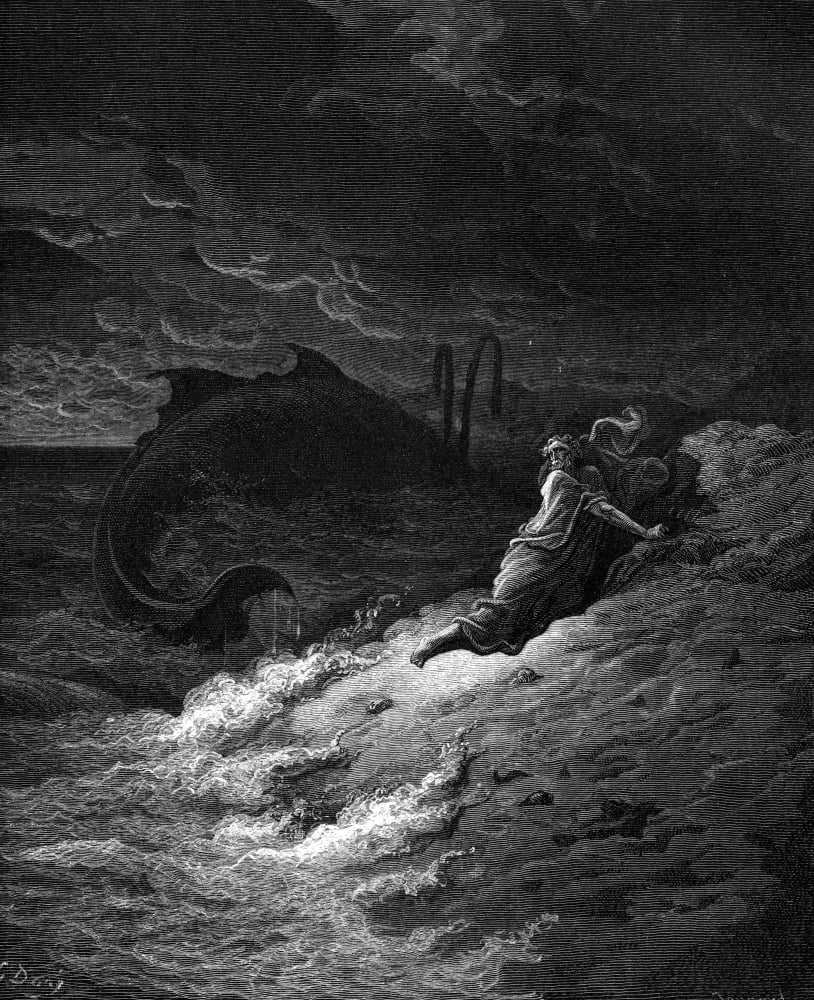
In a parallel universe, when being a Jew was still an acceptable — and, dare we say, sometimes even revered — identity, I wrote an essay about Abraham and Jonah.
In that parallel universe, my religious world was, on reflection, far more interior. I was preoccupied with questions of personal faith and spiritual experience. And so the two readings at the heart of Rosh Hashanah and Yom Kippur — the Akedah, the Binding of Isaac, and the Book of Jonah — seemed the perfect texts through which to think about religious uncertainty. Untroubled by any real existential crisis of Jewish identity or survival, I contrasted these two biblical figures and concluded that where Jonah failed, Abraham succeeded.
Today, I inhabit a very different universe. One that, with each passing day, feels more intolerable and more unreal. One in which I feel betrayed not only by much of the world around me, but most painfully, by some of my own people.
And so I want to return to those two narratives — to reread them in the light of the last few years, and particularly the last few days.
Abraham and Jonah are each confronted by a divine command that shatters the theological framework through which they understand the world. Abraham, the paradigm of chesed, is commanded to sacrifice his son. Jonah, the prophet whose very name — ben Amitai — evokes emet, truth, is commanded to bring God’s message to Nineveh, a city defined by its evil.
Both are asked to enter a reality that violates everything they think they know about God.
But they respond in opposite directions.
Abraham goes up.
Jonah goes down.
Abraham wakes, saddles, takes, walks, climbs. Jonah, by contrast, descends: to Jaffa, into the ship, into its hold, into sleep, into the sea. His physical descent becomes an existential one that is born of dissonance. I knew which of these two religious personalities I preferred: Abraham.
I preferred the man who could hold Hineni — “Here I am,” to God (Genesis 22:1) — and Hineni beni—“Here I am, my son,” to Isaac (Genesis 22:7) — within the same excruciating journey. The man who could be radically present to God without becoming absent to his son. I preferred the religious personality capable of moving forward without possessing certainty; who could climb towards God while remaining open to the possibility that the answer was still caught somewhere in the thicket.
I loved Abraham because I loved his open tent. I loved his compassion for the other. I loved his fierce devotion to God. And I loved — really loved — that at the very moment the knife was raised, he could still hear the angel calling his name and telling him to put it down.
Abraham’s epistemic humility meant that he was never so certain of his understanding of God’s first command that he became deaf to the second. I loved the quintessential questioner, always — even when it did not appear so — on a quest.
Jonah troubled me precisely because he seemed incapable of that.
He knows. That God is compassionate, that Nineveh is evil, that the storm is for him.
I read Jonah as the tragedy of the person whose commitment to absolute truth leaves no room for the contingency of reality. He is black and white: evil deserves punishment; goodness deserves reward. Divine compassion introduces a shade of grey that is intolerable to him.
And so I argued that perhaps this was precisely why Chazal, the sages, placed Jonah at the heart of Yom Kippur. Because teshuva (repentance) demands epistemic humility. If I possess the whole truth, I cannot change. If I cannot say ulai — perhaps — there can be no genuine transformation.
I still believe that.
But today, in my parallel universe of post-October 7th, I find myself reading Jonah differently.
When uncertainty becomes its own certainty.
Over the past few days, the controversy surrounding the Israeli documentary NAZA has erupted into public consciousness.
The film, made by Israeli filmmakers Yuval Abraham and Rachel Szor, premiered at the Venice Film Festival, where it received a 25-minute standing ovation. It is built around anonymous and unverifiable testimony from 24 Israeli military and intelligence personnel and makes grave allegations about Israel’s conduct of the war in Gaza. The IDF has categorically rejected the film’s characterization of its policies and challenged the unverifiable nature and context of its anonymous testimony.
Something about the reception of the film and the ease with which a devastatingly complex war can be placed into a clean moral frame, and something about its Israeli producers — sent me back to Jonah.
And unexpectedly, I found myself wondering: Had I been too hard on him?
There is an uncertainty born of humility. And there is an uncertainty that becomes an alibi for refusing to name some uncompromisable truths. There is nuance that expands our moral field of vision. And there is nuance that blurs it, or simply eradicates it. There is universal compassion that enlarges our humanity. And there is a universalism that somehow asks Jews, and only Jews, to transcend the particular loyalties, histories, vulnerabilities and responsibilities through which every human being actually inhabits the world.
As I returned to Jonah, I realized that the statement I once heard as arrogance rings a very different tune today.
As the ship threatens to break, the sailors surround Jonah with questions:
What is your occupation?
Where do you come from?
What is your country?
Of what people are you?
And amid all those questions, Jonah gives perhaps the most unequivocal sentence spoken in the entire book:
עִבְרִי אָנֹכִי וְאֶת ה׳ אֱלֹהֵי הַשָּׁמַיִם אֲנִי יָרֵא
I am a Hebrew, and I fear the Lord, God of heaven.
There is an austerity to the sentence. Unapologetic indignation. Arrogant and self-assured identity.
Ivri anochi.
I know who I am.
I know the story from which I come.
I know the people to whom I belong.
I know before Whom I stand.
Truth is not just a collection of propositions that can be externally verified. We know, from close up history, that moral categorical imperatives fail – on a grand and devastating scale. Real, authentic, sustainable, morally binding truth is covenantal: truths constituted by relationship, history, identity and responsibility.
My child is not objectively more human than another person’s child. But I have obligations and responsibilities towards my child that I do not have towards every child on earth because they are MINE. Because they share a part of my collective identity that others don’t.
Ivri anochi is not a claim of moral superiority. It is a refusal to pretend that universal compassion requires me to let go of fidelity to my people.
That detail, I suddenly realized this week, was one I had not taken seriously enough.
According to tradition, Jonah prophetically understands that Nineveh will repent and survive, only to become the power that will ultimately destroy and exile the Northern Kingdom of Israel. He believes God is asking him to participate in saving those who will one day destroy his own. His flight is still a refusal of God’s call, but one born of a passionate, visceral loyalty to his people.
And yet Abraham climbs and Jonah sinks. The juxtaposition remains. Both are asked to surrender something fundamental to their moral identity and to keep moving nonetheless. Abraham does. Jonah falters. It is an almost unbearable religious demand. And once, I embraced it unflinchingly. But the last three years have made me wonder whether our embrace of complexity can itself become morally simplistic. Whether we can become so committed to seeing every perspective that we lose the capacity to stand anywhere – so determined to extend compassion outward that we become embarrassed by the moral legitimacy of loyalty inward, so wary of certainty that we forget that covenant is necessarily particular and morally demanding.
And yet I cannot simply reverse my old reading, because the Book of Jonah does not end with Jonah.
It ends with God.
And God’s final word is compassion:
וַאֲנִי לֹא אָחוּס עַל נִינְוֵה הָעִיר הַגְּדוֹלָה
And should I not have compassion upon Nineveh, that great city…?
The book ends, poignantly, with a question.
God ask Jonah to keep questioning. To remain Ivri anochi while learning that the God before whom he stands is also Elo-hei haShamayim — the God of heaven, whose compassion cannot be confined within the borders of one people.
But perhaps the reverse is also true. God’s universal compassion cannot become an excuse to erase Jonah’s Ivri anochi.
The religious task is not to choose between them. It is to inhabit that place between them both. Abraham’s Hineni and Jonah’s Ivri anochi.
To be a Jew is to be open enough to say Hineni — to question the categories through which I see the world, to hear another possibility, to accept that I may be wrong.
But it is also to be rooted enough to say Ivri anochi — to know who I am, to whom I belong, and before Whom I stand.
Twelve years ago, I ended my essay by arguing that the answer to the Akedah remains tangled somewhere in the thicket: that religious life demands the courage to keep climbing even while our answers remain unresolved.
I still believe that.
But today I would add something:
You can only climb a mountain if you know the ground from which you began.
This Yom Kippur, I still want Abraham’s Hineni.
But perhaps, after everything we have lived through, I finally understand why I also need Jonah’s Ivri anochi.