
Rescue me
You know you’re Israeli when the national airline “rescues” you by airlifting you into a war zone. I was on my way back from Denver to Tel Aviv, a trip I have done countless times for work. My original flight to Israel (on Lufthansa) was canceled so instead I flew to Sofia, Bulgaria, where I planned to spend the night and take an El Al flight the next day. But at 3:30 a.m. that morning, Israel attacked Iran and closed its airspace, and so I found myself stranded in Bulgaria.
Over the next 12 days, like more than 100,000 other Israelis stuck abroad, I tried to get back home. More than once people asked me if it would be better to just wait until things calmed down, or if instead of trying so hard to get into Israel I should try to get my family out. But while I knew there was nothing my physical presence in Israel could do to protect my family or my country, I knew I needed to get home. It is the same instinct that prompted thousands to rush back after October 7, 2023. Despite incessant beeping from the Home Front Command app on my phone alerting me to missile sirens in Raanana (or perhaps because of that) I knew that being home, in my country, with my people, was ultimately the safest place to be.
Being outside of Israel during the war was bizarre. I spent that first Shabbat in Berlin, where my brother, a rabbi in New Jersey, was on sabbatical. We went to synagogue on Friday night, which was packed because of a bat mitzvah. I was keenly aware that synagogue services (like all public gatherings) were cancelled in Israel by order of the Home Front Command. And here I was in Berlin, in a 112-year-old synagogue that was wrecked on Kristallnacht and rebuilt after the war. Security was tight. The men put on hats or removed their kippot before walking out on the street. But nonetheless we could freely worship, guarded by heavily armed German police, in the heart of the former Nazi capital. And meanwhile on that same evening in Israel, synagogues were closed and people spent much of that evening in bomb shelters. And again, despite that fact (or because of it), I knew I had to get home – the only place where we can truly be safe.
Israelis love to complain about El Al – the high prices, the inconsistent service, the interminable hold times when trying to call them, the annoying earworm of their “El Al, hachi babayit ba’olam” jingle playing on loop while you wait to speak to an agent. But in wartime they sprung into action to get their people home. They worked with the IDF to land planes even while the country was being bombarded. They devised a rescue flight operation assigning flights to their stranded customers from wherever we were in the world. They communicated with me every day and I received a ticket for a flight home from London this past Monday night.
The week and a half of exile overseas was stressful and disorienting. I felt immense pride over the astounding successes of our army with its precision operation in Iran, and incredible worry every time my phone alerted me to incoming missiles and all I could do was refresh the news every minute to see if there were any impacts or injuries.
With each siren I texted with my wife. Are the kids sleeping in our bomb shelter? Were the booms louder than normal? I heard we should leave the windows open so they don’t shatter in case of a shock wave – did you do that? And leave the door unlocked so rescue workers can get inside the house if, G-d forbid, they need to?
And every few days I could have a brief call with my son from his army base. What’s the mood on the base? Is morale high? Are you getting any sleep? Will you be able to go home over the weekend?
When I finally received my boarding pass at Heathrow Airport, I was giddy with excitement to finally get home. The plane was packed. Every seat of the widebody Boeing Dreamliner was occupied. The airport security – British soldiers with machine guns, Israeli agents with their earpieces, and I am sure lots more not visible to us passengers – was immense. And finally, we were off. I was on my way home, and we’d be landing an hour early!
A little before 5 a.m. local time, with the sun still well below the horizon, we began descending toward Tel Aviv. I looked out the window. It was too dark to see anything, but that moment when the black of the Mediterranean gives way to the lights of the Israeli coastline always fills my heart with anticipatory joy. I’ve landed at Ben Gurion more times than I can count, but I still get excited to touch down during normal times, and all the more so now.
And then, I felt the plane bank right, and I saw the lights of the coastline behind us, and the black of the sea in front, and I felt us ascend. The flight attendant in his jump seat was seated across from me and I asked him why we turned around. “Probably missiles,” he shrugged nonchalantly. And sure enough, the captain announced that we’ll have to circle for a bit due to incoming missiles, and that we will land again shortly. There wasn’t an ounce of concern in his voice. “Todah al hasavlanut,” he said. Thanks for your patience.
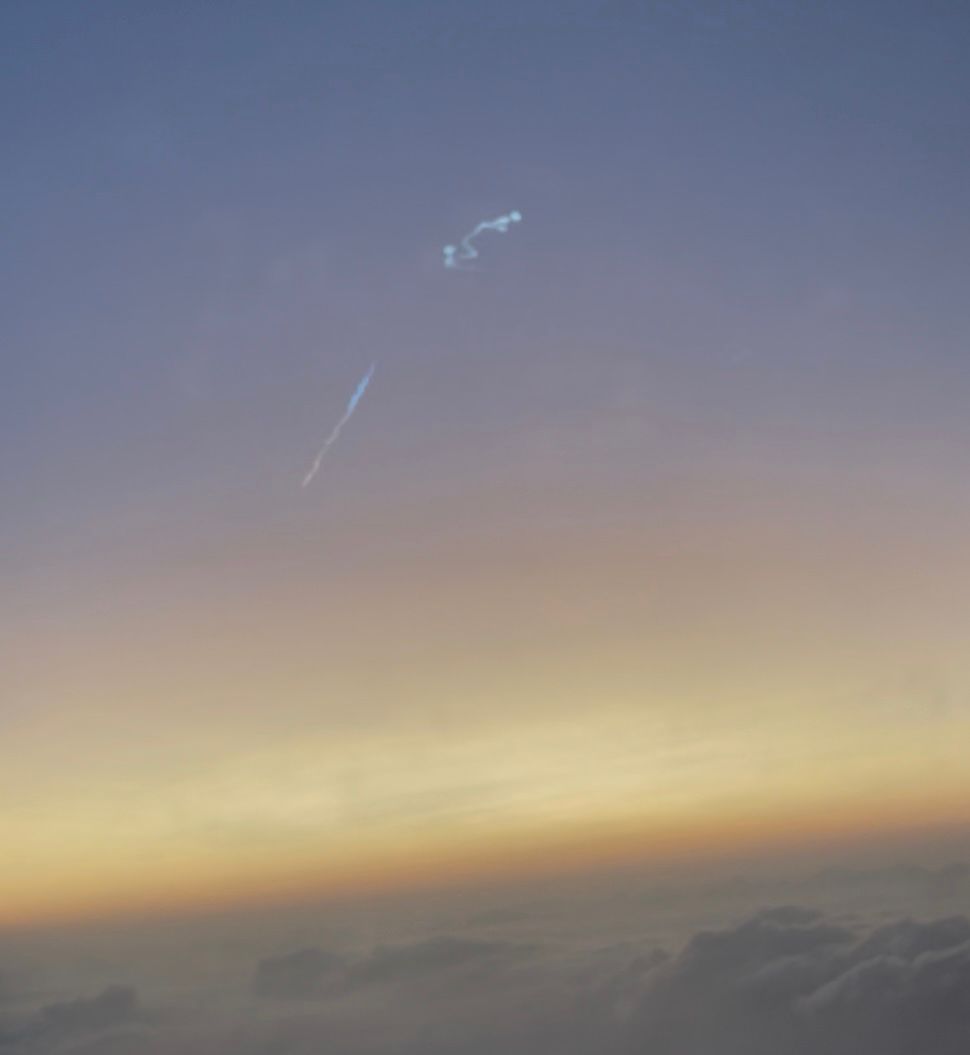
The sun began to peak over the horizon. We were above the clouds and they turned orange and pink. And then suddenly a passenger saw a projectile shoot through the blanket of clouds. “Tilim!” he shouted. Missiles! And passengers got up to look out the window. The flight attendants annoyingly reprimanded us. “Lashevet! Chagurot, bevakasha!” “Sit down! Seatbelts, please!” I looked out the window and saw the familiar white smoky trails of the missiles and the interceptors chasing them. My seatmate reached over me to take pictures. “Would you like me to take it for you?” I asked and he gave me his phone. “I want a video,” he instructed. It was hard to imagine a more Israeli scene.
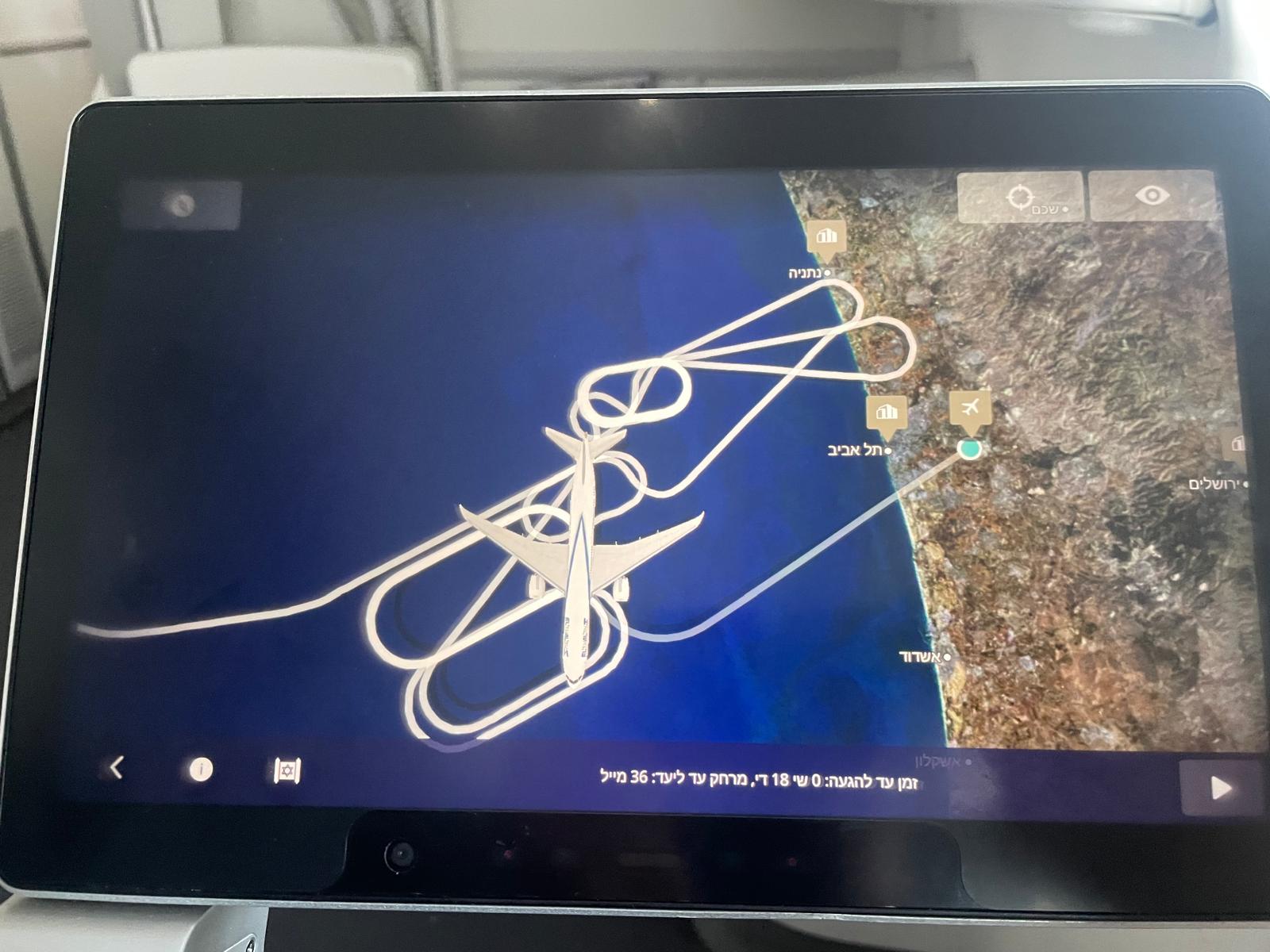
We made a second attempt to land. This time the sun was up and I saw the coast appear below me. Again we descended, banked to the right and went back out to sea. Again the captain explained that the airspace was closed, and we’ll have to circle a bit more. Again he calmly thanked us for our patience. We watched the progress of our flight on the seatback screens. We ended up circling for almost three hours. Finally, we landed at Ben Gurion to enthusiastic applause.
Back on the ground with an internet connection, I checked the news. I saw that a cease-fire had been declared, and in a final salvo beforehand Iran fired a barrage of missiles and hit an apartment building in Beersheva, killing at least four. The airport was eerily empty. Ours was the only flight to land. I finally got home and walked through the door and hugged my older daughter tightly. My younger daughter was still asleep in our bomb shelter. My wife had cleared it out and put in mattresses. I snuggled next to her and my wife said, “this is kind of what it’s been like – lots of quiet snuggles in the bomb shelter.”
But the war with Iran was over. By 8 p.m. that evening the Home Front Command lifted all restrictions. By the next day, schools and businesses were open and back to normal. And that too, is so incredibly Israeli. This country bounces back quicker than any place else on earth. Just hours after an unprecedented war with an existentially threatening enemy, everything is back to normal. There’s never any time to catch your breath. The unrelenting pace of Israeli life marches on.
It’s particularly surreal for those of us who were stranded abroad for these twelve days. To finally get back home just as life comes roaring back. There’s no time to regroup. The next morning, I got coffee and burekas at my favorite bakery, which was bustling just like it was before I left.
There is no other country in the world where a plane full of people rush back into a war, where we have to delay our landing to wait out missile attacks, and where we are all – without question – grateful to have scored a seat on this tisat chilutz – this “rescue” flight. For no matter what is going on in this crazy country, there is no question that we were rescued.