
Middle East Analyst
Resolving Eisenkot’s Haredi Conscription Dilemma
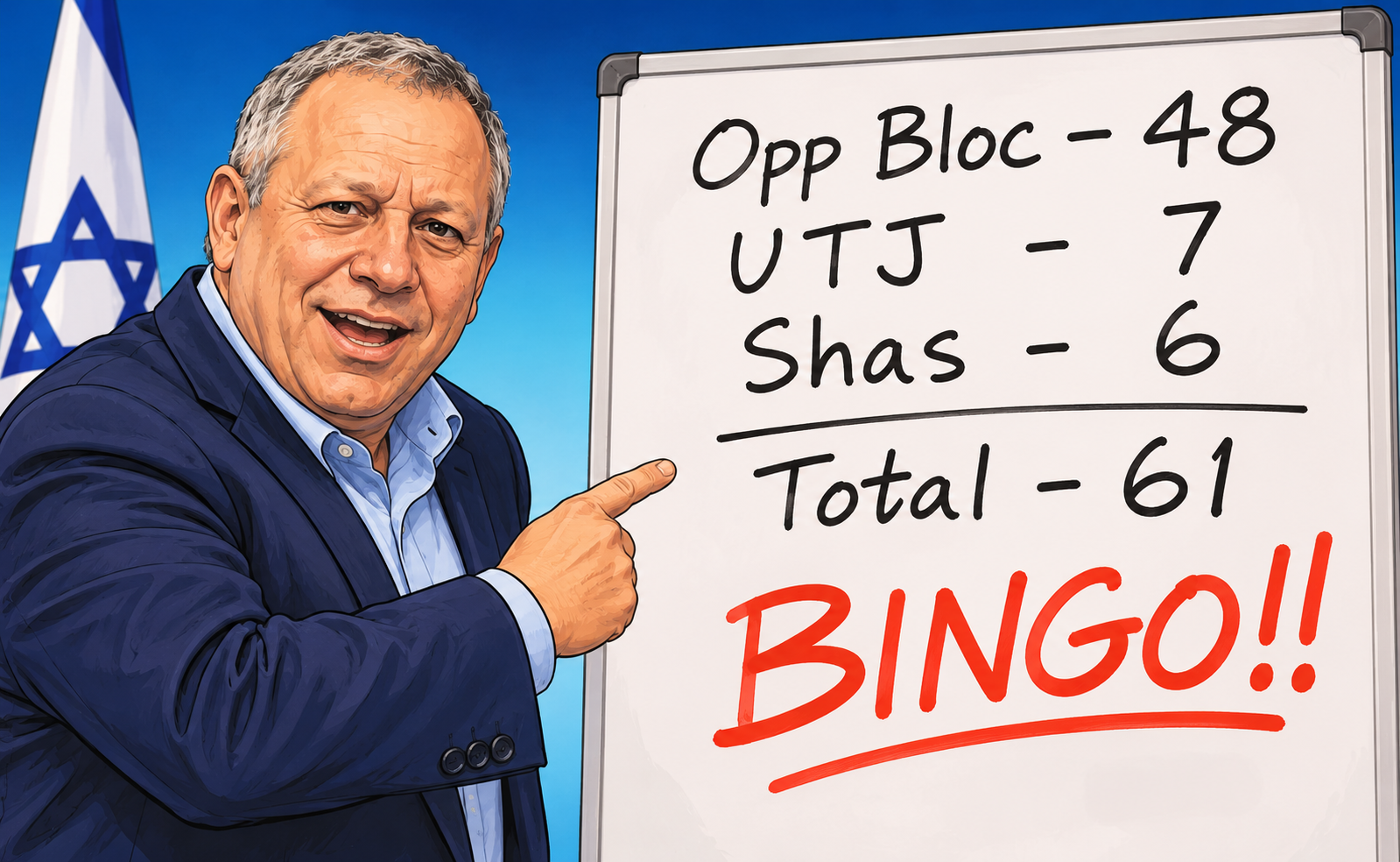
The Arithmetic of Coalition Politics
For all the public debate surrounding military service, religion, and national identity, the dilemma facing Gadi Eisenkot is ultimately rooted in mathematics. The Israeli political system does not reward ideological purity. It rewards the ability to assemble a governing majority of at least 61 seats in the 120-member Knesset.
Current coalition projections suggest that an Eisenkot-led bloc remains short of that threshold. The opposition’s challenge is not merely removing Prime Minister Benjamin Netanyahu from office but constructing a viable governing coalition afterward. This requirement forces difficult choices that ideological debates often obscure.
In theory, there are two possible paths to a majority. One is to rely on Arab parties for support, whether through formal coalition participation or through parliamentary arrangements that allow a government to take office. The other is to bring the ultra-Orthodox parties, particularly Shas and United Torah Judaism, into an alternative coalition.
Many outside observers assume that Arab inclusion is the more natural option for a centrist or center-left coalition. Numerically, that may be true. Politically, however, the situation is far more complicated.
The reality is that significant parts of the Zionist opposition remain uncomfortable with dependence on Arab parties for parliamentary survival. Whether one agrees with that position or not, it reflects an enduring reality of Israeli politics. A government perceived by large segments of the Jewish public as dependent on Arab parties could generate domestic backlash, increasing social polarization and potentially undermining the legitimacy of the government itself.
As a result, an accommodation with the Haredim increasingly appears to be the most practical route to a stable 61-seat majority.
Why Compromise is Unavoidable
The conscription debate is often presented as a struggle between principle and privilege. Critics argue that Haredi exemptions violate the principle of equality and place an unfair burden on secular Israelis who perform military service. Yet politics rarely offers ideal solutions. The question confronting Eisenkot is not whether the existing system is fair. It is whether a compromise can be devised that preserves social cohesion while creating a workable governing coalition.
Importantly, Eisenkot’s own positions suggest he understands this reality. Rather than insisting on universal military service, he has increasingly emphasized military or national service. That distinction is crucial. The debate is no longer between drafting every Haredi male or exempting all Haredim. Instead, the emerging discussion concerns how all sectors of society can contribute to the national good while recognizing substantial differences in culture, religion, and identity. This approach reflects political necessity as much as philosophy. A rigid insistence on universal military service would likely make coalition negotiations with the Haredi parties impossible. At the same time, a return to blanket exemptions would be unacceptable to much of the electorate. A middle ground is therefore not merely desirable. It may be essential.
Why Haredi Inclusion May Be Less Disruptive Than Arab Inclusion
This conclusion will be controversial, particularly among advocates of greater Arab political participation. Nevertheless, from a coalition-management perspective, accommodation with the Haredim may be less destabilizing than reliance on Arab parties. The reason is not ideological but sociological. The Haredim and secular Zionists disagree profoundly over religion, education, and military service. Yet they generally share a common Jewish national framework and broadly accept the legitimacy of the Israeli state.
By contrast, many Israeli Arabs possess a more complex set of identities that include familial, cultural, or national connections to Palestinians. This does not imply disloyalty. It simply reflects historical and political realities. In the aftermath of October 7 and the subsequent wars in Gaza and Lebanon, many Jewish Israelis remain deeply suspicious of arrangements that would make Arab parties essential to government survival. Whether such concerns are justified or exaggerated is almost beside the point. Political legitimacy depends not only on objective reality but also on public perceptions. A coalition that provokes large-scale social backlash can quickly become ineffective, regardless of the merits of its policies.
For this reason, a compromise with the Haredim may represent the less disruptive alternative. Secular Israelis may dislike such a compromise, but they are generally familiar with the political bargaining required to sustain relations between religious and secular communities. Reliance on Arab parties, by contrast, would likely provoke a much more emotional and polarizing debate.
The Parallel Between Haredi and Arab Exemptions
An overlooked aspect of this debate is the remarkable similarity between arguments regarding Haredi service and Arab service. Most Israeli Arabs are not currently subject to mandatory military conscription. Israeli governments have long recognized the practical and ethical difficulties involved in compelling large numbers of Arab citizens to fight Palestinians or other Arab populations. Few policymakers seriously advocate drafting Arab citizens into Gaza combat units. Yet similar considerations apply to the Haredim.
Many Haredim view military service not merely as inconvenient but as fundamentally incompatible with their religious commitments and communal identity. Their objections differ from those of Arab citizens, but the underlying issue is similar: how much value does the state gain by compelling military service from populations that are deeply reluctant to serve?
Military organizations function most effectively when personnel believe in their mission. While some unwilling conscripts can perform effectively, a strategy built around large numbers of reluctant recruits often generates friction, morale issues, and cohesion problems. The objective should not simply be to maximize the number of individuals wearing uniforms. The objective should be to maximize national contribution. Seen in that light, the Haredi and Arab questions become variations of the same challenge.
National Service as the Most Realistic Solution
The most promising solution may therefore be a universal national service framework. Under such a system, citizens would be expected to contribute to society, but the nature of that contribution would vary according to individual circumstances and community needs. Military service would remain the default option for many Israelis. Others could perform alternative national service in fields such as:
- Emergency response
- Healthcare
- Elder care
- Education
- Civil defense
- Infrastructure support
- Disaster relief
- Community resilience programs
Such an approach would preserve the principle of shared civic responsibility while avoiding the difficulties associated with forcing unwilling populations into military structures. Perhaps most importantly, it would provide a common framework applicable to both Haredim and Arabs. Rather than treating each group as a unique exception, the state could establish a broader understanding that all citizens contribute, but not necessarily in identical ways. This would represent a shift from equality of service toward equality of obligation.
The Missing Variable: Israel’s Security Strategy
Much of the conscription debate assumes that Israel’s manpower requirements are fixed. They are not. Military manpower requirements depend heavily on strategic assumptions. A government expecting continuous multi-front conflict requires larger force structures and a broader mobilization base. Under such circumstances, pressure for expanded conscription becomes understandable. But what if an Eisenkot government pursues a different strategic model?
Many supporters of Eisenkot believe that Netanyahu’s coalition structure limits Israel’s flexibility regarding Gaza and other regional conflicts. Whether that assessment is correct or not, it informs their political thinking. They argue that a different coalition could support a greater emphasis on diplomacy, regional engagement, and de-escalation. If such an approach were successful, the manpower equation would change. A state preparing for endless large-scale operations naturally seeks every available soldier. A state pursuing deterrence combined with diplomatic stabilization may be able to tolerate more limited force levels.
This does not mean military strength becomes unimportant. Israel’s security challenges are real and unlikely to disappear. Rather, it means that manpower policy cannot be separated from broader strategic objectives. The number of soldiers required depends partly on the kind of future Israel seeks to create.
Related Topics