
Rethinking Crohn’s Care: Prevent the Fire Early
Crohn’s disease is a companion no one chooses. It is chronic, unpredictable, and often invisible-until the moment it erupts. For the more than 10 million people worldwide living with inflammatory bowel disease (IBD), the greatest burden is not only pain or medical complexity but the constant uncertainty: What is happening inside my body right now, and why is it happening again?
Over the past decade, research has confirmed what many patients have long felt intuitively: stress is not merely an emotional experience, it is a physiological trigger. Research shows that patients under high stress face a risk of flare-ups that is up to 3.6 times greater. Think of stress as the “spark” that ignites the inflammatory “fire” in the gut. Currently, medicine waits for the fire to burn, treating the inflammation only after symptoms appear. But we asked a different question: What if we could catch the spark?
As a cancer researcher and PhD candidate developing EVs-CAR-Therapy, I spend my days studying biological systems that fall out of balance- signals the body sends long before symptoms appear. But my ongoing conversations with patients clarified a frustrating paradox. We live in an era of advanced diagnostics and endless health data, yet our lives are becoming increasingly stressful- fueling the very fire we are trying to treat.
Despite all our technology, our approach remains reactive; we treat the damage, but we ignore the trigger. I realized that we are missing a solution that connects these dots, one that tracks stress not just as background noise, but as a clinical predictor. The goal became clear: we shouldn’t just ignore stress, we should use it to our advantage. By tracking and controlling the trigger, we can finally control the disease.
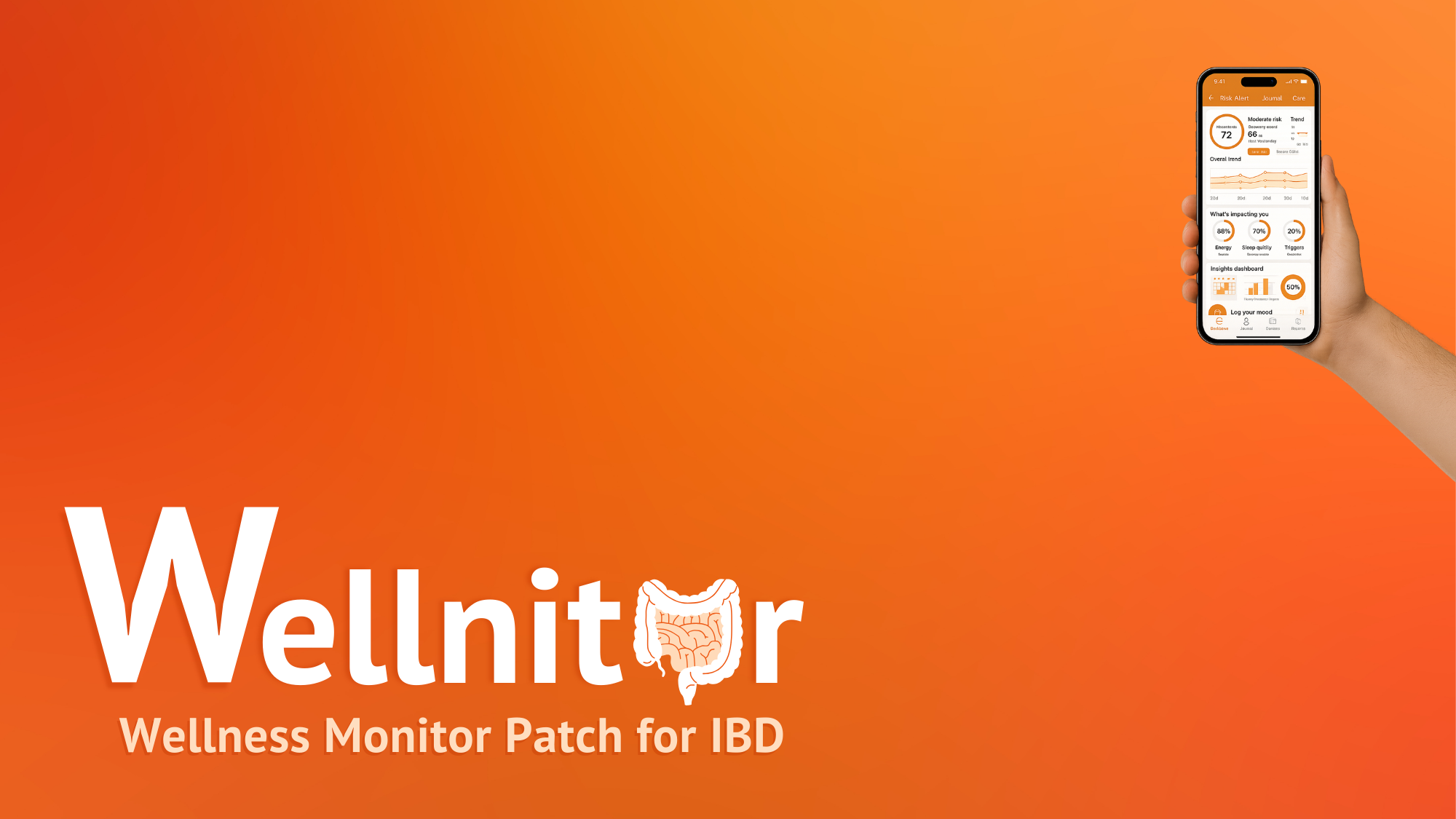
This realization led me to develop a new approach: a smart, skin-worn patch that monitors both stress-related physiological markers and indicators of Crohn’s inflammation in real time. The concept is simple but transformative: we don’t just track the fire (inflammation); we track the spark (stress). By monitoring both simultaneously, we move beyond passive prediction into active prevention.
This is orchestrated by an AI-driven app that acts as a continuous guardian. It analyzes these dual signals in real time to open two doors for intervention: alerting physicians to adjust medication early and guiding patients to neutralize the trigger itself. The AI doesn’t just display data; it provides personalized, evidence-based tools, like targeted mindfulness or breathing exercises, exactly when the patient needs them most, potentially stopping the flare before it starts.
Invisible processes become visible and, therefore, actionable. We move from reacting to damage to preventing it by editing the lifestyle triggers that fuel it.
Alongside scientific development, I participated in Teva’s BioInnovators scholarship, a program that fosters mentorship, innovation, and collaboration within the global bioecosystem to drive the future of translational science and bioentrepreneurship. As part of this program, I participated in the 6th BioMix competition, which showcases exceptional Ph.D. and postdoctoral ventures focused on advancing the translational aspects of biological therapies between academia and industry and promoting entrepreneurship in the biomed field.
The value of that process was not promotional; it was practical. It challenged assumptions, exposed blind spots, and pressured the project to evolve from a promising idea to a clinically meaningful solution. In a field as complex as IBD, that kind of multi-disciplinary scrutiny is essential.
For physicians, early detection could mean fewer hospitalizations, fewer complications, and more precise therapeutic decisions. But perhaps the most significant impact lies elsewhere: in the emotional landscape of the disease. When patients receive continuous feedback, the sense of helplessness begins to fade. And as stress decreases, flare-ups may decrease as well.
Crohn’s disease is not disappearing. But by combining research, technology, and genuine listening to patient experience, we can reshape how it is managed. These tools will not cure IBD, but they can restore something the disease has stolen from so many for so long: stability, clarity, and a restored sense of control.
For me, as a researcher, that is more than enough reason to keep pushing forward.
img class=”alignnone size-medium wp-image-1398342″ src=”https://static-cdn.toi-media.com/blogs/uploads/2026/01/ChatGPT-Image-Oct-18-2025-at-02_42_48-PM-400×250.png” alt=”” width=”400″ height=”250″ />