
Reverse Polarity

In earlier posts I noted some complications that come up when you move from a left-to-right place to a one where many things go from right to left.
For most of these, you adapt fast. If you see two doors at the entrance to a mall and you think the one on the right is the way to go in, getting trampled by exiting people waving stuffed shopping bags will set you straight. Next time you’ll head left.

Likewise, if you look to the left of your plate at a restaurant and see a knife and spoon, you will quickly find your fork on the right.
This blog is offered as a public service, as a guide to managing two more exotic examples of reversed polarity. Only one of them has to do with Hebrew and Israel. In each case figuring things out is harder than finding your fork.
- Formatting Your Self-Published Hebrew book.
Many years ago Kohelet wrote, “Of making many books there is no end.” With all due respect, he had no idea.
Nowadays anyone can make anything into a book. I may do that with this blog. You may think that a 1,000-word blog won’t make much of a book. But you can add:
- a page of all your previous books, including 21 blog-books, plus a Deluxe Jubilee compendium of all 21
- 5 pages of enthusiastic blurbs from all the friends you blurbed for
- a Title Page
- a page of classy epigraphs from famous writers, philosophers, and internet influencers
- Acknowledgments
- a Preface
- a Foreword
- extra illustrations
- an Afterword
- a Postscript
- a syllabus of questions and suggested discussion topics for Book Groups
- Exciting new titles forthcoming from you, your blurbers, and anyone you ever blurbed for
Add a nice hard cover, and you’ve got yourself a book. Whether anyone will ever order and read it is a different story. You can tell that story in a different book.
How to design a self-published book
You will need two things: a Cover, and Internal Text. The Cover template looks like this:

The back cover is on the left and the front cover is on the right. That way, when you fold the two-page spread in the middle, the front cover will be on top. Unless of course your book is in a right-to-left language like Hebrew, Arabic, or Japanese. In that case, you put the front cover on the left and the back cover on the right. Stay with me.

When it comes to the text, you provide a PDF document. For an English-language book, the first page is page 1 of the PDF, and the book’s last page is the last page of the PDF. If your book is in Hebrew (or Arabic or Japanese), the last page of the PDF is the first page of the book, and so on backwards.
At the publisher I work with, the icon in their bookstore shows the back cover, even though the book itself has the front cover where it is supposed to be, on the back. They say they are working on it. I doubt anyone will refuse to buy the book because they can only see the back cover. They have so many other reasons. Right?
Left….?
- Installing a left pedal on an exercise bicycle.
Before I start, I want to acknowledge that bicyclists, plumbers, and mechanical engineers will read what follows with smug self-satisfaction. They will think, “Are you kidding? You really didn’t know that?” This blog is for the rest of us.

So no, my expert friends, I did not know that. I have used screwdrivers and pliers and wrenches for a long time. I knew, or thought I knew, that when tightening something, you turn it to the right.

We ordered an exercise cycle. It was, of course, manufactured in China, where they speak neither Hebrew, Arabic, nor Japanese.
The box came with no instructions, but there was not much assembly to do. I was able to screw in the right handle, which I knew was the right handle because it said R on it. I did the same with the other one, which said L.
I then turned to the pedals, also helpfully labeled R and L. I screwed in the right pedal first. Done in seconds.
I turned to the left pedal. When I tried to screw that in, nothing happened. The screw didn’t catch. I held it firmly. I tried to turn it using a pliers for greater leverage. I tried over and over and over. Nothing happened. It didn’t attach.
I tried using the right pedal by unscrewing it and trying it on the left, but that didn’t work either.
After a while, I was ready to give up. I groaned at the thought of sending either the pedal or the whole apparatus back to China.
And then I decided to try it one more time. For no reason, I tried screwing it in by turning it to the left. I had no reason to think that would work.
But it did. It went right in.
Why would Righty be Tighty everywhere and always all my life, and even in this case for both handles and for the right pedal but not for the left?
A quick search–using AI of course–explained as follows: You tighten some things by turning left because they have left-handed threads, used to counteract rotational forces or vibrations that would loosen when used if they had normal right-handed threads.
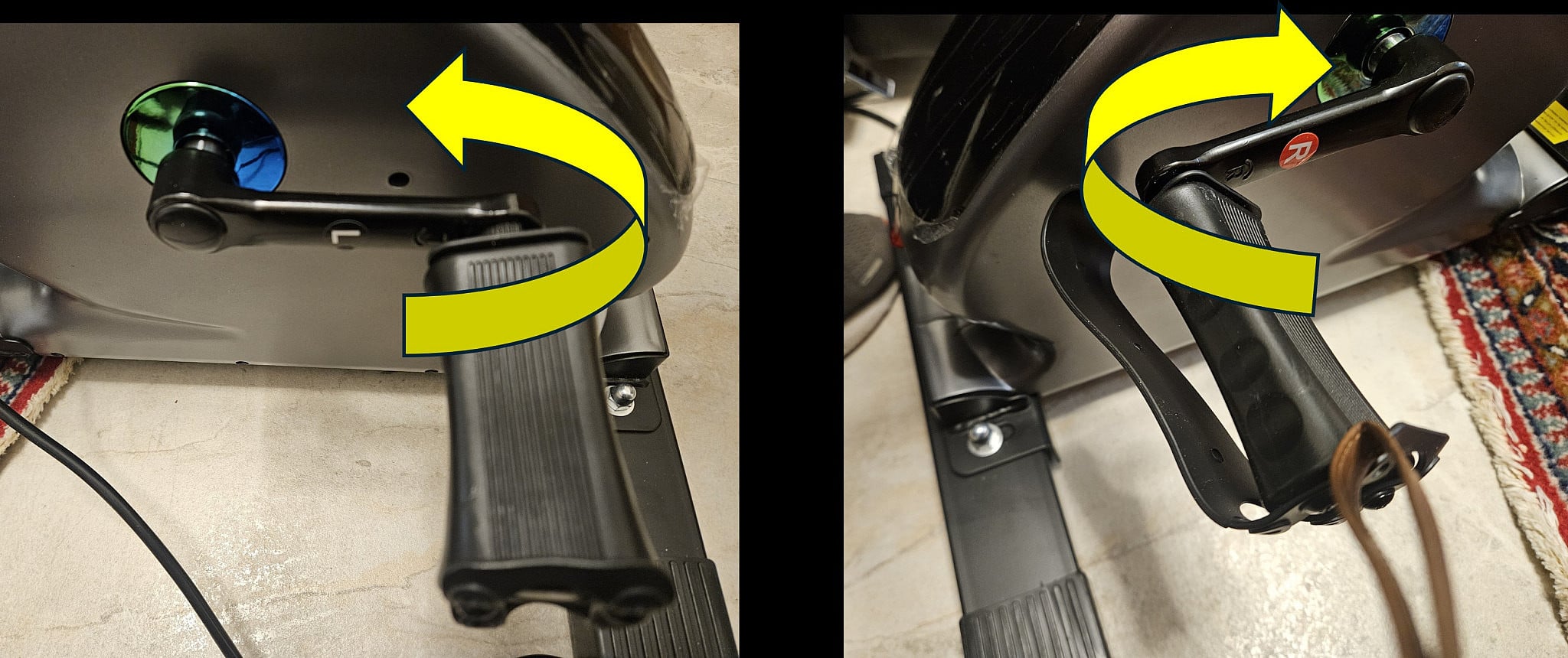
One example is left-sided bicycle pedals, where the left-handed thread tightens as you pedal forward and prevents it from coming loose. Another example is high-pressure gas lines. I haven’t been in one of those since the oil shock of 1979.
Why did the Chinese manufacturer not include this instruction? Possibly because of the old Confucian maxim: 永远不要给傻瓜任何机会
This translates as: “Never give a sucker an even break.”
All I have to offer is a new mnemonic: