Journalist
Ron Prosor at Track 17: Remembrance Is Not Enough
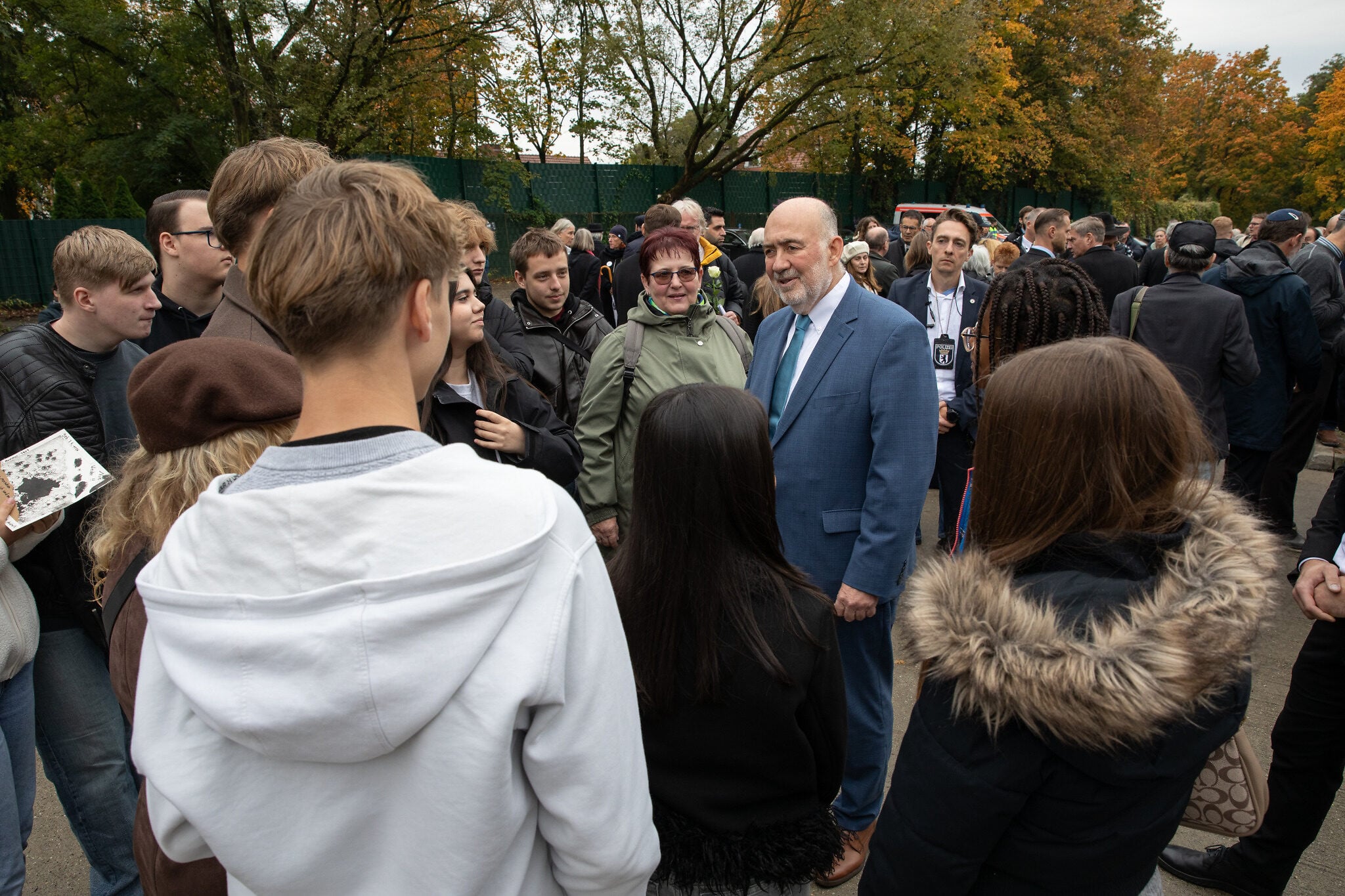
Israeli Ambassador to Germany Ron Prosor speaks with students who attended a ceremony marking the 85th anniversary of the first mass deportation of Berlin’s Jews, at the Track 17 memorial at Grunewald railway station in Berlin on Sunday, October 18, 2026. Photo: Michael Kuenne (PRESSCOV)
“Eighty-five years after the first transport, trees are growing through the tracks. They have become a natural obstacle. A silent sign that never, ever again should a train deporting Jews leave this place.”
Israel’s ambassador to Germany, Ron Prosor, was nearing the end of his speech when he added:
“Each of us can be such an obstacle.”
He was speaking on Sunday, October 18, 2026, at Berlin’s Grunewald railway station, where exactly 85 years earlier, 1,013 Jewish men, women and children were deported to the Lodz ghetto in Nazi-occupied Poland. It marked the beginning of the systematic mass deportations of Berlin’s Jewish population. In the years that followed, more than 50,000 Jews from the city were murdered in the Holocaust.
Today, the tracks are overgrown. Steel plates record the deportation transports, and white roses lay at the memorial. Berlin Mayor Kai Wegner attended the ceremony, as did Stephan Harbarth, president of Germany’s Federal Constitutional Court, alongside representatives of Jewish organizations and mourners.
Prosor spoke about Jewish parents who wonder whether their children are safe at school, Jewish institutions that require police protection around the clock, and Jews who still find themselves having to justify their identity, their beliefs or the country they feel connected to.
These are not scenes from old black-and-white footage, he told his audience. They are happening here and now, in Berlin and in Germany.
Germany has spent decades confronting the Holocaust, and the memorial at Track 17 is an important part of that effort. But Prosor was concerned with what that commitment means for Jews living in Germany today.
Mourning at this place and finding the right words are not enough, he said. Neither is observing days of remembrance or invoking historical responsibility. Remembrance must prove itself through action.
He questioned how long freedom of expression could be used as a shield for hatred and ideological incitement. He called for effective laws to be applied wherever freedom is abused, with clear violations identified and punished.
Prosor also warned against becoming accustomed to antisemitism. Antisemitism does not begin only with an attack, he said. It begins where hatred goes unchallenged, where people are excluded and others remain silent. The responsibility to confront it cannot simply be handed over to politicians, the police, the courts or the next generation.
“We can speak of having fulfilled our responsibility only when Jewish children can go to school without fear,” he said, before describing a Germany where Jewish institutions no longer resemble fortresses and Jews can wear a kippah openly without having to justify who they are.
It is hardly an extravagant demand. Yet Jewish schools and synagogues in Germany still need security measures that most other citizens never have to think about.
I found the image of the trees hard to forget. People were once deported from those railway tracks. Now trees grow through them.
Prosor told those gathered that each of them could be such an obstacle in everyday life, at school, at work and wherever Jews are excluded or targeted.
Near the close of his speech, he put it plainly:
“The answer to the destruction of Jewish life must never be silence. It must be life itself.”
Ron Prosor delivered his remarks in German. All quotations have been translated into English for this article.
Related Topics
Related Posts