


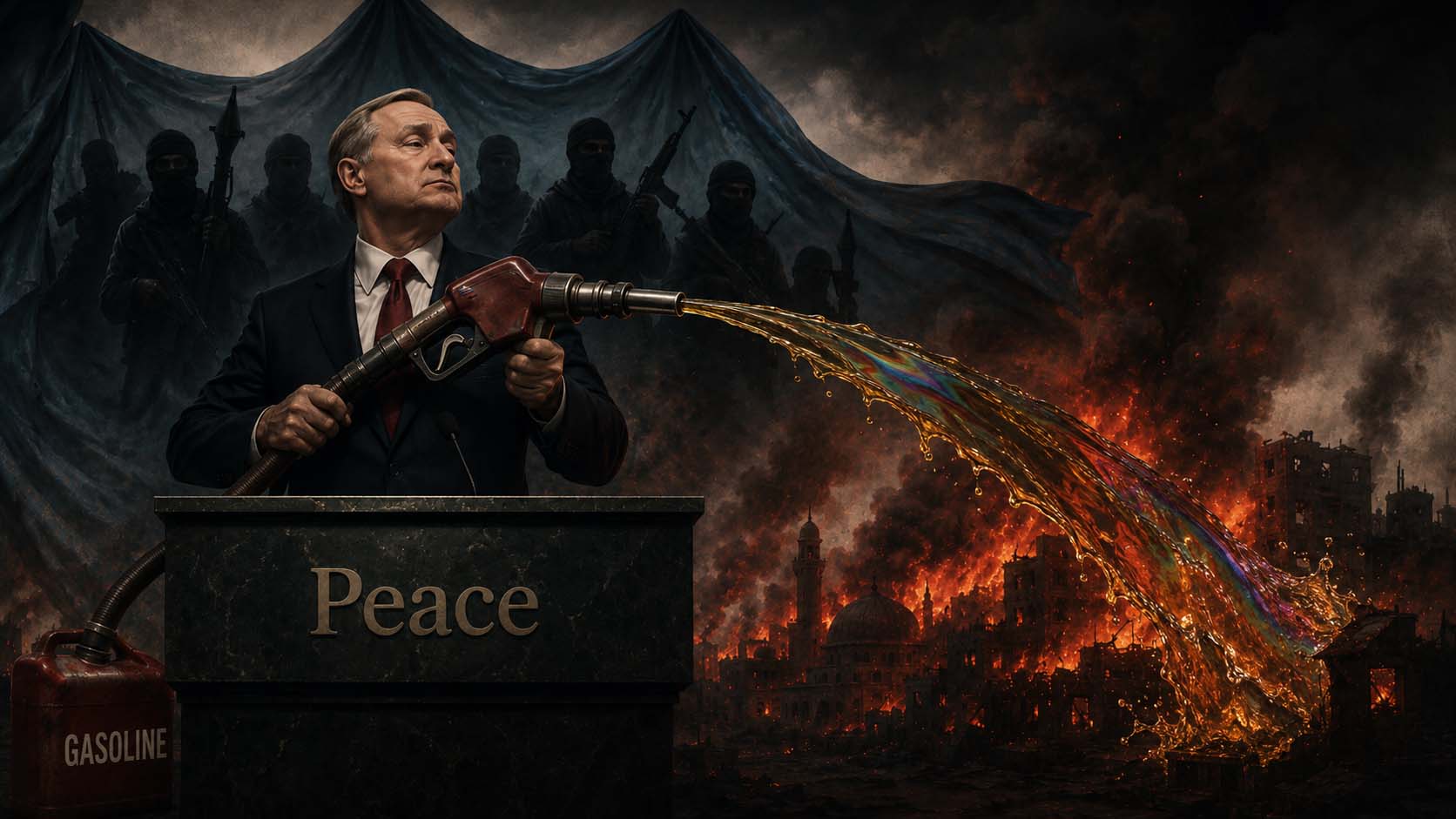
Russia’s “Peace” Means the Survival of the Killers
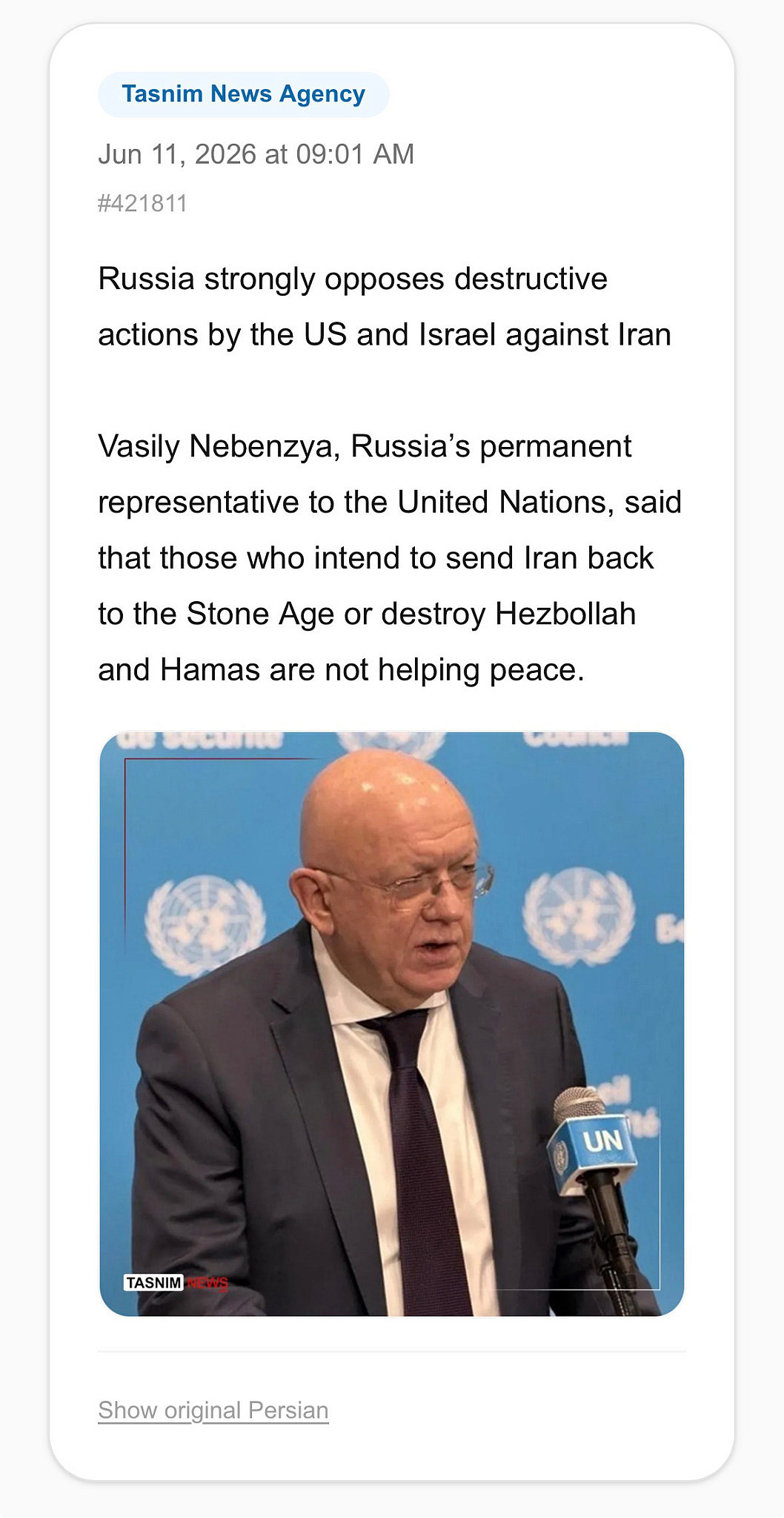
On June 11, Russia’s ambassador to the United Nations offered the world a lesson in peace. Vasily Nebenzya, Moscow’s permanent representative, warned that those who seek to send Iran “back to the Stone Age,” or to destroy Hezbollah and Hamas, “are not helping peace.” The remarks were carried, approvingly, by the Iranian state news agency Tasnim, under the headline “Russia strongly opposes destructive US and Israeli actions against Iran.”
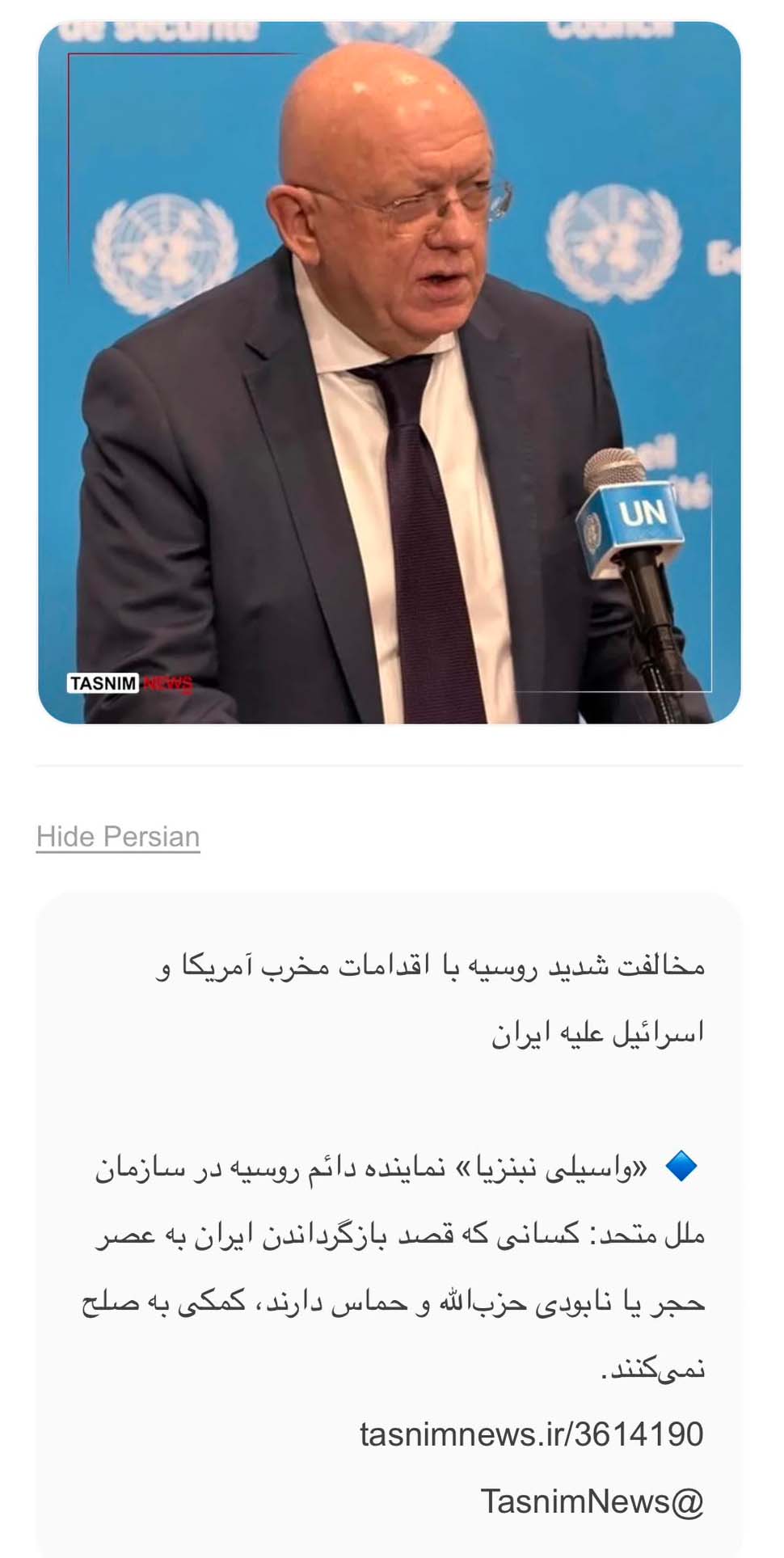
I read it in the original Persian, in the feed of Iranian state channels I monitor daily, and I had to sit with the sentence for a moment. Here was the representative of a government that has spent more than four years waging the largest war in Europe since 1945, a war that has flattened cities and killed tens of thousands, presenting itself as the conscience of the Middle East. The arsonist, hose in hand, gravely lecturing the neighbors about fire safety.
Set aside, for a moment, the bottomless hypocrisy of the messenger. Look at what the message actually defends. Nebenzya’s objection was not to violence in the abstract. It was specifically to the prospect of Hezbollah and Hamas being destroyed. These are not nations. They are not peoples. They are two terror organizations, one of which carried out the largest single-day massacre of Jews since the Holocaust, the other of which spent years raining rockets on northern Israel. To mourn the possibility of their destruction, and to file that mourning under “peace,” is to drain the word of any meaning it ever had.
This is not a slip of the tongue or a diplomat caught off guard. It is policy, and it is consistent. The same Nebenzya told the Security Council in 2023 that Israel had no right to defend itself against Hamas, because Israel, in his telling, is an “occupying state.” Weeks after the October 7 massacre, Moscow rolled out the red carpet for a Hamas delegation. At the UN, Russia has reliably shielded the group from condemnation. And in the weeks before this latest statement, Nebenzya rejected a US-backed resolution on Iran and declared, on the record, that Russia “condemns the aggression by the United States and Israel against Iran.”
The rhetoric is matched by hardware. Moscow has steadily deepened its operational ties to Hezbollah, Hamas and the Houthis, leveraging its partnership with Iran’s so-called Axis of Resistance to expand its own reach through weapons and security cooperation. This is the tell. A state genuinely interested in regional peace does not arm the region’s most destabilizing actors. A state interested in bleeding the United States, in posing as the champion of the Global South, and in keeping Israel permanently besieged, does exactly that. Russia’s “peace” is not the absence of war. It is the preservation of the groups that start them.
What makes the moment worth noticing is not that Russia lies. Great powers have always dressed their interests in the language of principle. What is striking is the seamlessness of the alignment now on display. Nebenzya’s words were not merely reported in Tehran. They were embraced there, packaged by Tasnim as a defense of Iran, amplified to an Iranian audience as proof that a permanent member of the Security Council stands with them. Moscow speaks, and the Islamic Republic’s megaphone carries it. The distance between Russian diplomacy and Iranian propaganda has narrowed to almost nothing.
For Israelis, none of this is a revelation. We have watched the axis form in real time, in the votes at Turtle Bay, in the drones over Ukraine that began their lives in Iranian factories, in the comfortable proximity of Moscow, Tehran, and the men who plan the murder of Jews. But it is worth pausing when the alignment is stated this plainly, in a diplomat’s own words, and then proudly republished by the very regime he is defending.
There is a particular kind of clarity in being told the truth by your adversaries. When the representative of a nuclear power stands at the United Nations and frames the survival of Hezbollah and Hamas as a precondition for peace, he is not confusing anyone who is paying attention. He is telling us precisely where he stands, and precisely what he means to protect. We should believe him.
The word “peace” did a great deal of work in Nebenzya’s sentence. It is worth remembering what it was being used to shield: not the end of the killing, but the survival of the killers.