
From Kibbutz to the global stage
Saudi Arabia,Turkey: Battle Over IMEC,What It Means for Haifa, Piraeus and Eilat
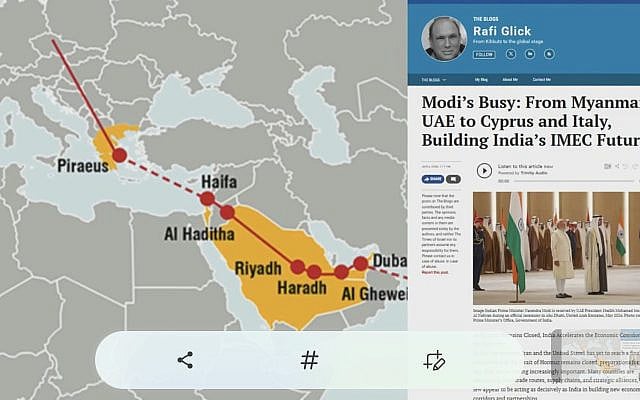
Saudi Arabia and Turkey are advancing a new trade route that could redirect the India–Middle East–Europe Economic Corridor (IMEC) away from Haifa and toward Turkey’s Mediterranean ports.
Indian media has already begun discussing the possible changes to the trade corridor. An article I published last Friday in The Times of Israel examined India’s activities, Prime Minister Narendra Modi’s diplomatic efforts, and the shifts taking place in regional economic corridors following the war. The article was later cited by an Indian Hindi-language television/video channel.
The broader picture emerging from both the article and the Indian media discussion suggests that Modi has recently been engaged in a series of strategically significant meetings. He met with the President of Myanmar, the President of Cyprus, who currently serves as the rotating President of the Council of the European Union, and the ruler of the United Arab Emirates. Next week, he is expected to meet French President Emmanuel Macron in Nice at a summit that will also include leading figures from French and Indian industry.
When viewed together, these meetings suggest that IMEC has become a central focus of India’s regional strategy. For India, the corridor is not merely an economic project but a broader strategic initiative with significant geopolitical and security implications.
India is working with France, Myanmar, Cyprus and the UAE to strengthen the foundations of the corridor while simultaneously paying close attention to the regional security environment. In a region characterized by instability, geopolitical shifts and security challenges, infrastructure corridors of this kind become strategic assets that support long-term stability, supply chain resilience and regional influence.
The questions I raised in my previous article regarding Saudi Arabia’s position gained additional relevance this week following reports of a meeting in Riyadh between the transportation ministers of Turkey and Saudi Arabia. According to those reports, the two countries signed an agreement to promote a railway route from western Saudi Arabia through Jordan and Syria to Turkey’s Mediterranean ports, bypassing both Israel and the Port of Haifa.
The new route proposed by Saudi Arabia and Turkey raises several important questions.
First, it differs significantly from the original IMEC vision presented in 2023 by the project’s partners, including India, Saudi Arabia and the United States.
Second, according to available estimates, it would extend the land segment by more than 1,000 kilometers, potentially increasing costs, lengthening transportation times and altering the economic characteristics of the project.
Third, previous discussions considered incorporating ports in Syria and Lebanon as part of a broader regional framework. However, the current Saudi-Turkish proposal appears to bypass those options as well.
Fourth, India has not yet publicly expressed its position. Given Turkey’s complex relationship with India and Ankara’s regional alliances, it remains unclear whether New Delhi would be willing to accept such a significant change in the corridor’s route. Without India’s support, it would be difficult to continue defining the project as IMEC in its original form.
Europe is also likely to examine the proposal carefully. Cyprus, Greece, Italy and France have expressed considerable support for the original corridor in recent years. Ongoing tensions between Turkey, Cyprus and Greece, together with strengthening cooperation between France and Cyprus, may complicate efforts to build broad European support for the proposed alternative route.
The United States has not yet issued an official response to the proposed change. However, President Trump’s recent calls for regional countries to join the Abraham Accords may indicate a preference for a regional integration model that includes Israel rather than bypasses it.
The discussion taking place in the Indian media highlights the strategic importance of IMEC for India. The corridor is not merely a trade route but an important component of India’s long-term economic, geopolitical and security planning.
The debate over IMEC is not only about national interests. Port cities along the corridor—including Aqaba, Eilat, Haifa, Limassol, Piraeus and Trieste—have a direct stake in the outcome. As competing corridor visions emerge, these cities may need to reassess infrastructure plans, logistics investments and long-term economic development strategies in order to adapt to changing trade patterns across the region.
The key question is whether these competing visions will eventually complement one another or evolve into rival corridors. What is already clear is that the struggle over future trade routes, logistics hubs and strategic connectivity is becoming one of the most important geopolitical stories in the region.
Related Topics
Related Posts