From Kibbutz to the global stage
Saudi shapes the Delhi–Riyadh–Damascus corridor, India hosts the IMEC powers
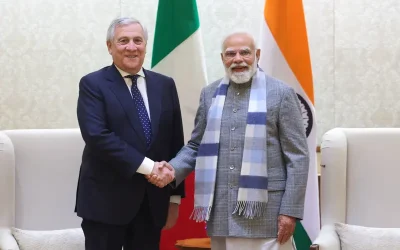
Photo: WIOn
Saudi shapes the Delhi–Riyadh–Damascus corridor, India hosts the IMEC powers.
The world is reorganizing itself: Five moves that turned this past week into a geopolitical turning point:
The past week was one of the most intense the region has seen: from the rapprochement between the U.S. and India, through the Saudi–Qatar–Syria axis, to diplomatic activity in Europe and Washington.
Last night, Trump postponed the unveiling of his “Peace Council” by several days — not due to a crisis, but because of the unusually large number of leaders, including kings and princes, who asked to join.
2026 may open with a diplomatic shockwave.
1. The U.S. is trying to repair the rift with India — and finally accepts that India is not “in anyone’s pocket”:
Since the February 2025 leaders’ summit, U.S.–India relations have cooled.
Trump’s tariff policy hit Indian imports, and the additional 25% tariff on Russian oil created historical friction.
India — now the world’s seventh-largest economy and its most populous country (1.5B people) — is relentlessly pursuing its grand objective:
becoming a fully developed global power by 2047.
Putin’s visit to India last week was a turning point. Washington understood that India is not a simple player but a sovereign power with its own orbit.
Then came the Hooker mission:
U.S. Deputy Assistant Secretary Allison Hooker arrived in New Delhi and concluded her visit in Bengaluru, at ISRO’s Space research and development center.
In parallel, negotiations opened to reduce tariffs.
The American “gift” to India:
a $17.5B Microsoft investment aimed at turning India into a global hub for cloud, data infrastructure, and renewable-energy technologies.
India is now waiting for a U.S. decision on tariffs — a critical crossroads for IMEC.
Italy steps onto the field:
Italy’s Deputy Prime Minister and Foreign Minister visited New Delhi this week, pledged support for IMEC, and spoke openly about military, aviation and space cooperation — including with Israel.
Prime Minister Meloni is expected to arrive soon as well.
Italy is signaling: Europe is re-entering the game.
Israel is also mentioned — Haifa Port is now defined as an essential node in the emerging land corridor.
2. Saudi Arabia is working to break the Qatar–Turkey alliance — and reconnect Doha to the regional system:
The meeting between MBS and Emir Tamim Al Thani was not symbolic. It was a real mechanism of regional repositioning.
Why now?
- Turkey is in severe economic crisis
- Qatar wants a role in Gaza’s Phase 2
- The U.S. is redefining Turkey’s place in the Middle East
- And Qatar is committed to its U.S. defense pact:
- Reducing ties with extremist groups.
- Moderating Islamist media.
- Assuming new regional responsibilities.
The shift toward Turkey
Turkey may receive multi-billion-dollar reconstruction deals in Gaza — but only if it moderates its Muslim Brotherhood posture and tones down its anti-Israel rhetoric.
3. Saudi Arabia is trying to bring Syria in — integrating it into the regional economy:
A rare phone call between MBS and President Al-Sharaa opened a strategic door:
- Integrating Syria into the economic corridor
- Joint energy, oil, and gas projects
- Expanding output from existing fields
- Creating “a north–south corridor, in addition to the option through Israel”
For Saudi Arabia, Syria is the alternative route if IMEC gets stuck with Israel.
4. Qatar breaks into a new American arena — the media and communications industry
This week it was reported that Qatar, Saudi Arabia, and the UAE are backing the Allison family and Paramount in a hostile takeover bid for Warner Bros — currently under an $83B pending deal with Netflix.
If the acquisition goes through, the new Gulf-backed consortium would become a major owner of U.S. media outlets (CBS, ABC, CNN, HBO).
In practice:
the Gulf is attempting an unprecedented entry into the core of American media power, sparking regulatory and political storms in the U.S., U.K., Europe and Australia.
This is a multi-billion-dollar play — likely higher than the Netflix offer — and the mere fact that Qatar is in the running speaks volumes about its upgraded economic and geopolitical weight.
5. A highly unusual message from Senator Lindsey Graham — “Do not let this window close”
At a Jewish conference in New York, Graham — one of Israel’s strongest supporters in the Senate — delivered a sentence unseen in years:
“This is the best idea in 3,000 years if it brings Saudi Arabia and Israel to peace.
Do not let this window close.”
Graham pointed to what the media has not yet articulated:
There is now strategic scarcity — and all sides are moving in one direction.
He emphasized:
- Even controversial moves, such as advanced U.S. aircraft for Riyadh, may be justified if they enable a historic breakthrough.
- Despite years of bloodshed and political chaos, a rare strategic alignment is emerging across the Middle East.
- The Arab world understands: Hamas and Hezbollah are not the future.
- The Abraham Accords are real. The regional shift is real.
- “Do not miss this moment.”
The world is reorganizing itself — and it is happening right now, continuing into 2026
- IMEC is awakening
- India is critical
- Saudi Arabia is reframing Gulf alliances
- Qatar is shifting identity
- Turkey must adjust
- Europe is returning
- Washington is preparing announcements
- And Trump is delaying the Peace Council — perhaps because the list of leaders is now too large, and perhaps so the achievement will be recorded in early 2026
A regional picture that was fragmented for two years — finally began to connect this week.
Image: Italian Deputy Prime Minister and Foreign Minister Antonio Tajani meets Indian Prime Minister Narendra Modi in New Delhi this week — a meeting that signals Europe’s renewed involvement in the Delhi–Riyadh–Haifa (and Damascus) corridor and broad international support for India.
Photo: WION
Related Topics