
Schnorrerim

Yiddish, which lost out as the language of the new Jewish state, has had little influence on Hebrew, which won.
So I was delighted when our Israeli grandsons identified the Hebrew word for “navel” as pupik. (I was tickled that they did not pronounce it pipik, though I did not tell them why. )
Another Hebrew word which owes its origin to Yiddish is לשנורר , lishnorer. This means to Schnorr–to beg, cadge, or mooch. Chaim Nachman Bialik coined the word in Hebrew. Schnorrers have been around a long time, and no doubt Bialik met many of them.
Over the years, I have met many Schnorrers, in the US and now in Israel. I want to share my experience, in case you should meet a Schnorrer or decide to become one yourself.
***
Schnorrers are known for being not just needy but cheeky, as though they doing you a favor by letting you be generous.
Schnorrer: Where is Goldberg?
Man: Maybe don’t bother Goldberg. His business is going through a rough patch.
Schnorrer: So if he is having a bad day, why should I suffer?

***
Schnorrers in shul
When my father gave up the Rabbinate and moved to a more Jewish neighborhood, I accompanied him on Sunday mornings to a local shul. As we approached, small cars appeared and disgorged amazing numbers of Schnorrers, reminiscent of the old films about the Keystone Kops.
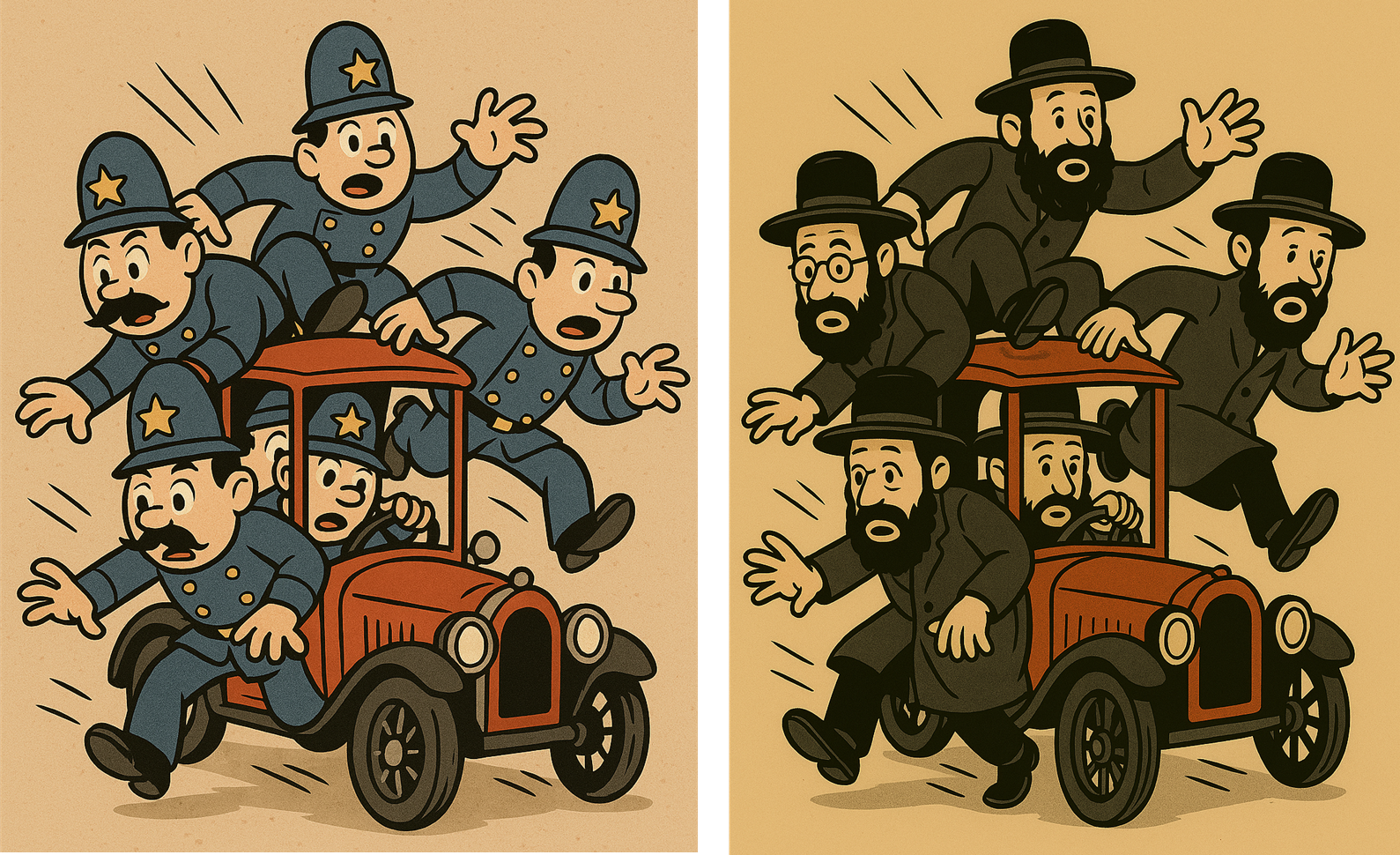
As they emerged, each went to whichever local shul was theirs on Sundays. Schnorrers are very territorial, about both place and time. Best for other Schnorrers not to mess with the regulars.
Left to their own inclinations, Schnorrers can be intrusive. They interrupt people trying to daven, criticize the placement of tefillin or the orientation of tefillin straps, block people trying to accept an aliyah. In minyanim where the local authority—usually the gabbai—lays down the law, Schnorrers act more civilized.
At my current morning minyan in Jerusalem, different cohorts of Schnorrers come each day. The ones who come on Mondays require a ride after davening to another shul nearby. If someone in our minyan has yahrzeit and brings schnapps and herring for fellow daveners, the Schnorrers do not wait for their ride. These are busy people, with places to go.
I asked my friend who gives them donations and rides how long he has known them.
“I’ve been coming 18 years,” he said. “They were already here.”
“Do you know their names?” I asked.
“No idea,” he said.
Two Schnorring Mysteries
- Schnorrers But from where? Where do Schnorrers live?
- Schnorrers show up in shul when other people are davening but do not daven with them. Where do Schnorrers daven themselves? Is there a Schnorrer’s minyan somewhere? And if there is, do other Schnorrers bother them while they are trying to daven? And does a Schnorrer’s Shul have a Building Fund?

***
Schnorrers in Suburbia
Schnorrers go where opportunity knocks. If opportunities are in suburban US, Schnorrers come in the evening and knock themselves.
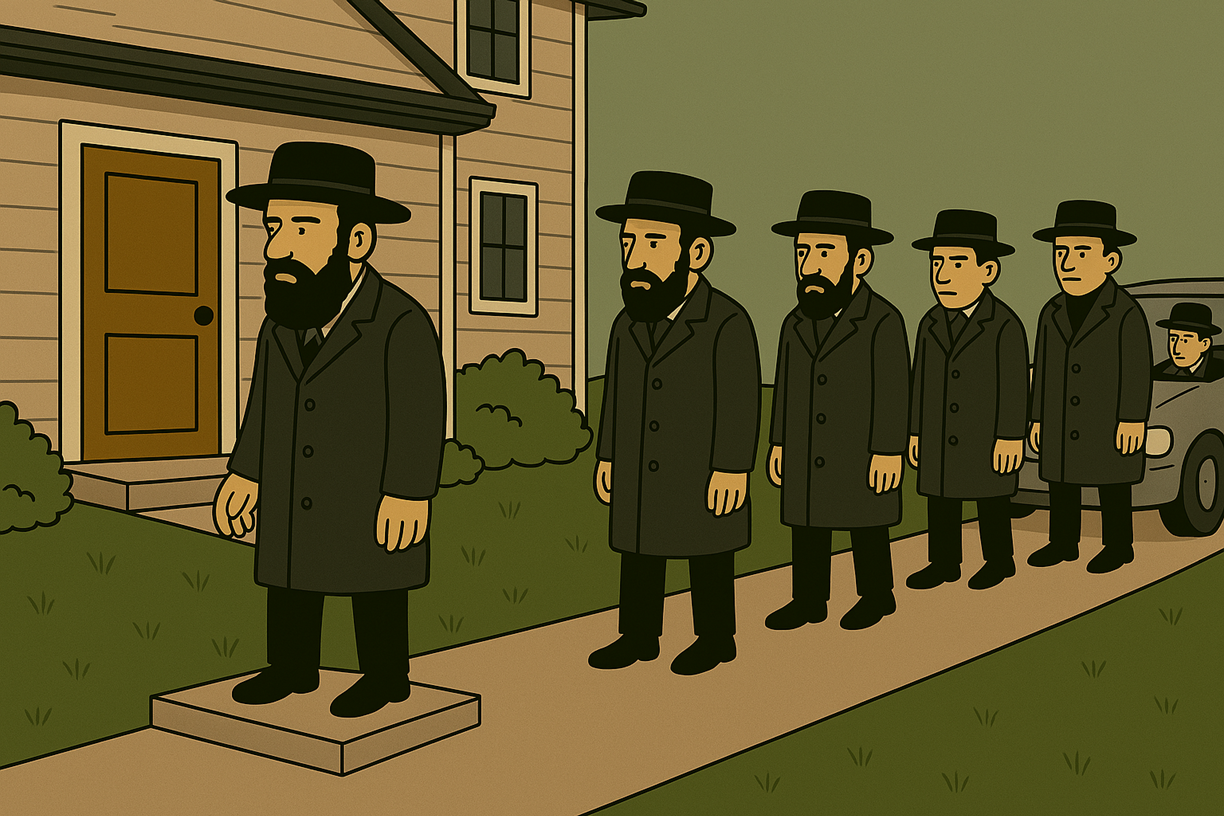
A man in a black hat and coat whom you don’t know is on your doorstep. He hands over a letter in a nylon folder, from a Rabbi you may or may not know, attesting to the Schnorrer’s worthiness, as representative of a helpful charity or as needy himself.
You invite him in. You hear him out. You write him a check, made out to a tzedakah laundry in Brooklyn, which operates as a 501c3. He is pleasant and personal–until you give him the money. Then he mutters bracha hatzlacha tizku l’mitzvos and turns to leave. As he opens the door, another Schnorrer is on your doorstep.
This practice of tag-team Schnorring proliferated until it got to be a lineup of 4 or 5. The car that brought them—the driver takes a cut—was always parked just out of view. When I figured out what was going on, I strolled down the street and politely told the driver to take my address off his itinerary. He could take his charges to shul where they, along with the other Schnorrers, got a modest sum from the Rabbi’s tzedakah fund.
When Schnorrers came to shul for mincha-ma’ariv and found that the Rabbi was out of town, their driver became incensed. But even a Rabbi is allowed to be elsewhere now and then.
***
Travel expenses
I never did work out the finances. How did Schnorrers who flew from Israel to the US make enough to pay their fare, much less meet their needs?
One day a man came from Israel to ask for help with medical expenses. He originally hailed from Sunderland, and spoke the lingo of Northeast England.
After he listed an impressive litany of complex surgeries that his relatives needed, I asked him, “Doesn’t Israel have universal health insurance?”
“Well, yes,” he said. “You can see a doctor. But we need the best ones.”
***
New Schnorring technology
At a wedding in a charedi wedding mill in Monsey, New York, I encountered a new sort of Schnorrrer—one who only took credit cards. If you let him swipe yours, he would take his card reader to the team boss, whose instrument processed the transactions.
One man to whom I had already given upstairs approached me again on the steps.
“I already gave you,” I said.
“I’m sorry,” said the Schnorrer. “I didn’t recognize you.”
Tough business, Schnorring. Maybe face-recognition software is next.
***
A washout
Once a man I had already met came to my door. He was very sheepish.
“Your friend gave me a check, “he said, “but I forgot to take it out of my shirt pocket before I put the shirt in washer.” The check he showed me was illegible.
“Could you ask him to write me another one?” he asked.
This was my only brush with laundered money.
***
Schnorring in Jerusalem
Schnorrers can be found in many places around here, and not only in shuls. Individual Schnorrers stake out their own territories: the man who stands near the entrance to the super on Fridays; the women who sits nearby, near the outdoor lending library against the wall. (Give-a-book-take-a-book.) The man who tools around in his personal jitney. Sometimes he parks near a shul; other times he’s near the super; still other times he drives the streets of the German Colony.
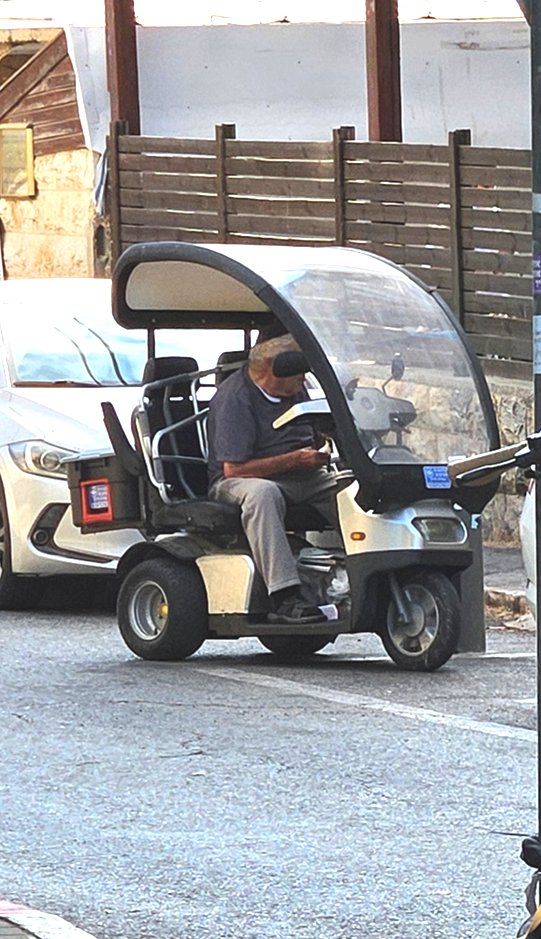
“Adoni!” he calls out wherever he is. “Adoni! Tzadaka!” If asked, he is happy to make change.
Downtown one is sometimes surprised by women Schnorrers, modestly dressed. They too call out, “Yom tov!” or “Ezrah,” and look straight at you with soft eyes full of practiced pathos. Some ask for help for themselves, others for brides who need funds for their trousseaus.
Sometimes people who walk by hit you up for bus fare. They cannot make it home. If you don’t give them enough, they demand more, adding an improbable tale of how they happened to fetch up right next to you and run out of cash.
It takes focus and effort to ignore someone trying to get your attention on the street. Practice helps.
***
Schnorrers at the Kotel
In 2013 police began to arrest Schnorrers at the Kotel HaMa’aravi, where Schnorring had been outlawed. They used videos to apprehend the perpetrators.
Prior to that, Schnorrers had inundated the Kotel plaza, smothering anyone trying to daven, or to celebrate a family simcha.
Where the Kotel Schnorrers went is not clear. But they are—mercifully–not there anymore.
***
Well, it’s a living
The actual financial status of Schnorrers is, of course, unknown. Schnorrers are not licensed.
This is an old story. When I was a student at Yeshiva University, in Upper Manhattan, an older woman Schnorrer waylaid every young man on his way to the nearby Beit Midrash.
One student asked our Rebbe whether we were obligated to give her tzedakah, and if so, did we have to do it every day.
“They say she has a penthouse on Central Park West,” said the student. Some wag always says something like that.
Our Rebbe, a sturdy Litvak who never lacked for pungent judgments—of colleagues of students—grew reticent.
‘Well,” he said, quietly. “If someone says they are in need…then….you should….probably give them something.
“And now,” he said, regaining his composure and his volume, “let us return to our studies!”