


Scroll Down
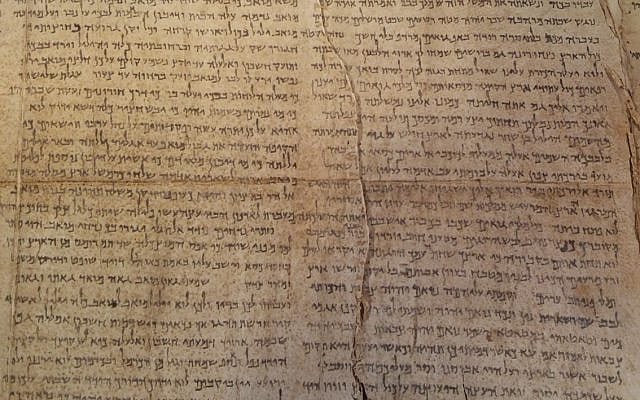
And two millennia later, as the world limped out of its second war of the century, two unknown Bedouin shepherds were searching for a stray goat. They suspected the goat had entered a cave, but they feared the demons of the dark and thus threw a stone inside first. Instead of the sound of the distant cave wall, they heard the sound of the stone on something hard and hollow. They entered the cave to investigate and found ancient pots containing tiny scrolls, some of them blackened by fire and age. They knew that precious things were sometimes found in caves but this time were disappointed—old parchment isn’t treasure, after all. They had no idea that they’d stumbled upon one of the most astonishing archaeological finds of the century. They may have feared the darkness of the cave, but it had provided ideal conditions for the preservation of texts that shaped humanity.
At first, they didn’t know what to do with them and hung them inside their tents. But they finally managed to sell them for today’s equivalent of $400. The scrolls went from dealer to dealer. As the historical significance of the scrolls gradually sank in, a giant archaeological cat and mouse ensued which moved from country to country, dealer to dealer. And the scroll of Isaiah was kept out of reach of the Jewish people.
But for the People of the Book, these scrolls were a treasure worth fighting for. For many years the fledgling state of Israel went to enormous pains to retrieve the ancient writing of their heritage, now known as the Dead Sea Scrolls. It involved negotiations, clandestine operations and huge amounts of money.
But today this scroll, the only one that was recovered intact, is ours. It is permanently housed in a climate-controlled underground warehouse—to be preserved for future generations. And now, it has been taken out for an airing. The timing couldn’t be better. Yes, folks, you don’t have to see its imitation brother at the Shrine of the Book exhibition (although you should definitely pay it a visit). You can now see the real thing—a rarity in our AI-fueled era of fake. And this only happens every 60 years. So go while you have a chance.
After walking past the enormous museum’s mummies, totems and impressionist art, I reached the dimly lit, climate-controlled temporary home to our ancient manuscript last week. I wasn’t allowed to view the exhibit for more than 10 minutes, as human sweat can damage the fragile parchment.
The small scroll bears the deep stains of two millennia, but the black Hebrew text is clear enough to read throughout. Parts of it are stained and burned. Corrections were written over the top or squeezed between its neat lines rather than being crossed out. The parchment pieces are coarsely stitched together with linen. There is no color besides the yellowing parchment and black ink, no dazzling artwork—this isn’t the Mona Lisa, and the images of two thousand years of our survival, metaphorical and otherwise, lie beneath its lines.
But it’s breathtaking. These words and this parchment are us. Our narrative—in black and white script that is both ancient and shockingly modern. It is the story of us then and us now. Our breath may shorten its lifespan, but it breathes life into us. This uncurled artefact reminds ourselves that we, too, are real. An ancient people. Just like the parchment, our survival is nothing short of a miracle. We are the descendants of those who knew that it would be a long and rocky road. And we’re still here.
‘Comfort, oh comfort!’ the words read. Our words. Our alphabet. Our language.
The neat tiny handwriting unfolds prophecies of doom and is yet profoundly optimistic. Then it reads; ‘the Lion Shall Live with the Lamb’. Perhaps one day. Hard to see right now.
It also mentions Jerusalem. 49 times.
The Israel Museum (in Jerusalem) invites you to spend an unforgettable ten minutes with this, a two-thousand-year-old scroll, rather than indulging in a pointless one. Jew or non-Jew, believer or doubter, I think the very act of staring at those ancient letters on parchment will wash over you and something inside might shift. No explanations needed. Just let history penetrate your bones.
‘A Voice from the Desert Exhibition’ is open to the public at the Israel Museum, but preregistration is required. For more details, go here.